

Pick up and pickup sound almost the same, so it is easy to mix them up when writing. The good news is that the difference is simple once you look at how each form works in a sentence.
Use pick up when you are talking about an action.
I need to pick up my package.When to Use Pickup
Use pickup when you are using the word as a noun.
My package is ready for pickup.
You may also see pickup before another noun, as in pickup truck or pickup service.
The key is not the pronunciation. It is the job the word does in the sentence.
Pick Up vs. Pickup
Here is the basic difference:
| Form | Usually used as | Example |
| pick up | Verb | I’ll pick up the groceries. |
| pickup | Noun | The grocery pickup is at 5 p.m. |
| pickup | Modifier | We offer pickup service. |
Think of it this way: pick up describes something someone does, while pickup usually names the thing, event, or service connected with that action.
When to Use Pick Up
Pick up is a phrasal verb. It has several meanings so that you will see it in many different types of sentences.
The most familiar meaning is to lift something.
Please pick up that book.
It can also mean going somewhere to collect a person or an item.
I’ll pick up my daughter after school.
Can you pick up the package on your way home?
You can also use pick up when someone learns something through experience or casual exposure.
Maria picked up a few Spanish phrases while traveling.
Another common meaning is to improve or become stronger.
Business usually picks up before the holidays.
The wind picked up in the afternoon.
It can also mean continuing something after a pause.
Let’s pick up this conversation tomorrow.
So don’t think of pick up as having only one meaning. The important point here is that it functions as a verb.
A useful test
Put the phrase into a different tense:
I pick up my order at noon.
I picked up my order at noon.
I am picking up my order at noon.
The form changes because you’re using a verb.
There is also another useful feature of the phrasal verb. In many sentences, you can place an object between pick and up:
Pick up the box.
Pick the box up.
Both work.
With pronouns, the object normally goes between the two parts:
Pick it up.
Not:
Pick up it.
That is another clue that you’re dealing with the verb pick up.
When to Use Pickup
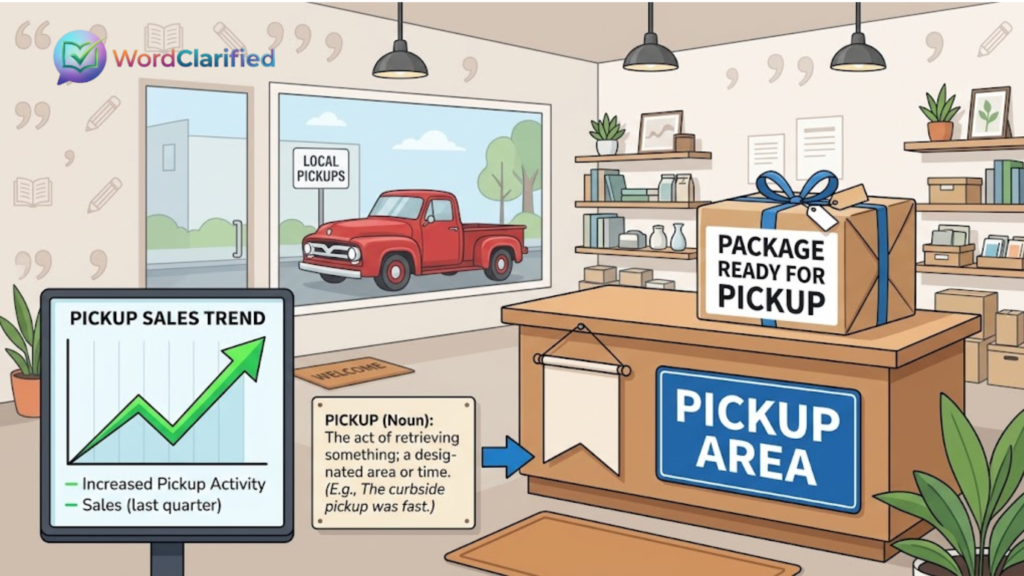
Pickup is generally a noun when it is written as one word.
It can refer to an occasion when someone or something is collected.
The package is ready for pickup.
We scheduled a pickup for Friday.
The store has a separate pickup area.
It can also refer to an increase or improvement.
There was a pickup in sales after the new product launched.
Pickup has other noun meanings as well. For example, a pickup can mean a pickup truck.
My neighbor drives a blue pickup.
The spelling stays together because the word is functioning as a noun rather than the verb phrase pick up.
See Also: Arose vs Arisen: What’s the Difference?
Pick Up or Pickup an Order?
This is one of the most common places where people get confused.
Compare these sentences:
I’ll pick up my order after work.
My order is ready for pickup.
Both are correct.
In the first sentence, pick up tells us what the person will do.
In the second, pickup names the collection of the order.
You can use the same rule with online shopping:
I need to pick up my shoes tomorrow.
The shoes are available for pickup tomorrow.
A quick memory trick is:
You pick up an order. An order is ready for pickup.
Pick Up or Pickup a Person?
The same difference applies when you’re collecting someone.
I’ll pick up Jake at the airport.
Here, pick up is the action.
Now compare:
Jake’s pickup is scheduled for 7 p.m.
Here, pickup refers to the arranged collection.
You might also see:
The school has a designated pickup area.
In this case, pickup describes the type of area.
This distinction is especially useful for signs, schedules, school notices, and business instructions.
Is Pickup an Adjective?
Pickup can be used before another noun to describe something related to pickup.
For example:
pickup truck
pickup service
pickup location
pickup game
Some style guides may handle compound modifiers differently, and you may occasionally encounter a hyphenated form. But in everyday American English, pickup is widely used as a closed compound in expressions such as these.
What About Pick-Up?
You may come across pick-up with a hyphen, especially in older writing or under particular style conventions.
That does not mean you should use a hyphen whenever you see the phrase.
For the most common situations in American English, this simple approach works well:
- pick up for the verb
- pickup for the noun
- pickup in common compounds such as pickup truck and pickup service
Never write the verb as pick-up in a sentence like:
Please pick up your order.
The verb stays as two words.
See Also: Skillset or Skill Set: What’s the Difference?
Common Mistakes
Mistake 1: Using “pickup” as the verb
Incorrect:
I will pickup my package at noon.
Correct:
I will pick up my package at noon.
The phrase describes an action, so it needs the two-word verb.
Mistake 2: Separating the noun
Less standard:
Your order is ready for pick up.
Better:
Your order is ready for pickup.
Here, pickup names the collection service or event.
Mistake 3: Using a hyphen in the verb
Incorrect:
Can you pick-up the kids?
Correct:
Can you pick up the kids?
The verb is written as two separate words.
Mistake 4: Assuming one spelling works everywhere
It is tempting to choose either pick up or pickup and use it throughout your writing. That does not work because the two forms have different grammatical roles.
Look at the sentence first.
Pick Up or Pickup? More Examples
Here are a few pairs that make the difference easier to see:
I need to pick up my prescription.
The pharmacy offers free pickup.
We will pick up the furniture tomorrow.
The furniture pickup is scheduled for 10 a.m.
Sales began to pick up in June.
The company saw a pickup in sales.
Can you pick up the children?
The children’s pickup time is 3:30.
He bought a new pickup truck.
He will pick up the supplies with it.
The first form in each pair describes an action. The second treats pickup as a noun or uses it to describe another noun.
How to Remember the Difference
If you’re stuck, ask yourself one question:
Is someone doing something?
If yes, you probably need pick up.
She will pick up the documents.
If you’re naming the collection, service, event, or thing, pickup is usually the better choice.
The document pickup is tomorrow.
This isn’t a rule you need to memorize through dozens of examples. Once you pay attention to the grammatical role, the spelling becomes much easier to choose.
Pick Up or Pickup: Conclusion
The difference between pick up and pickup comes down mainly to how the word functions in a sentence.
Use pick up as the verb:
I will pick up my order.
Use pickup as a noun:
My order is ready for pickup.
You will also see pickup in common compounds such as pickup truck, pickup service, and pickup location.
When you’re unsure, don’t rely on how the word sounds. Look at what you’re trying to say. If you’re describing the action, use pick up. If you’re naming the pickup itself or describing something related to it, pickup is usually the right form.
Frequently Asked Questions
Is “pick up” one word or two?
As a verb, pick up is two words.
I need to pick up my keys.
Pickup is the common one-word noun.
The pickup is scheduled for noon.
Is it “pickup” or “pick up” an order?
Use pick up when describing the action:
I will pick up my order.
Use pickup when referring to the collection:
My order is ready for pickup.
Is “pickup” a verb?
In standard American English, pick up is the normal spelling for the phrasal verb. Pickup is commonly used as a noun and in compounds.
Is “pick-up” correct?
You may see pick-up as a hyphenated form in some writing and style systems. However, for ordinary American English, pick up is the standard verb form, while pickup is commonly used as the noun.
Is “pickup” one word in American English?
Yes. Pickup is commonly written as one word when it functions as a noun or appears in compounds such as pickup truck and pickup service.
What is the easiest way to remember “pick up” vs. “pickup”?
Remember this:
Pick up = action.
Pickup = thing, event, or service.
I’ll pick up the package.
The package is ready for pickup.

[…] See Also: Pick Up or Pickup: Which One Is Correct? […]