

Arose or Arisen
Have you ever been writing a sentence and stopped because you were not sure whether to use arose or arisen? The two words look similar, and both come from the verb arise, but they have different grammatical roles.
The basic forms are:
arise → arose → arisen
Arose is the past tense of the verb arise. Arisen is the past participle. Once you know this pattern, choosing between the two becomes much easier.
For example:
A problem arose during the meeting.
A problem has arisen, so we need to delay the meeting.
Both sentences are correct—the first talks about a past event. The second uses the present perfect form.
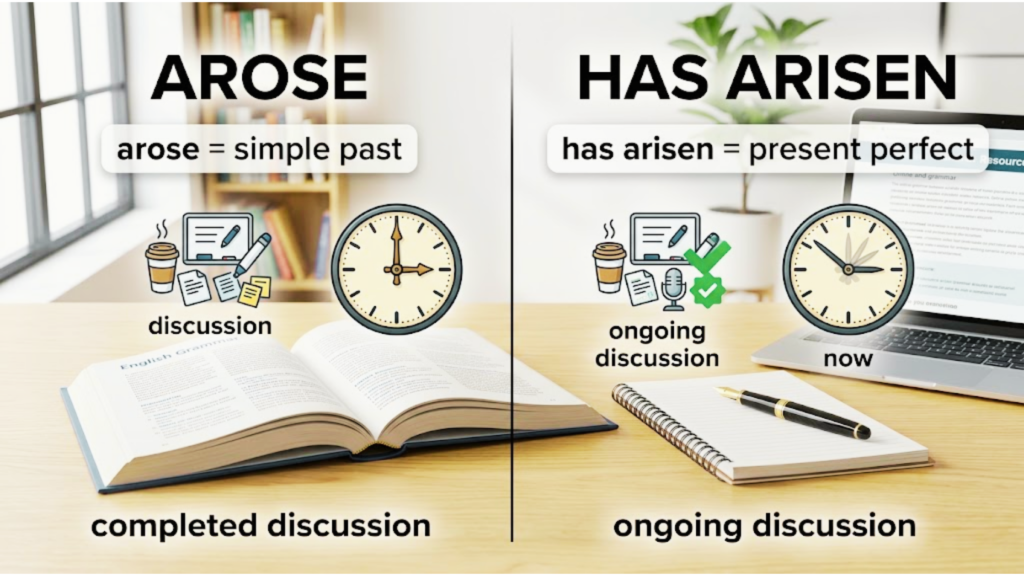
Arose vs Arisen: Quick Answer
Here is the basic rule:
| Form | Grammar | Example |
| arise | Present/base form | Problems arise when instructions are unclear. |
| arose | Simple past | A problem arose yesterday. |
| arisen | Past participle | A problem has arisen. |
So, if you are talking about something that happened in the past, use arose:
A disagreement arose during the discussion.
If you are using has, have, or had in a perfect-tense construction, use arisen:
A disagreement has arisen between the two groups.
A disagreement had arisen before the meeting began.
Oxford and Cambridge both list arose as the past form and arisen as the past participle of arise.
What Does “Arise” Mean?
The verb arise usually means that something happens, begins, appears, or comes into existence. It is often used with abstract things such as problems, questions, opportunities, difficulties, and disagreements.
For example:
- Problems arise when instructions are unclear.
- Questions may arise during a lesson.
- An opportunity may arise later.
- Difficulties can arise from poor communication.
- A disagreement arose between the two groups.
The word is fairly formal in this use. In everyday conversation, people often use phrases such as come up instead.
For example:
A problem came up during the meeting.
This sounds casual and natural.
A problem arose during the meeting.
This sounds more formal and would fit well in a report, essay, or other formal writing. Cambridge and Oxford both describe this common use of arise as formal or rather formal.
When to Use “Arose”
Use arose when you are describing something that happened in the past.
It is the simple past form of arise. You do not need has, have, or had before it.
For example:
- A problem arose during the exam.
- Several questions arose after the presentation.
- A disagreement arose between the students.
- A technical issue arose last night.
- An opportunity arose after the meeting.
Consider this sentence:
A question arose during yesterday’s class.
The question appeared during a class that took place in the past. That is why arose works.
You can also use arose when the past time is understood from the context:
We were discussing the new policy when a problem arose.
The sentence does not give a specific date, but the event is still presented as something that happened in the past.
A simple question can help you choose the form:
Am I describing something that happened?
If yes, and you are using the simple past, arose is the correct form.
When to Use “Arisen”
Arisen is the past participle of arise. It is used with auxiliary verbs in perfect-tense constructions, including has arisen, have arisen, and had arisen.
Examples:
A new problem has arisen.
Several questions have arisen.
A disagreement had arisen before we arrived.
The first sentence uses the present perfect. The second does too. The third uses the past perfect.
This is why you should not write:
A problem has arose.
The correct version is:
A problem has arisen.
Likewise:
Several issues have arisen.
Not:
Several issues have arose.
The important point is not simply that has, have, and had are followed by arisen. The real rule is that arisen is the past participle used when arise appears in a perfect construction.
See Also: Skillset or Skill Set: What’s the Difference?
Arose vs Arisen in Context
The difference becomes clearer when you compare complete sentences.
Simple past
A problem arose during yesterday’s meeting.
This reports a past event.
Present perfect
A problem has arisen, so we need to change the schedule.
Here, the problem has appeared and is relevant to the current situation.
Past perfect
A problem had arisen before the manager arrived.
The problem appeared before another event in the past.
The three sentences use the same verb, but the tense changes:
arose → simple past
has arisen → present perfect
had arisen → past perfect
The same verb forms can also be used with other nouns:
Several questions arose after the lecture.
Several questions have arisen since the lecture.
Several questions had arisen before the teacher returned.
The choice depends on the grammar of the sentence, not on a difference in the basic meaning of arise.
Common Mistakes With Arose and Arisen
These two forms cause a few common errors.
1. “Has arose”
Incorrect:
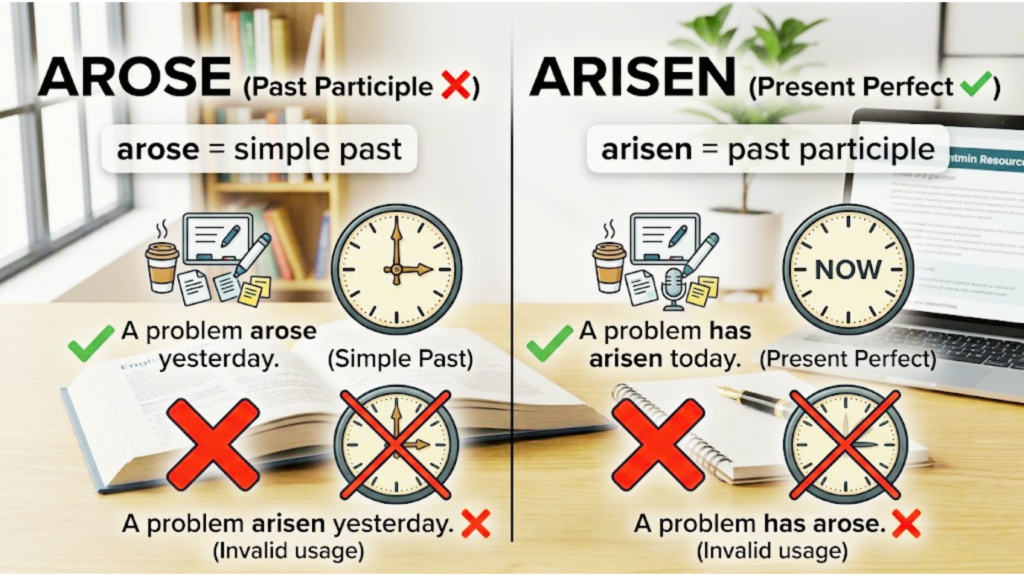
A problem has arose.
Correct:
A problem has arisen.
Arisen is the past participle needed in this perfect-tense construction.
2. “Have arose”
Incorrect:
Several problems have arose.
Correct:
Several problems have arisen.
The same rule applies with have.
3. “Had arose”
Incorrect:
A disagreement had arose before the meeting.
Correct:
A disagreement had arisen before the meeting.
Here, had arisen forms the past perfect.
4. Using “arisen” as the simple past
Incorrect:
A problem arisen yesterday.
Correct:
A problem arose yesterday.
The sentence describes a completed past event, so the simple past form arose is needed.
5. Using “arised”
Incorrect:
A problem arised during the test.
Correct:
A problem arose during the test.
Arise is an irregular verb. Its main forms are arise, arose, arisen, not arise, arised, arised.
Learning the three forms together is easier than trying to remember them separately:
arise → arose → arisen
Arose vs Rose: Do Not Mix Up “Arise” and “Rise”
Another common source of confusion is the verb rise.
The two verbs have similar-looking forms:
arise → arose → arisen
rise → rose → risen
But they have different meanings.
Arise commonly means that something happens or comes into existence:
A problem arose during the meeting.
Rise generally means to move upward or become higher:
The sun rose early.
Food prices have risen.
Cambridge specifically distinguishes the two verbs this way: arise means “happen” or “occur,” while rise means “go up.”
A quick comparison helps:
| Verb | Simple Past | Past Participle | Common Meaning |
| arise | arose | arisen | happen or come into existence |
| rise | rose | risen | move upward or become higher |
So:
A problem arose.
is correct.
But:
A problem rose.
does not express the same meaning.
Likewise:
The temperature has risen.
is correct when talking about an increase in temperature.
Is “Arose” More Formal Than “Came Up”?
Often, yes.
The verb arise is commonly used in formal writing when talking about problems, questions, opportunities, or situations. Oxford describes this use as “rather formal,” while Cambridge labels the common “happen or exist” meaning as formal.
Compare:
A problem came up during the meeting.
and:
A problem arose during the meeting.
The first sounds more conversational. The second sounds more formal.
This does not mean arise is always the better choice. Use the word that fits your audience.
For a message to a friend, came up may sound more natural:
Something unexpected came up, so I couldn’t make it.
For an academic paper or report, arose may fit better:
Several concerns arose during the review.
“If the Need Arises” vs. “Should the Need Arise”
You may also see arise in expressions such as:
If the need arises, contact the office.
Here, arises is the present-tense form because the sentence refers to a possible situation.
You may also see:
Should the need arise, contact the office.
This has a similar meaning to “if it becomes necessary,” but it has a more formal style. Cambridge lists should the need arise as a standard expression.
Other examples include:
If any questions arise, ask your teacher.
We can discuss the issue if the need arises.
These examples show why it is useful to learn the whole verb family rather than focusing only on arose vs arisen.
Practice: Choose the Correct Form
Try to complete each sentence before checking the answers.
- A problem ______ during yesterday’s exam.
- A new issue has ______ with the software.
- Several questions ______ after the lecture.
- More difficulties have ______ since the project began.
- A disagreement ______ during the meeting.
- The problem had ______ before we arrived.
- New questions may ______ during the discussion.
- A technical problem ______ last night.
Answers
- arose
- arisen
- arose
- arisen
- arose
- arisen
- arise
- arose
The pattern is straightforward.
In sentences 1, 3, 5, and 8, the action is described in the simple past, so arose is correct.
In sentences 2, 4, and 6, the verb is part of a perfect construction, so arisen is correct.
In sentence 7, may is followed by the base form, so arise is correct.
A Simple Way to Remember the Difference
If these forms keep getting mixed up, remember:
Arise → Arose → Arisen
Then ask what the sentence is doing.
Talking about a past event?
Use arose:
A problem arose yesterday.
Using a perfect tense?
Use arisen:
A problem has arisen.
A problem had arisen.
Talking about the present or a possible future situation?
Use arise:
Problems arise when communication is poor.
More questions may arise later.
This gives you a quick way to choose the right form without memorizing a long grammar explanation.
Arose vs Arisen: Quick Reference
| Situation | Correct form | Example |
| Present | arise | Problems arise when instructions are unclear. |
| Simple past | arose | A problem arose yesterday. |
| Present perfect | has/have arisen | Several questions have arisen. |
| Past perfect | had arisen | A problem had arisen earlier. |
| Possible future | arise | More questions may arise later. |
The main pattern is:
arise → arose → arisen
Use arose for the simple past.
Use arisen as the past participle in perfect-tense constructions.
Use arise when the sentence needs the base form, such as after may, can, or will.
Conclusion
The difference between arose and arisen is mainly a matter of verb form.
Arose is the simple past:
A problem arose during yesterday’s meeting.
Arisen is the past participle:
A problem has arisen.
The complete verb pattern is:
arise → arose → arisen
If you are describing something that happened in the past, arose is the form you need. If arise is being used in a perfect-tense construction, use arisen.
Also keep rise → rose → risen separate from arise. Rise usually refers to moving upward or becoming higher, while arise commonly refers to something happening or coming into existence.
Once you remember these two verb patterns, choosing the right form becomes much easier.
FAQs
1. Is “arose” the past tense of “arise”?
Yes. Arose is the past tense of arise.
For example:
A problem arose during the meeting.
Oxford and Cambridge both list arose as the past tense of arise.
2. Is “arisen” the past tense of “arise”?
No. Arisen is the past participle.
The three main forms are:
arise → arose → arisen
For example:
A problem arose yesterday.
A problem has arisen today.
3. Should I say “has arose” or “has arisen”?
Use has arisen.
Correct:
A new problem has arisen.
Incorrect:
A new problem has arose.
The first sentence uses the past participle in a perfect-tense construction.
4. Can “arisen” be used without “has,” “have,” or “had”?
Arisen is the past participle, so in ordinary perfect-tense sentences it appears with an auxiliary verb such as has, have, or had.
For example:
A problem has arisen.
If you are describing a completed event in the past, use arose:
A problem arose yesterday.
5. What is the easiest way to remember arose vs arisen?
Remember the three forms:
Arise → Arose → Arisen
Then use this rule:
Arose = simple past
A question arose during class.
Arisen = past participle
Several questions have arisen since class.
If you also remember rise → rose → risen, you can avoid confusing arise with rise.

[…] See Also: Arose vs Arisen: What’s the Difference? […]