

Formal vs Informal Communication: Examples and Simple Rules
Formal vs informal communication comes down to one question: does the message travel through an official route, or through ordinary conversation? A notice pinned to the staff board is formal. Asking the person beside you whether Friday’s schedule changed is informal. Most people mix the two all day…
Continue Reading Formal vs Informal Communication: Examples and Simple Rules
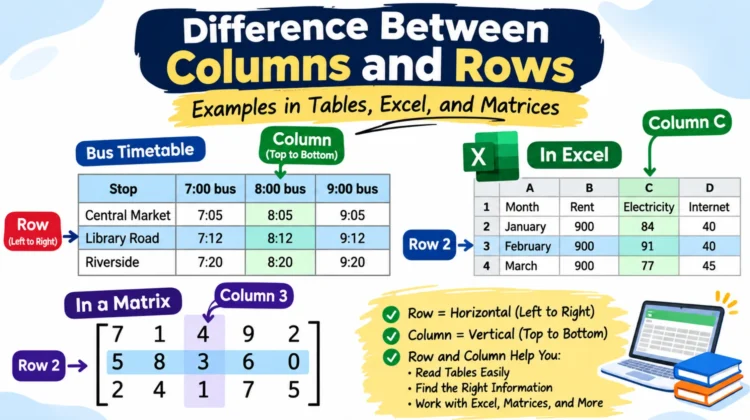
Difference Between Columns and Rows: Examples in Tables, Excel, and Matrices
Ask which way your eyes move, and you’ve found the difference between columns and rows: sideways along a row, downward along a column. Rows lie flat, left to right, and columns stand upright, top to bottom. You’ll meet both in spreadsheets, exam halls, math matrices, and plain tables,…
Continue Reading Difference Between Columns and Rows: Examples in Tables, Excel, and Matrices

Difference Between I Need and I Want: Meaning and Examples
“I need” points to something necessary. “I want” points to something you’d like to have. Where the line falls depends on the situation, and a handy test is to ask what goes wrong if you don’t get it. A ladder is a need when the gutter’s overflowing and…
Continue Reading Difference Between I Need and I Want: Meaning and Examples
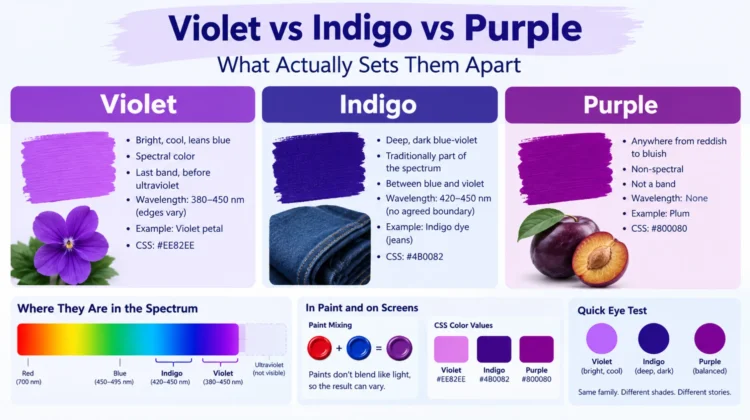
Violet vs Indigo vs Purple: What Actually Sets Them Apart
Two of these three are bands of the spectrum: violet at the far end, and indigo just before it, after blue. Purple is the odd one out: light has no purple wavelength, so it never shows up as a band. Most people use the three words loosely, and…
Continue Reading Violet vs Indigo vs Purple: What Actually Sets Them Apart

Nighttime or Night-Time? Both Are Right, Don’t Mix Them
Both are correct. Nighttime and night-time are the same word with two spellings, and both name the hours between the sun going down and coming back up. The only visible difference is the hyphen, and that comes down to habit, audience, and house style. Pick the one your…
Continue Reading Nighttime or Night-Time? Both Are Right, Don’t Mix Them
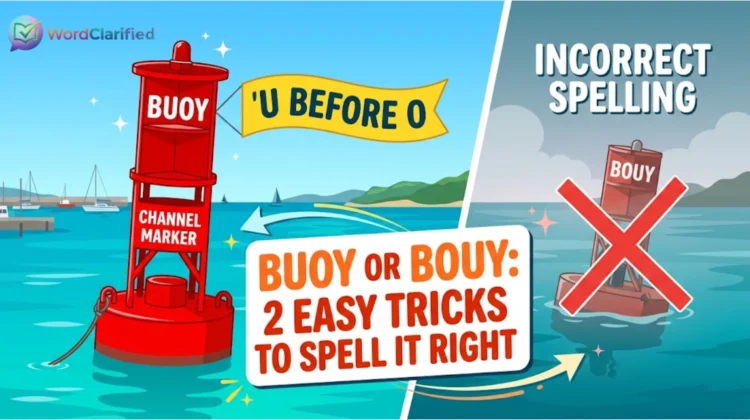
Buoy or Bouy: 2 Easy Tricks to Spell It Right
Buoy is the correct spelling. Bouy is a misspelling, and it isn’t accepted in standard English. If you’re writing about boats, swimming areas, or someone’s lifted mood, buoy is the word you need. The letters run B-U-O-Y, with the U before the O. People often flip them because…
Continue Reading Buoy or Bouy: 2 Easy Tricks to Spell It Right
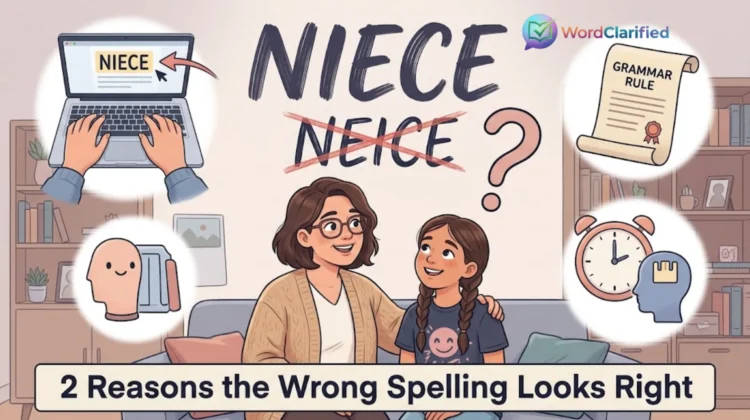
Niece or Neice: 2 Reasons the Wrong Spelling Looks Right
Niece or neice? Niece, with the I ahead of the E. The other version isn’t a regional spelling or a looser modern variant. It’s a slip, and a common one, made by people who know exactly who they mean and still can’t get the letters to line up.…
Continue Reading Niece or Neice: 2 Reasons the Wrong Spelling Looks Right
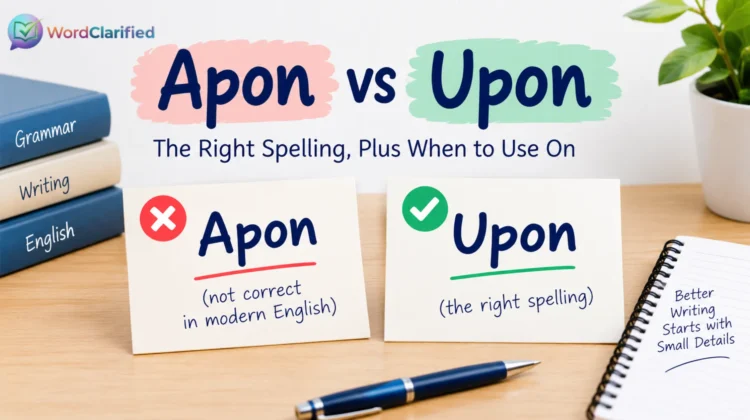
Apon vs Upon: The Right Spelling, Plus When to Use On
The apon vs. upon question has a short answer: it’s “upon” every time. If “apon” slipped into a cover letter, an invoice, or a note to your landlord, count it as a typo and fix it. No modern reader will take it as a style choice. The fuller…
Continue Reading Apon vs Upon: The Right Spelling, Plus When to Use On