
You’re typing a reply to a job offer, and your thumb stops over the screen: “I’d be happy to except.” Something looks off, but the word is real, so nothing turns red. That’s the accept vs except trap, and it catches careful writers too.
What’s the Difference Between Accept and Except?
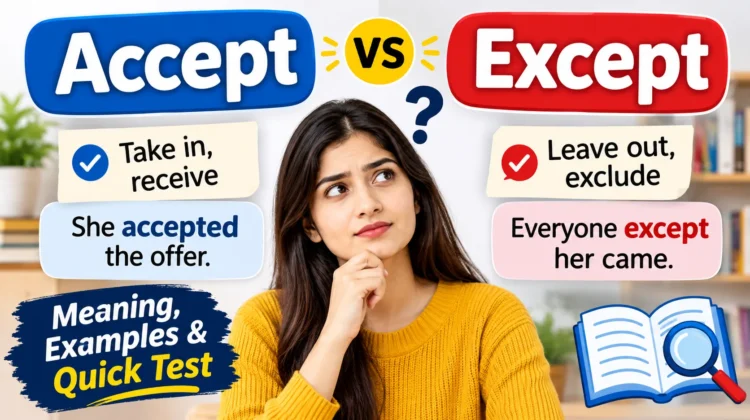
Accept is a verb for taking in what’s offered: a gift, a job, a payment, an apology. Except marks what’s left out. Not sure which you need? Try “take” first, then “but not.” Whichever swap works is your word. The team accepted every request except the late ones.
The Swap Test That Settles It in Five Seconds
Say you’re stuck on this sentence: “The store ___ returns ___ clearance items.” Try “takes” in the first gap. It works, so that’s accepts. Try “but not” in the second gap. It works too, so that’s except.
Run the test any time you hesitate. It takes one read.
Sometimes neither swap works. “I ___ the package by Thursday” doesn’t mean “take the package” or “but not the package.” You mean you anticipate it, and the word you want is expect, which gets its own section below.
What Accept Means
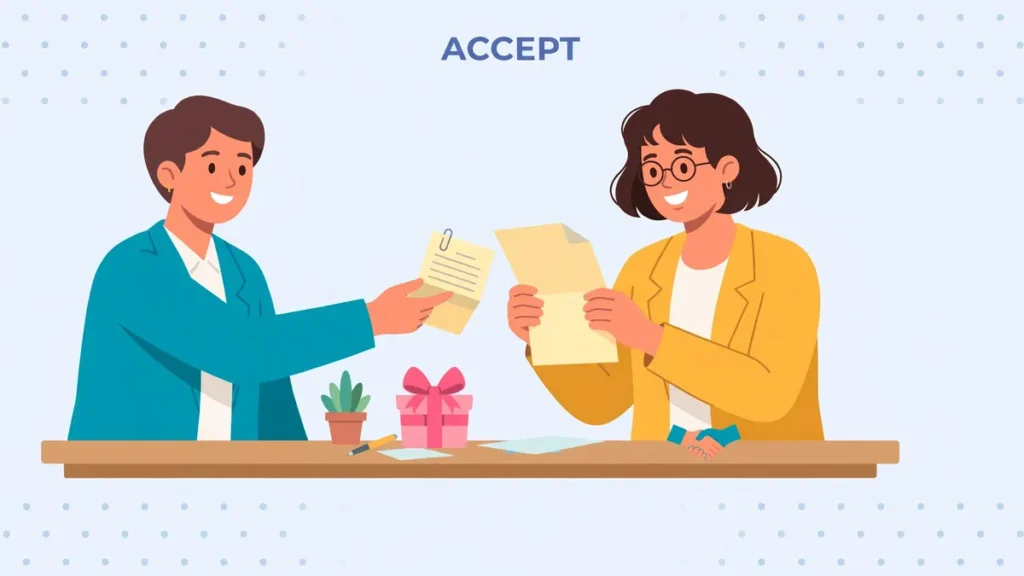
Accept is always a verb. Its job is to take something in, and it does that in a few different ways:
- Receive something offered. Marcus accepted the cold coffee because it was free.
- Approve or recognize something as true. After three recounts, the council accepted the result.
- Admit someone. The program accepted only twelve applicants this year.
- Take payment. Does the parking garage accept cards?
The opposite is refuse or reject. The word also gives you accepted, accepting, acceptable, and acceptance. Notice that every one of those starts with acc-.
What Except Means
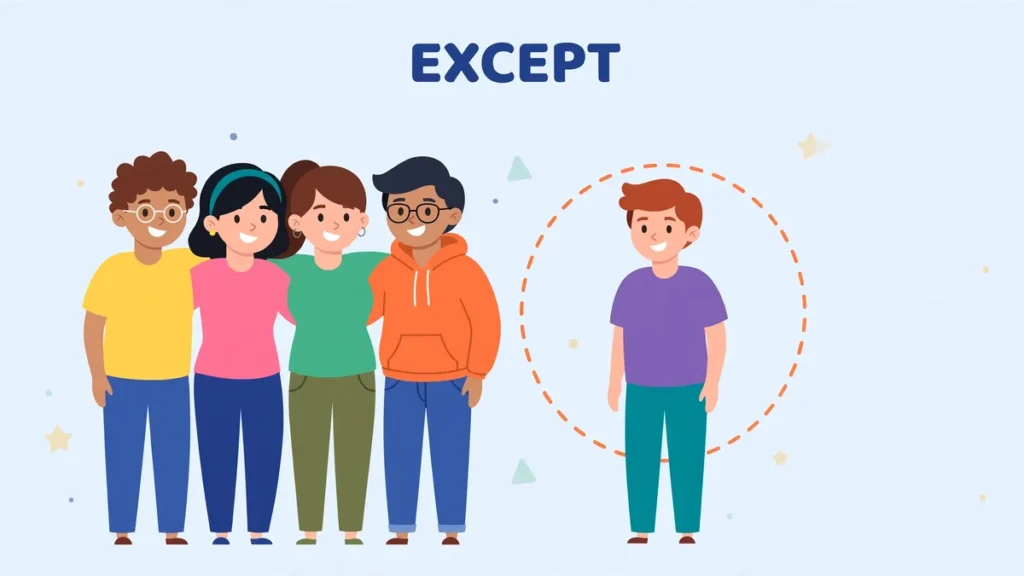
Except marks the thing that doesn’t fit the rule. Most of the time it’s a preposition: everyone except Dan, open every day except Monday. When the excluded thing is part of a bigger group, you’ll often see “except for”: the whole trip was easy except for the last hour.
It also works as a conjunction, usually before that or when. “I’d join you, except that I promised to cover Saturday’s shift.” Or: “We walk to school, except when it pours.”
A rare third use is as a verb meaning to leave out. You mostly see it in formal rules or the fixed phrase “present company excepted.” Here’s one more: students with a
signed note are excepted from the late penalty. You’ll rarely write it yourself, but it’s real, and it’s another reason not to confuse it with accept.
See Also: Loose or Lose: What’s the Difference? Meaning and Examples
Accept vs Except at a Glance
| Item | Accept | Except |
| Part of speech | Verb only | Preposition, conjunction, or (rarely) verb |
| Core meaning | Take, receive, agree to | Leave out, exclude |
| Use it when | Something is being taken in | Something is being left out |
| Opposite | Refuse, reject | Include |
| Quick test | Swap in “take” or “receive” | Swap in “but not” |
| Example | The bakery accepts cash only. | The bakery is open daily except Sunday. |
Mistakes That Slip Past Spellcheck
Both words are spelled correctly, so no tool will flag the wrong one. A few slips show up again and again:
- Except for accept. “I except your offer” should be “I accept your offer.” Anything you receive or agree to is accepted.
- Accept for except. “Everyone left accept for Maya” should be “Everyone left except for Maya.” If the sentence points to someone being left out, you want except.
- Except for expect. “I except rain by noon” is a typo for “I expect rain by noon.” Plenty of people make this one in a hurry.
- Exceptable. The word you want is acceptable, spelled with acc-. Exceptable is a rare, formal word and almost never what the writer meant.
My advice: if you catch yourself typing “accept for,” stop and reread. That pair almost always means “except for.”
See Also: Affect vs Effect: How to Pick the Right Word Every Time
Using Accept and Except in the Same Sentence
The two words sit next to each other more often than you’d think. Here are a few real-life settings:
- Our refund policy accepts any return within 30 days, except for opened software.
- Everyone in the group chat accepted the new plan except Jordan, who wanted Saturday instead.
- She accepted the job offer, except the part about weekend shifts, and the manager agreed to change it.
- At the potluck, we’ll accept anything you bring except another bowl of chips.
In each one, accepted or accepts is the action, and except names what gets left out.
Accept vs Except vs Expect
Expect is the third word that keeps sneaking in. It means to anticipate or believe something will happen: “I expect the bus by 8.” It shares its opening ex- with except, which is where much of the mix-up comes from.
Here’s a simple way to sort them. If nothing is being taken and nothing is being left out, and you’re talking about something you think will happen, you want expect. “I expect Stan will be late” can’t be rewritten with “take” or “but not.” That’s your clue.
How Accept and Except Sound
The only real difference is the first vowel. Accept opens with a short “a,” close to “ak-SEPT.” Except usually opens with a softer “ik” or “ek,” close to “ik-SEPT.” Dictionaries don’t all agree on that vowel, and plenty of speakers say the two almost the same way.
So don’t count on your ear to pick the spelling. In fast speech, they can blur together. The swap test works because it ignores sound entirely.
A Memory Trick That Actually Holds Up
Link except to exclude. Both start with ex-, and both are about leaving something out. It’s the trick I’d rely on.
You’ll also hear “a for agree” as a way to remember accept. It works for sentences like “I accept your apology,” but it falls apart on “the store accepts cards” or “the school accepted her.” Nobody is agreeing in those. Keep it as a backup, not your main rule.
Both words come from the same Latin verb meaning “to take.” That’s why the spelling is so close. Accept takes something toward you. Except takes something out.
See Also: May vs Might: Difference, Meaning and Examples You Can Use
Quick Check: Four Sentences
Pick accept, except, or expect for each blank:
- The corner shop ___ cash and cards.
- Every desk was empty ___ for Lena’s.
- Will the food truck ___ tips on a card?
- I ___ the package by Thursday.
Answers: 1. accepts, 2. except, 3. accept, 4. expect.
Quick Answers (FAQ)
Do accept and except sound the same?
Close, but not identical. The first vowel differs slightly, and in quick speech the two can blur, so you can’t rely on your ear.
Can except be a verb?
Yes, but rarely. It means to leave out, as in “children under five are excepted from the fee.” Most of the time it’s a preposition or a conjunction.
Is it “except” or “except for”?
Both are correct. Use plain “except” before a noun (everyone except Dan) and “except for” when the excluded thing stands apart from the main statement (the trip was easy except for the last hour).
What’s the opposite of accept?
Refuse or reject. The opposite of except is include.
Which word goes with an apology, an offer, or a payment?
Accept. You can only take or receive those things, so except never fits.
Final Thoughts
You don’t need to memorize a rule for every sentence. You need one check you’ll actually use. Before you send anything, search your draft for “except” and read each one as “but not.” If a sentence breaks, it probably meant accept or expect. That ten-second pass will catch the slips spellcheck can’t.

Leave a Reply