
You’re halfway through an email to your manager: “The schedule change will ___ everyone on nights.” You type affect, delete it, type effect, delete that too. That stall is the whole affect vs effect problem, and the fix takes about ten seconds once you know where to look.
What Is the Difference Between Affect and Effect?
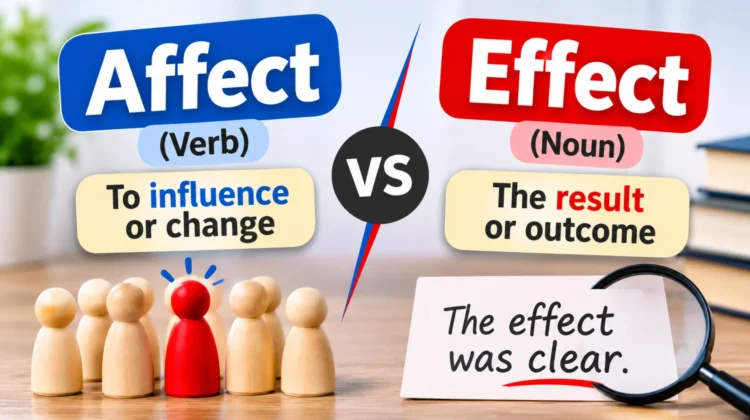
Affect is the word for doing something to a thing, and effect is the word for what you end up with afterward. If you can swap in “influence,” write affect. If you can put “the” or “an” in front and mean “result,” write effect. Rain affects traffic; the effect is delay.
What Does Affect Mean?
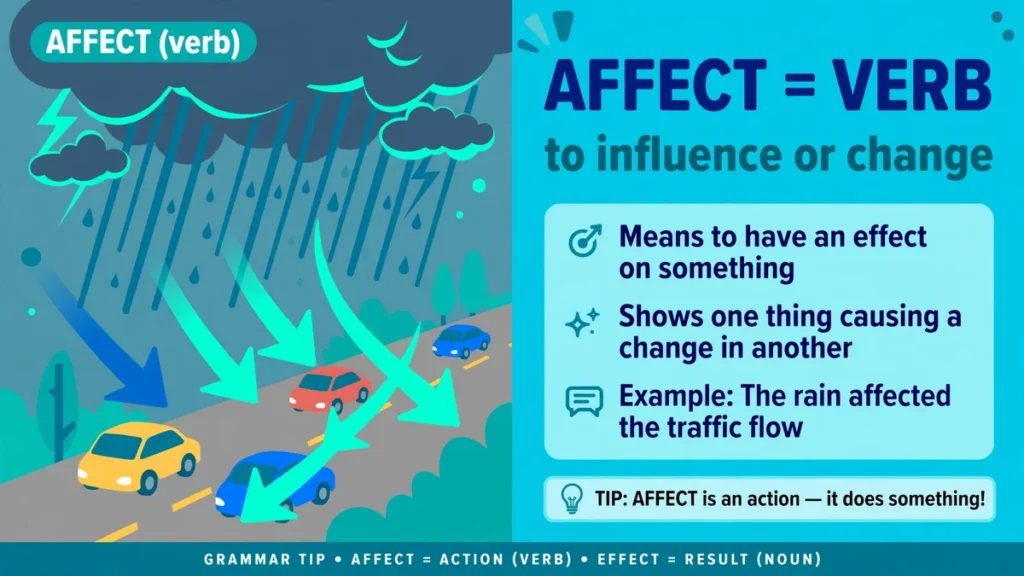
Affect is something one thing does to another. Poor sleep affects your mood. A late bus affects your whole morning. The word always has a doer and a target.
A few more that sound like real life: “The new font affected how fast people read.” “Her apology didn’t affect the decision.” “Skipping lunch affects me by about 3 p.m.”
Affect also has a second, less common verb sense: to put on or fake something, as in “He affected an accent after one semester abroad.” You’ll meet it mostly in fiction and essays.
What Does Effect Mean?
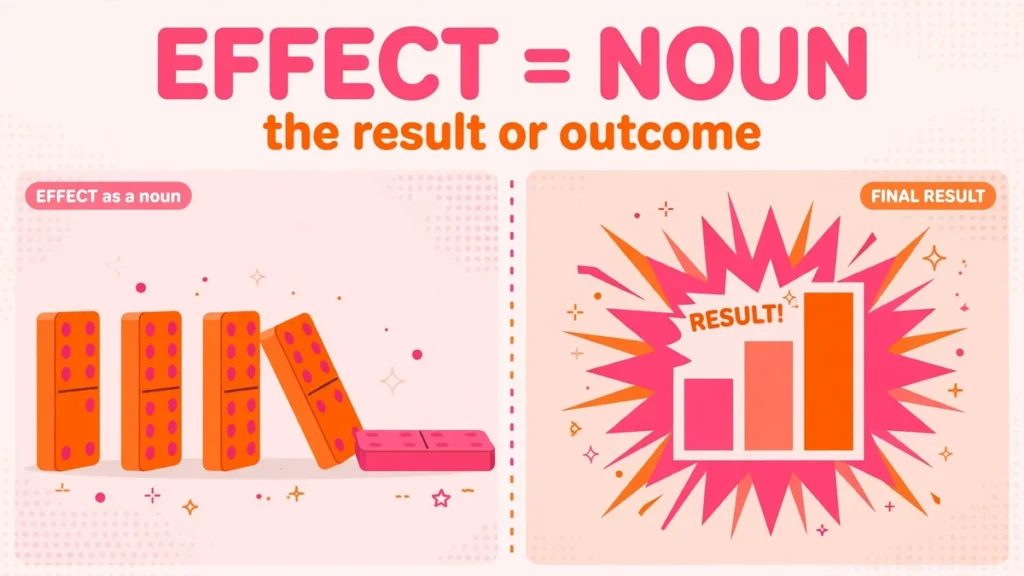
Effect is the thing left behind after something happens. It’s a noun, so it behaves like one: it takes “the,” “an,” “no,” “any,” or “side” in front of it.
The price cut had little effect on foot traffic. This cough syrup does not affect me. The special effects in that film looked cheap. Notice how each effect needs something to have happened first. An effect never starts the action. It follows it.
See Also: Affective or Effective: What’s the Difference? (Examples)
Affect vs Effect Side by Side
| Item | Meaning | Use it when | Example |
| Affect (verb) | To influence or change | Something acts on something else | The heat affected the team’s pace. |
| Effect (noun) | The result of a change | You’re naming the outcome | The heat had a clear effect on the team’s pace. |
| Affect (noun, rare) | Outward emotion shown | Writing in psychology or clinical settings | The patient showed a flat affect. |
| Effect (verb, rare) | To bring about | Formal writing about causing change | The board effected a full restructure. |
Affect vs Effect in Real Sentences
Seeing both words doing their jobs in the same situation clears up more than any rule. Here are a few from ordinary days:
| Situation | With affect | With effect |
| A noisy upstairs neighbour | Their late-night music affects my sleep. | The music has an effect on my sleep. |
| A coffee habit | Too much coffee affects my hands. | The effect on my hands is a slight shake. |
| A software update | The update affected our login page. | The update’s effect was a two-hour outage. |
| A school exam | Nerves affected her handwriting. | The nerves had an effect on her handwriting. |
| A gym routine | Lifting twice a week affects my back. | It took about a month before I saw any effect. |
| A medicine label | This drug may affect your appetite. | A common side effect is a dry mouth. |
One sentence can hold both: “The delay affected hundreds of passengers, and the effect lasted all day.” The first word is the action. The second is what stuck around.
Tricks That Work (and One That Doesn’t)
My pick is RAVEN: Remember, Affect is a Verb, Effect is a Noun. It’s the only trick that covers the ordinary uses with no extra steps, so I’d learn it and drop the rest.
Here’s a backup for when RAVEN slips your mind. Look at the word just before your blank. If it’s “a,” “an,” “the,” “no,” or “any,” you almost always need effect, because only nouns get those little words. “The ___ on sales” can only be effect.
The “A for action, E for result” shortcut is cute and works nearly all the time. It breaks on the rare uses, though. Effect as a verb isn’t a result, and affect as a noun isn’t an action. If you rarely meet those, the shortcut is fine.
See Also: May vs Might: Difference, Meaning and Examples You Can Use
Do Affect and Effect Sound Different?
Barely. The verb affect is usually said uh-FEKT, and effect is said ih-FEKT. In fast speech, plenty of people say both the same way, and that’s a big reason the pair gets mixed up in writing.
The one real stress shift is the noun “affect” in psychology, which is usually said AF-ekt, with the stress on the first syllable. Most readers will never need to say that aloud.
Don’t try to fix this by forcing a different pronunciation. Your listener can’t hear spelling anyway. Use the verb-or-noun check on the page instead.
Phrases People Get Wrong
A handful of fixed phrases cause most of the real-world slips:
Side effect vs side affect: Always write side effect. It names a result, so it’s a noun. “Side affect” is never right, and a sentence like “The pills made me sleepy, and that’s a side effect” shows the correct form.
Take effect: This means something begins to apply. “A new rule takes effect Monday” tells you the rule starts working from that day.
In effect: This means “in practice” or “in force.” If a rule is “in effect,” it’s the one people are following right now.
Affect change vs effect change: Both exist. To effect change is to cause it. To affect change is to influence change already underway.
Affected vs effected: Most of the time you want affected, as in “The storm affected the coast.” Effected is rare and means “brought about.”
Personal effects: This is a noun for belongings, as in a hospital handing you a bag of personal effects.
The “affect change vs effect change” pair trips up careful writers too. If a company “effected change,” it made the change happen. If it “affected change,” it nudged something that was already moving.
See Also: Leach vs Leech: Which Is Correct? (Easy Rule + Examples)
Mistakes I See Most Often, Fixed
Writing “the affect of” is the classic one. “The affect of sleep on memory” should be “the effect of sleep on memory.” The word “the” in front gives it away.
Another is using effect where a verb belongs: “It effected me deeply” should be “It affected me deeply.” Nine times out of ten, a sentence like that wants affect.
Then there’s “side affects,” which should always be “side effects.” And “had a big affect on” should be “had a big effect on.”
When a formal email has you stuck, rewrite the sentence. Swap in “influence” or “result.” If “influence” fits, write affect. If “result” fits, write effect. It takes five seconds and spares you the guess.
The Rare Cases: Effect as a Verb and Affect as a Noun
You can skip this section unless you write for work, school, or a clinic.
Effect works as a verb in formal writing, meaning to bring something about: “The new director effected a complete turnaround.” You’ll see it in business and legal text, and almost nowhere else.
Affect works as a noun in psychology, where it means the emotion a person visibly shows. A clinician might note a “flat affect” for someone who shows little expression, or write about “positive affect” in a study of mood. Outside psychology, you won’t need it.
In research writing, effect is the usual word for what a treatment or condition produces: “the effect of caffeine on reaction time.” The behaviour being studied might be said to affect something, but the outcome you report is the effect.
Affective vs Effective, Affected vs Effected
Two look-alike pairs send people searching. Affective means related to feelings, as in “affective disorders.” Effective means it works, as in “an effective plan.” Affected means influenced, and effected means brought about. The same verb-noun logic holds.
Check Your Own Sentence in 15 Seconds
Paste your sentence into your head, then run three checks in order. First, find the blank. Second, look at the word before it. If it’s “a,” “an,” “the,” or “no,” write effect. Third, if nothing sits in front, try replacing the blank with “influence.” If the sentence still works, write affect.
Try it on “Will the new rule ___ our team?” Nothing in front of the blank, and “influence” fits. Affect. Try “What’s the ___ of the new rule?” The word “the” is right there. Effect.
Affect vs Effect for Kids
Here’s a version you can read to a ten-year-old. Affect is something you do to something else. Effect is what you get afterwards.
Rain affects recess. The effect is that we stay inside. Ice cream affects your mood. The effect is a big smile.
If a child gets stuck, ask them: “Is it the doing or the getting?” Doing is affect. Getting is effect.
Quick Quiz
Pick affect or effect for each blank.
- Does the new font ___ how fast people read?
- The price cut didn’t have much ___ on foot traffic.
- The new rule takes ___ on Monday.
- The manager hopes to ___ a policy change.
Answers: 1. affect. 2. effect. 3. effect (“takes effect” is a fixed phrase). 4. effect (the rare verb meaning “to bring about”).
Item four is the trap. If you wrote affect, you weren’t wrong to be tempted. It only fits if the manager already has a change underway.
Quick Answers
Can affect be a noun?
Yes, but rarely. In psychology, it means a person’s visible emotion, as in “flat affect.”
Can effect be a verb?
Yes. It means to bring about, as in “to effect change.” It’s formal and uncommon.
Is it “affect change” or “effect change”?
Both exist. To effect change is to cause it, and to affect change is to influence change that’s already happening.
Is it “side effect” or “side affect”?
Side effect. It’s a noun naming a result.
Do affect and effect sound the same?
Close, but not identical. Affect is usually uh-FEKT, and effect is ih-FEKT, though many speakers blur them.
Final Thoughts
The next time you’re stuck in an email, don’t try to recall a rule. Reread your sentence with “influence” in the blank and see if it works. If it does, you wanted affect. If you actually meant “the result,” you wanted effect.
And if you ever feel the urge to use effect as a verb outside of “effect change,” pick another word. Almost nobody will notice, and the sentence will usually read better.

Leave a Reply