

Your coworker texts, “Still coming Friday?” and you’re stuck on may vs might. Write “I may” if you’re leaning yes, and “I might” if you’re leaning no.
May vs Might: What’s the Difference?
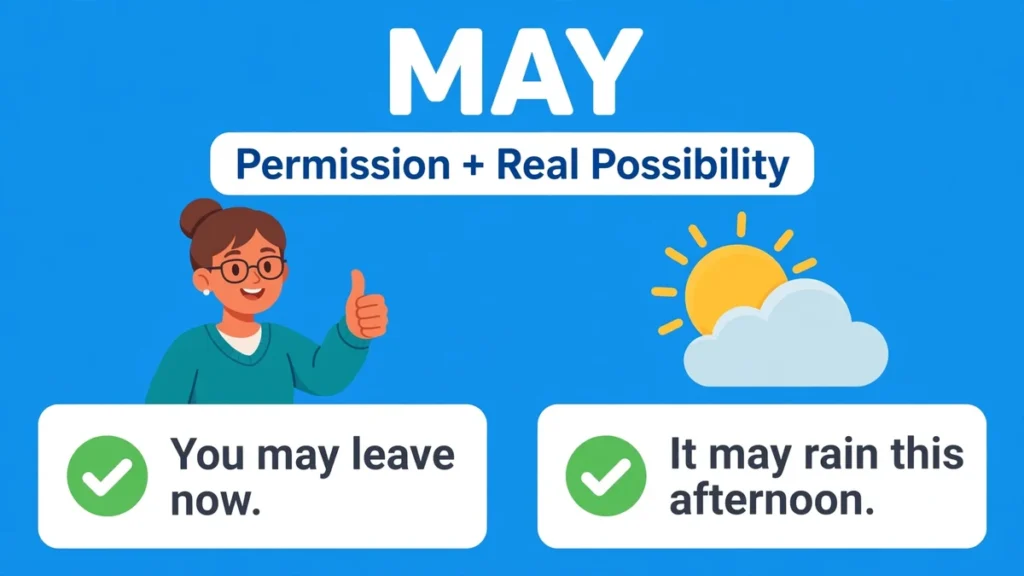
May shows permission or a real possibility in the present, as in ‘You may leave now.’ Might shows a weaker possibility, a past possibility, or a hypothetical one, as in ‘It might rain later.’ If permission or a strong chance is meant, use may; if the chance is small or imagined, use might.
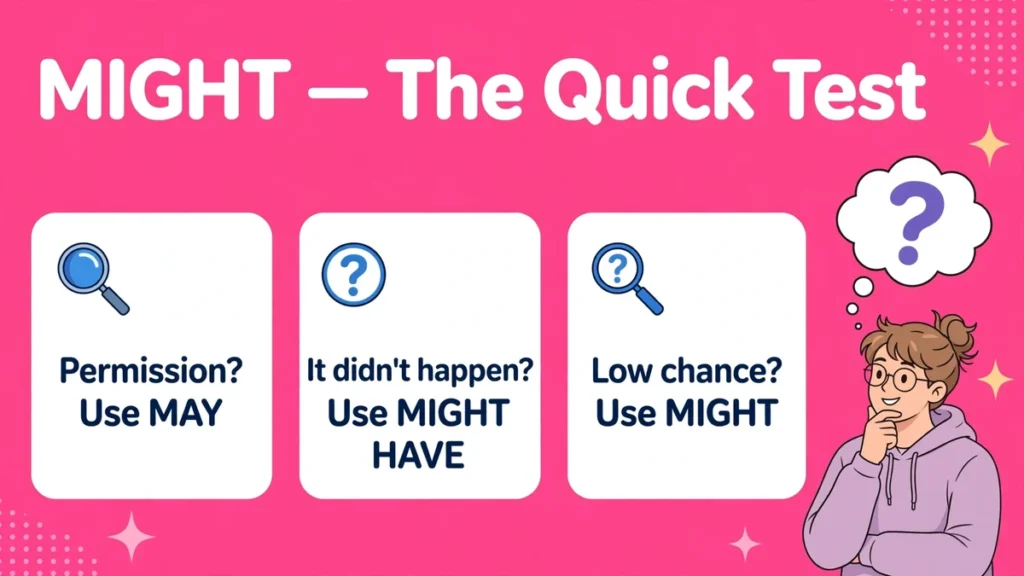
The two words only refuse to swap in two places: permission, and things that never happened. Everywhere else they overlap more than most guides admit.
| Item | Meaning | Use it when | Example |
| May | Permission, or a possibility you lean toward | You’re asking or granting permission, or the chance feels real | Visitors may park behind the library after 6. |
| Might | A weaker, past, or imagined possibility | The chance is small, or the situation never happened | I might skip the meetup if my bus runs late. |
When May Is the Right Pick
Permission is where may stands alone. “May I leave at 4 on Thursday?” asks. “Residents may use the laundry room until 10 p.m.” grants. Most people say “can” in casual talk, and nobody at the coffee machine will flinch. But if you’re writing a sign, a policy, or an email to your boss, pick may. “Might I” exists too, though it sounds very formal and is used for asking, not granting.
May also covers a chance you lean toward. “We may order sushi tonight; Priya already checked the menu” tells people the plan is probably on.
See Also: Principle vs Principal: Which One Do You Need? Examples
When Might Is the Right Pick
Reach for might when the odds look thin. “I might text her, but she hasn’t replied in two days” sounds like you’re talking yourself out of it.
It also fits things you’re only imagining: “If I’d left at 6:50, I might have caught the train.” No train was caught. That’s might’s second job, and may can’t do it.
Suggestions land softly with either word. “You may want to restart the router first” and “You might want to restart the router first” both work.
Is Might the Past Tense of May?
Dictionaries list it that way, and reported speech shows it: “I may come Saturday” turns into “She said she might come Saturday.” But stopping there would mislead you. People use might in the present constantly (“I might call him later”), and in those sentences it only signals a slight chance. Treat past tense as one of its jobs, not the whole story.
Past Sentences: Is the Question Still Open?
One question handles most past-tense cases: do you already know how it turned out?
If you don’t, may have and might have both work. “The package may have gone to the neighbor’s” fits a tracking page that says delivered while your porch sits empty.
If you do know, use might have. “The package might have arrived Tuesday if the truck hadn’t broken down.” Tuesday came and went with no box, so that door is shut. Write may have there, and the sentence quietly reopens it, which is why usage notes frown on it.
May Not vs Might Not
“May not” can mean two different things, and the reader has to guess. “Dev may not use the guest pass” could be a rule, or it could mean he hasn’t decided. Put that on a gym notice, and you’ve started an argument at the front desk.
My pick: use may not for rules (“Guests may not use the pool after 9”) and might not for chances (“Dev might not use the guest pass”). Nobody misreads the second one.
May vs Might vs Could (and Can)
Could sits close to might for possibility: “It could be that the bus is just late.” It also covers past ability, which neither may nor might does: “I could hear the neighbors through the wall.” Speakers don’t agree on how to rank the three by certainty, so don’t try. If you want a slight chance, might is the safe pick.
Can lives in a different lane. It handles ability (“I can lift that”), everyday permission (“Can I borrow your charger?”), and general truths about what’s possible (“Anyone can make a mistake”). May and might talk about one specific case.
See Also: Leach vs Leech: Which Is Correct? (Easy Rule + Examples)
May and Might Examples From Real Messages
| Situation | Sentence | Why that word |
| Asking your manager for time | May I leave at 4 on Thursday? | Permission, polite request |
| Leaning toward yes | We may take the ferry instead; the bridge is backed up. | The chance feels real |
| Leaning toward no | I might skip the meetup if my bus runs late. | The chance is thin |
| Past outcome unknown | She may have missed the 6:15 bus; her phone’s off. | Still open |
| Past outcome known | I might have made the 6:15 bus if I hadn’t gone back for my keys. | It didn’t happen |
| Honest doubt at work | The client might push the call to Friday. | Doubt, no promise |
What to Write When Someone Asks “Are You Coming?”
Say a lunch invite lands, and you’re mostly in. “Probably. I may need to leave by 1:30” tells them yes, with a catch.
A boss asking about Friday’s deadline is trickier. “It might slip to Monday. I’ll know by noon tomorrow” gives honest doubt plus a time they can plan around. That second sentence matters more than the verb.
For a friend’s weekend plan, keep it loose: “I might drive up Saturday if the weather holds.”
Declining is where people go wrong. If it’s a no, say no. “I might not make it” keeps someone holding a seat for you, and that isn’t fair to them. “I can’t make Friday, but dinner next week?” is.
Mistakes People Make
Out loud, may have and might have blur into “may’ve” and “might’ve,” and that’s how “may of” and “might of” sneak into drafts. It’s always have.
Watch the verb after have, too. It’s a participle: “She may have gone home early,” never “She may have went.” And “She may went” skips the have entirely.
Then there’s the spacing trap. Two words, may be, is a modal plus a verb (“He may be at the office”). One word, maybe, means perhaps (“Maybe he’s at the office”). Swap in perhaps. If the sentence survives, you want the one-word version.
See Also: Weather or Whether: Which Is Correct? (With Examples)
See Also: Affect vs Effect: How to Pick the Right Word Every Time
Try It: Four Sentences
- “___ I borrow your charger?” (Answer: May. Can works in casual speech.)
- “If I’d left earlier, I ___ have made the 7:10 train.” (Answer: might, since it didn’t happen.)
- “Guests ___ not use the pool after 9.” (Answer: may, because it’s a rule.)
- “I ___ text him tonight, but I doubt it.” (Answer: might, since the chance is thin.)
Final Thoughts
Nobody’s going to flag a text because you wrote “I may” instead of “I might.” Save your attention for the two places where the choice changes the meaning: permission, and things that didn’t happen.
Here’s a habit that catches most slips. Before you publish anything, search your draft for “may have” and “may not.” Every “may have” where you already know the outcome becomes “might have.” Every “may not” that really means “maybe not” becomes “might not.” It takes about ten seconds.
And if a sentence still won’t settle, ask whether you’d be surprised if it didn’t happen. Surprised? Write may. Not surprised at all? Write might.
Quick Answers
Can I use may and might interchangeably?
For plain possibility in a text, usually yes. In careful writing, use may when you’re leaning yes and might when you’re leaning no. They don’t swap for permission (may) or for things that never happened (might).
Which is better for asking permission?
May. “Might I” is very formal, and “can” is fine in casual talk.
What’s the difference between may have and might have?
If the outcome is still unknown, either works. If you know it didn’t happen, only might have fits.
Do may and might change for he, she, or they?
No. “She may go” and “they might go” both take the plain verb, with no -s and no “to.”
Is could the same as might?
Close for possibility, but only could also covers past ability.

Leave a Reply