

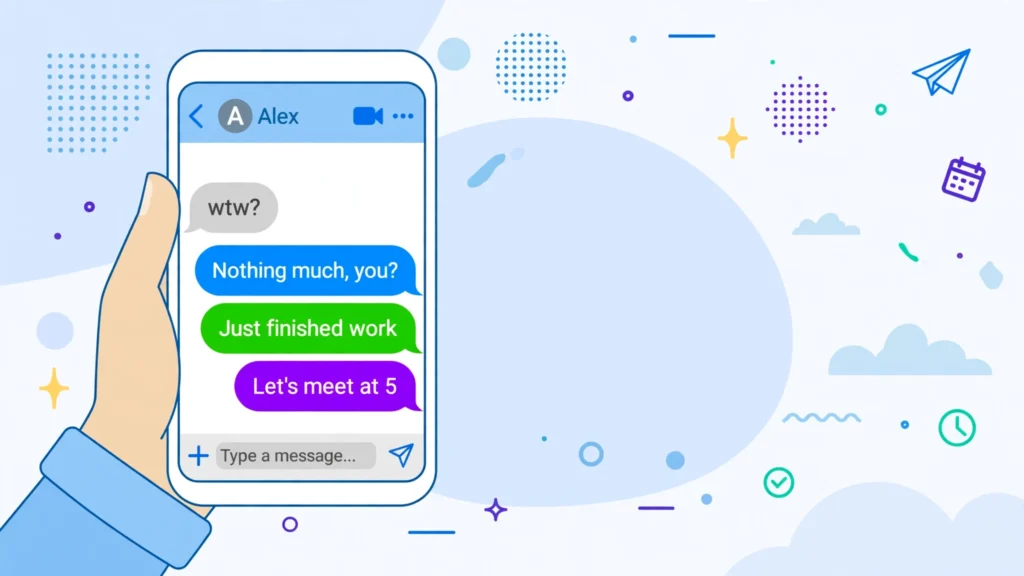
If a friend texts you “wtw,” WTW means “what’s the word?” It’s a casual way of asking what’s going on or what the plan is, the same job “what’s up?” does. Nobody wants an actual word from you. It’s a greeting squeezed into three letters.
Quick Answer: What Does WTW Mean in Text?
WTW stands for “what’s the word?” In texting, it’s a casual greeting that asks what you’re doing, what’s happening, or what the plan is. People send it to catch up or to start making plans, and a short reply that includes a detail works best.
“What’s the word?” is an old spoken greeting, the kind you’d say to a cousin walking into the kitchen. It means “what’s the news?” or “what are you up to?” WTW is that question typed with a thumb.
The sender usually wants one of two things. A few are only checking in. Others are fishing for a plan.
Say Priya texts “wtw” at 4 p.m. on a Saturday. Maybe she’s restless and wants someone to talk to. She might also hope you’ll answer “nothing, wanna get boba?” The three letters don’t tell you which. The rest of the conversation does.
My advice: treat WTW as an opening, not a quiz. The sender kept it short on purpose, so a short, easy answer is exactly what they expect.
TL;DR
WTW means “what’s the word?” It’s a casual way to ask what you’re up to or what the plan is. Answer with one real detail instead of “nothing.” With a boss or teacher, skip it and write the full sentence. And if you see WTW in a finance story, that’s the company, not the slang.
Reading the Clues Around the Letters
Same three letters, different jobs. A few small things tell you which one you’ve got.
Punctuation. “wtw?” is a check-in. “wtw!” or “wtw?!” usually reacts to news, as in “what the what?” Say your friend texts that she got a job offer, and you reply “WTW?!” That’s shock and delight, not a greeting.
Time words. Anything with a day or hour attached points to plans. “wtw sat” and “wtw after practice” both ask what’s happening and whether you’re in. A “wtw” that lands on a Friday afternoon is often a plan in disguise.
Then there’s the message before it. Context beats everything. If someone sends three photos of dresses and then “wtw for Saturday,” they probably mean “what to wear.” Two texts into picking a movie, “wtw tonight” may mean “what to watch.” Neither reading is common, and both only work when the topic is already on the table.
You may also run into “what’s the wave?” or “what’s the move?” in some friend groups. They ask the same thing: what are we doing? Treat them as local variations, not a separate rule.
Here’s a rough guide:
| What you see | Most likely means |
| “wtw?” out of nowhere | A casual hello |
| “wtw tmrw” | What are you doing, and can we hang out? |
| “wtw?!” after your big news | Surprise, a softer “what the…?” |
| “wtw for the party” in an outfit chat | What to wear |
See Also: What Does WTM Mean in Text? (2 Meanings + Best Replies)
What to Text Back
Skip the one-word answer. “Nothing” isn’t rude, but it closes the door, and the other person probably texted because they wanted to talk.
If you’re free and chatty, give a detail and toss the question back: “Just eating cereal over the sink, you?” The cereal does more work than “chilling” ever could.
If something’s planned, say so. “Heading to my brother’s game at 6, come with” turns a greeting into an invitation.
When you’re busy, be honest and short. “In the middle of homework, text you after 8?” beats leaving it unread. A late reply stings less than no reply at all.
Not interested in hanging out? You don’t owe a long excuse. “Staying in tonight, but let’s plan something next week” is kind and clear.
And if a WTW comes from someone you haven’t heard from in months, treat it as a hello, not a request. “Hey! Long time. Work’s been wild, how are you?” is a good reply.
Where WTW Shows Up
You’ll see it in Snapchat chats, Instagram DMs, TikTok comments, WhatsApp, and plain old text messages.
The platform doesn’t change the meaning. A WTW on Snapchat means the same as one in a group text. What changes is the setting around it: a comment under a video reads differently from a private message. Under a creator’s post, “wtw” may be a general question to everyone, not something aimed at you.
WTW, WYD, WYA, and Sup
These openers look alike, but each asks something slightly different.
WTW is wide open: what’s happening, what’s the plan. WYD, short for “what are you doing?”, is narrower and asks about right now. WYA, short for “where you at?”, asks for a location, and it often shows up when someone’s late. “Sup” is just hello with nothing attached.
Which should you send? If you want a plan, WTW. Suppose you’re curious what someone’s doing this minute, WYD. If you’re standing outside a restaurant checking your watch, WYA. And if you only want to say hi, “sup” works fine.
See Also: What Does WYLL Mean in Text? (Is It Rude + 4 Replies)
Is WTW Okay to Send to a Boss, a Teacher, or Someone You Like?
With a boss or teacher, no. WTW isn’t rude, but it’s casual enough to read as too familiar, and some adults won’t know what it means. Try “Good afternoon, Ms. Alvarez. Could you tell me where the project stands?” and the message needs no explaining.
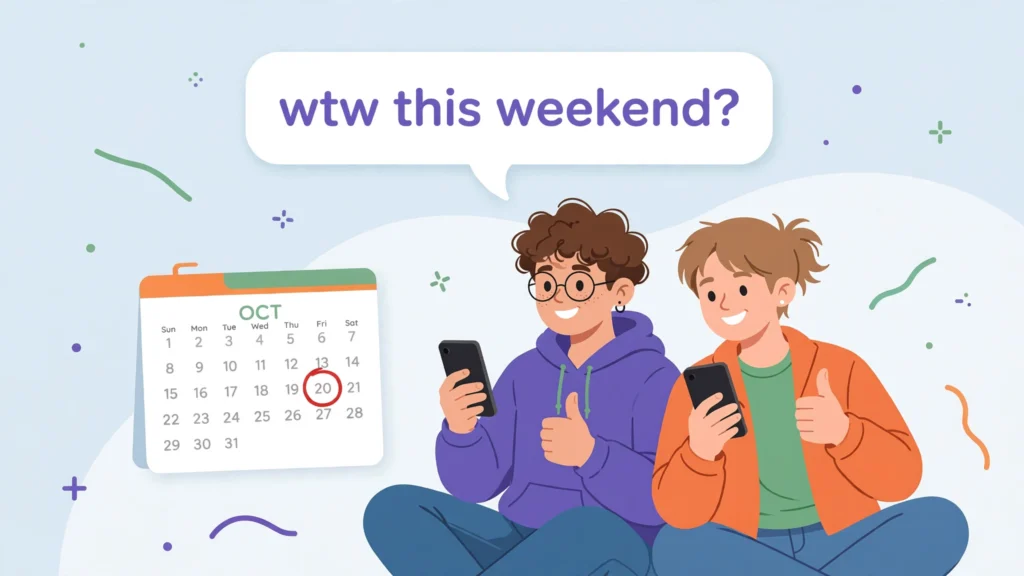
With a crush, it depends. It’s relaxed and low-pressure, which helps. But it’s also vague, and a vague opener can feel lazy. “wtw this weekend?” is okay. “I’m trying that new ramen place Saturday, want to come?” is better.
With friends and siblings, use it freely. That’s where it fits.
Where Did WTW Come From?
Nobody can point to a first use. There’s no dated post or dictionary entry that settles it.
What we can say is that “what’s the word?” existed as a spoken greeting before smartphones, and chat culture chopped phrases into initials long ago. WTW followed the same path as LOL and BRB.
You’ll find confident origin stories online. I’d treat them carefully, since none have a verifiable record.
WTW Isn’t Always Slang
If you’re reading about money or work, WTW likely isn’t texting slang at all. It’s the name and stock ticker of a global advisory and insurance broking company, formerly called Willis Towers Watson. The company’s own filings show its Nasdaq ticker changed from WLTW to WTW on January 10, 2022, with a rebrand to WTW.
So if a job posting or news story says “WTW,” think of the company. If a friend sends it at 9 p.m., think of the greeting.
See Also: What Does ICL Mean in Text? Meaning, Examples & Replies
Quick Quiz: Can You Read These WTW Texts?
1. A friend texts “wtw?” at 4 p.m. on a Saturday. Nothing else. What does it most likely mean?
a) What to wear
b) A casual hello, asking what you’re up to
c) A company stock ticker
d) Where are you?
2. You tell your cousin you got a scholarship, and she replies “WTW?!” What is she saying?
a) She’s asking what you’re doing tonight
b) She’s surprised and happy
c) She’s asking what to watch
d) She didn’t read your message
3. Your sister sends three photos of dresses, then “wtw for Saturday.” What does she mean?
a) What to wear
b) What’s the word
c) Where to wait
d) Who to watch
4. Which one asks for your location?
a) WTW
b) WYD
c) WYA
d) Sup
5. Your teacher emails you about a project. What’s the best way to ask where it stands?
a) “wtw on the project?”
b) “Good afternoon, Ms. Alvarez. Could you tell me where the project stands?”
c) “sup, project?”
d) “wyd with my grade”
Answers: 1) b, 2) b, 3) a, 4) c, 5) b
FAQs
Does WTW mean something different from a guy or a girl?
No. It’s the same greeting either way. Whether it feels friendly or flirty depends on the conversation, not the letters.
Is “what the what?” a real meaning?
Yes, but it’s less common. You’ll mostly see it as a reaction to surprising news, with an exclamation mark.
Is WTW the same as WYD?
Close, but no. WYD asks what you’re doing right now. WTW asks what’s going on or what the plan is.
Can WTW be rude?
Not by itself. If you send it to the wrong person, it can sound lazy, which is why formal messages need full words.
What if I can’t tell which meaning someone intended?
Ask. Something like “wait, wtw like ‘what’s up’ or ‘what to wear’?” takes five seconds, and it’s a lot better than answering the wrong question.
The Last Word on WTW
A text like this takes two seconds to send, so it’s easy to answer on autopilot. Slow down for one beat before you reply. Look at the time it arrived, the punctuation, and whatever came before it.
Then answer the question they probably meant, with one real detail. “Just got back from the dentist; my whole face is numb. You?” will get you a better conversation than “nm” ever will.

Leave a Reply