
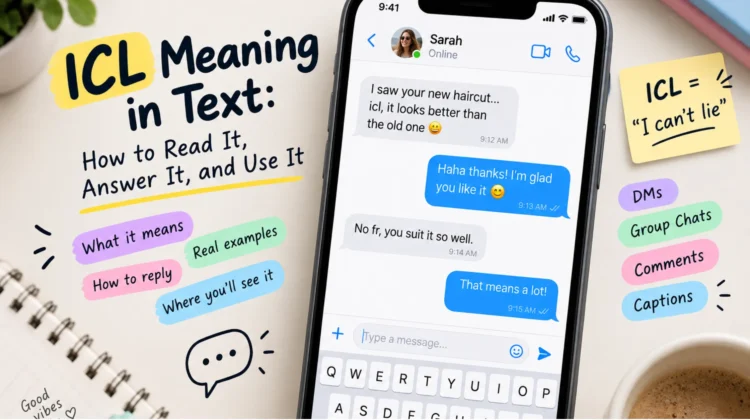
The ICL meaning in text is “I can’t lie,” and people type it right before they say something candid. Your friend sends “icl that haircut looks better than the old one,” and you’ve got the whole idea: she’s being straight with you, and probably teasing a little. You’ll see it in DMs, group chats, comments and captions, usually in lowercase and usually without much thought behind it.
The phrase is easy. The tone is harder. Three letters can sit in front of almost anything: praise, a confession, a dig, a punchline. You’d answer each one differently. So below you’ll find how to tell which one you’ve got, who started saying it, and what to type back.
Where ICL sits in a message
It shows up in three places, and where it lands changes the feel.
Up front, it works like a drumroll. “icl I didn’t finish the book” tells you something mildly embarrassing is on its way, so you’re ready before the sentence lands.
At the tail, it sounds like a thought that leaked out. “that meeting was a waste of everyone’s time icl” puts the opinion first and adds the tag afterward, so it comes across as less planned.
You’ll also catch it wedged mid-sentence, usually right before the turn: “Great hike, icl, my knees are paying for it today.” Whoever types like this is writing the way they’d talk, with a small beat before the catch.
Capital letters carry no extra meaning. Most people type it small because a quick message to a friend rarely gets proofread. A comma is a slightly bigger signal: “icl, you’re right” sounds like someone pausing to say “honestly,” while “icl you’re right” just tumbles out.
The surroundings matter too. A 😂 stuck onto “icl I teared up during that dog food commercial” turns it into a joke you’re meant to enjoy. Take “icl I’m tired of this,” end it with a period and nothing else, and nobody’s laughing.
See Also: WYLL Meaning: Is It Rude? Easy Replies for 4 Situations
Why say “I can’t lie” at all?
Nobody is accusing you of anything, so the phrase isn’t there to prove a point. What it really says is: here comes the unedited version. Or at least the version I’d like you to believe is unedited.
It pulls in two directions at once. Sometimes it cushions. “icl I’d skip the second movie” tells the person you’re not attacking their taste, just saying where you land. The older “not gonna lie” does the same thing: people use it to admit something awkward or to take the edge off a complaint.
Other times it adds weight. “icl that lasagna was unreal” hits harder than the bare compliment, because the tag says you mean every word.
If I had to pick one, I’d say softening is more common. It tends to appear when someone’s about to admit a small slip, push back gently, or pay a compliment that would feel gushy without a casual tag in front. Nobody’s counted, so file that under gut feeling.
Sincere, or a bit?
Most of the time, ICL means what it says: somebody’s giving you their take. But lately it’s also a punchline, and on a screen the two look the same.
The joke kind grew out of a meme where people crammed slang abbreviations together until the sentence fell apart. Strings like “ts pmo icl,” roughly “this sh*t pisses me off, I can’t lie,” spread across captions and overlaid clips of people dancing. The point was to mock how much slang gets crammed into everything. One early viral example, posted in late December 2024, piled “ts” and “pmo” together, and the format snowballed through early 2025.
A few clues separate the two:
- A real statement points at something. “icl the last two episodes felt rushed” gives you a specific thing to agree or argue with.
- A bit is absurd or stacked. A wall of abbreviations, or an outraged claim about something trivial, is almost certainly a joke.
- The sender’s habits count. If your friend clowns around constantly, assume irony until they show otherwise. A friend who normally writes full sentences and suddenly drops an icl is probably meaning it.
Can’t tell? Go with sincere. If you guess wrong and answer a joke seriously, you’ll cringe for a second and move on. Laughing off someone’s real feeling costs more.
Who came up with it?
Nobody knows who typed it first, or when. If a site hands you an exact date and a name, it’s making that up.
There’s more solid ground on the culture around it. ICL is widely traced to Black internet users and African American Vernacular English, and it spread from there across TikTok and X. That history matters because of what came next. When the slang-overload memes took off, many Black users, and other users of color, objected that the joke mocked words they’d been using sincerely and flattened their language into a punchline.
You don’t have to treat three letters like a hazard. Typing it to a friend is one thing; turning it into a bit that mocks how a group of people talks is another.
Its closest relative has a clearer record. “NGL,” for “not gonna lie,” has no single author either, but it was showing up as its own entry in crowd-edited slang dictionaries by 2009. That puts it about fifteen years ahead of the ICL surge, which may explain why NGL feels familiar to more people.
The rest of the honesty shorthand
ICL has relatives. NGL is the closest match, and the one people know best. TBH (“to be honest”) reads the least like slang. IWL and IWEL, “I won’t lie” and “I won’t even lie,” mean the same thing, but you’ll rarely see them. IMO, “in my opinion,” signals a personal view rather than candor.
FR, “for real,” is the one people mistake for a sibling. It doesn’t introduce a confession, it backs one up: “icl that was embarrassing fr.”
Swap ICL for NGL mid-conversation and the message hasn’t changed. Which one someone picks mostly comes down to habit and whom they chat with. I guess that ICL sounds a little more current, but I wouldn’t read much into it.
See Also: Hope You’re Having a Good Day: What to Write Instead, and When It’s Fine as Is
Does ICL mean they like you?
On its own, no. It’s a tag, and it carries no feeling about you in particular. “icl I’m obsessed with this song” means the same thing whether you send it to a crush, a cousin, or a stranger in the comments.
What follows it, and who’s typing, does the real work.
A new crush. “icl I look forward to our chats more than I should” is a flirtatious admission with the tag as cover. “icl that was a good game” is a comment about a game.
A close friend. Between friends, ICL lets people say something warm and keep it light. “icl you’re the only one who gets my sense of humor” is affection, not necessarily romance.
An ex. Go carefully. “icl I still think about that trip” could be nostalgia, a nudge, or what exes say at 11 p.m.
One warm ICL from someone warm with everybody tells you little. Several personal ones in a row, all aimed at you, none triggered by anything, is a pattern worth noticing. Still unsure? Ask them straight out, or say something honest yourself and see how they respond.
What to say back
Your reply belongs to the sentence that follows the tag. The tag itself needs nothing.
You agree. Keep it short.
They: “icl that finale was a mess.”
You: “Right? I paused it twice to see if it was glitching.”
You disagree, kindly. Acknowledge, then add your angle.
They: “icl the remake is better than the one we grew up with.”
You: “Bold. Convince me over lunch.”
It’s a compliment. A plain thank-you beats something clever.
They: “icl that toast you gave at the wedding got me teary.”
You: “Thank you, honestly. I rewrote it on the train that morning.”
It’s a small confession. Make it easy.
They: “icl I lost the tickets.”
You: “Okay, deep breath. Does the venue have a reprint desk?”
It’s about you, and it hurts. Don’t fire back. Ask what they mean.
They: “icl you’ve been kind of distant lately.”
You: “That’s fair to say. Can I call you tonight?”
You want to flirt back. Match the warmth and add a detail only you’d know.
They: “icl I keep checking my phone hoping it’s you.”
You: “Good. I’ve been sitting on a reply for ten minutes, trying to sound casual.”
Sending “icl” back is only worth it if you’d say it anyway. Otherwise, write in your usual voice, which will read as more genuine.
Is it okay to use it yourself?
Friend chats, group threads, a throwaway caption: that’s home turf, particularly if you already type in lowercase fragments.
It goes wrong when honesty needs a careful touch. Open an apology, a piece of bad news or a reply to someone upset with “icl,” and it can sound like you’re brushing the moment off. In anything formal, like a job application or a note to a teacher, write “honestly” or just say the thing.
Two habits are worth dropping. One is attaching it to something you’re not being straight about, which cancels the effect. The other is overuse: when half your lines start with “icl,” the tag stops signaling anything and becomes a verbal twitch.
If you’re a parent or a teacher, decoding it is the useful skill. Typing it yourself is optional.
See Also: What Does HBU Mean in a Text? 2 Meanings, 4 Easy Replies
Other things ICL can mean
Away from your phone, ICL stands for something unrelated. Eye surgeons use it for the implantable collamer lens, a tiny lens placed inside the eye to correct nearsightedness and astigmatism. A newer model won US approval in 2022. If the letters appear on a clinic’s website or come from an eye doctor, they’re real.
A few sites list other expansions, like “I see, I learn,” “I can’t laugh” or “I couldn’t love.” Treat those as noise. In a chat, a comment or a caption, “I can’t lie” is the reading.
Frequently asked questions
Is ICL the same as NGL?
Practically, yes. Both announce that something frank is coming. NGL is older and more widely recognized.
Is the meaning different on Snapchat, TikTok or Instagram?
No. It’s the same words on every app, and what shifts is the audience. A DM is usually personal, while a video comment is quick and written for onlookers.
Is ICL rude?
The abbreviation is neutral. What follows it carries the temperature. “icl you were wonderful tonight” is warm, while “icl I zoned out halfway through” stings, and the tag doesn’t change that. If anything, it announces that a blunt line is coming.
Is ICL fine for work messages?
I’d leave it out of anything a manager or client will read. “Honestly” does the job without the risk.
What does “ts pmo icl” mean?
Word for word, it’s “this sh*t pisses me off, I can’t lie.” You’ll mostly find it as a gag poking fun at slang overload, so don’t expect an actual gripe behind it.
Why does it show up so often in video comments?
Comments are quick and public, and ICL gives you a three-letter way to sound candid. I haven’t seen data on this, so treat it as a guess.
Final thought
Next time an “icl” pops up, skip past it and read what comes after. Say a friend sends “icl I’m dreading this weekend.” Those three letters only open the message. The dread is what needs an answer, and “What’s going on?” is plenty.

Leave a Reply