
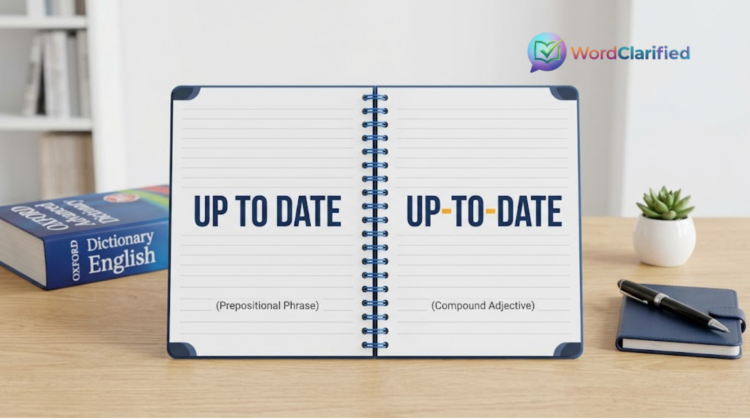
Is it up to date or up-to-date? Both forms are used in English, but the hyphenated form is normally used when the phrase comes directly before a noun.
For example:
We need up-to-date information.
But:
The information is up to date.
The basic idea is simple. Up-to-date works as a compound modifier before a noun. Up to date is generally written open in other positions, especially after a verb. Cambridge and Oxford both use these forms in their dictionary examples.
There can be some variation between dictionaries and style guides, so this is best treated as a practical writing rule rather than an absolute rule for every sentence.
Up to Date or Up-to-Date: Quick Answer
Use up-to-date when it directly describes a noun that follows it:
an up-to-date textbook
up-to-date information
an up-to-date report
Use up to date when it follows a verb or appears in another position where it is not acting as a compound modifier before a noun:
The textbook is up to date.
The information is up to date.
Please keep your records up to date.
A quick comparison makes the difference clearer:
| Form | Typical use | Example |
| up-to-date | Before a noun | We need up-to-date information. |
| up to date | After a verb or in other open constructions | The information is up to date. |
| upto date | Not the standard form | ❌ Avoid it. |
If you are writing for school, work, or general online use, this rule will handle most situations you come across.
What Does “Up to Date” Mean?
Up to date means current, recent, or containing the latest information. It can also describe something modern. Cambridge and Oxford give these meanings in their dictionary entries.
For example:
The school website is up to date.
This tells us that the website contains current information.
Now compare it with:
The school has an up-to-date website.
The meaning is similar, but the phrase now comes before the noun “website,” so the hyphenated form is used.
You can use the phrase with many things that change over time:
- information
- records
- websites
- software
- research
- schedules
- textbooks
- equipment
For example:
Please check that the exam schedule is up to date.
Students need up-to-date exam information.
The phrase can also describe something modern:
The school has up-to-date computer equipment.
The exact meaning depends on the sentence, but the general idea is that something is current or modern.
When to Use “Up-to-Date”
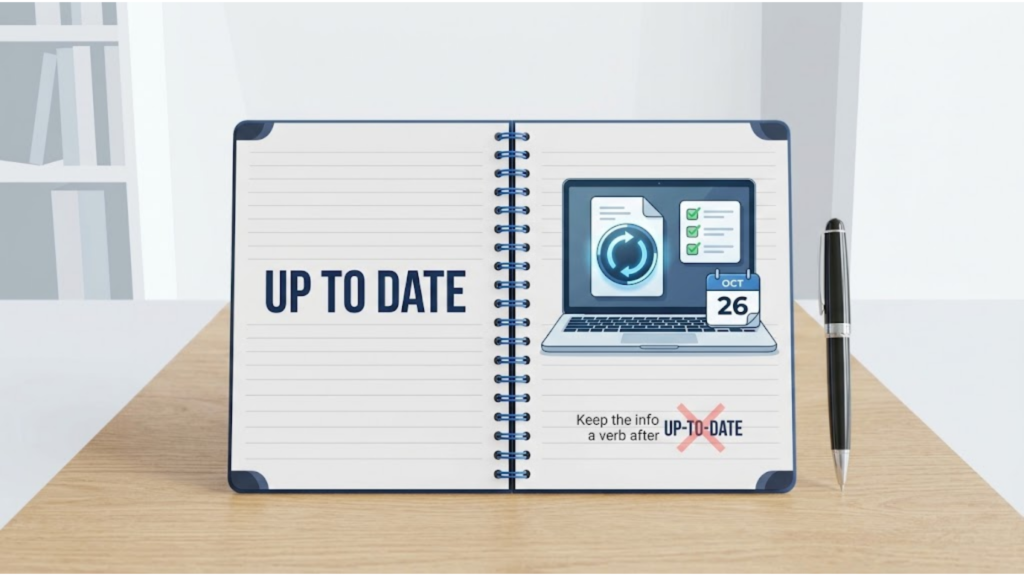
Use up-to-date when the phrase comes directly before a noun and describes it.
For example:
We need up-to-date information about the course.
She bought an up-to-date textbook.
The school published an up-to-date timetable.
Students should use up-to-date sources for their research.
The company keeps up-to-date records.
In these sentences, the phrase tells the reader what kind of information, textbook, timetable, sources, or records you mean.
The hyphens join the words into one compound modifier before the noun.
You can see the same type of construction in phrases such as:
- a well-known author
- a full-time student
- a high-quality book
- an up-to-date textbook
The main point is not to add hyphens whenever you see these three words. The position of the phrase matters.
See Also: Writing or Writting: Which Spelling Is Correct?
When to Use “Up to Date”
Use up to date when the phrase follows a verb or appears in another position where it is not being used as a compound modifier before a noun.
For example:
The information is up to date.
My notes are up to date.
The website is up to date.
Is your software up to date?
Please keep your records up to date.
You will often see this form with verbs such as be, keep, stay, and bring.
For example:
Keep your notes up to date.
I try to stay up to date with new vocabulary.
Can you bring me up to date on the changes?
Oxford includes examples with expressions such as “keep up to date” and “bring somebody up to date.”
This is why the simple rule “before a noun, use hyphens” is more useful than trying to memorize every possible sentence.
Up-to-Date vs. Up to Date: Compare the Examples
A side-by-side comparison makes the difference easier to understand.
We need up-to-date information.
The information is up to date.
He bought an up-to-date computer.
His computer is up to date.
The teacher shared up-to-date research.
The research is up to date.
Check the up-to-date schedule.
The schedule is up to date.
Students need up-to-date course information.
The course information is up to date.
The meaning does not change much in these pairs. What changes is the role and position of the phrase.
Before the noun, it works as a compound modifier:
up-to-date information
After the verb, it describes the current state of something:
The information is up to date.
Once you notice that difference, choosing the correct form becomes much easier.
Common Mistakes
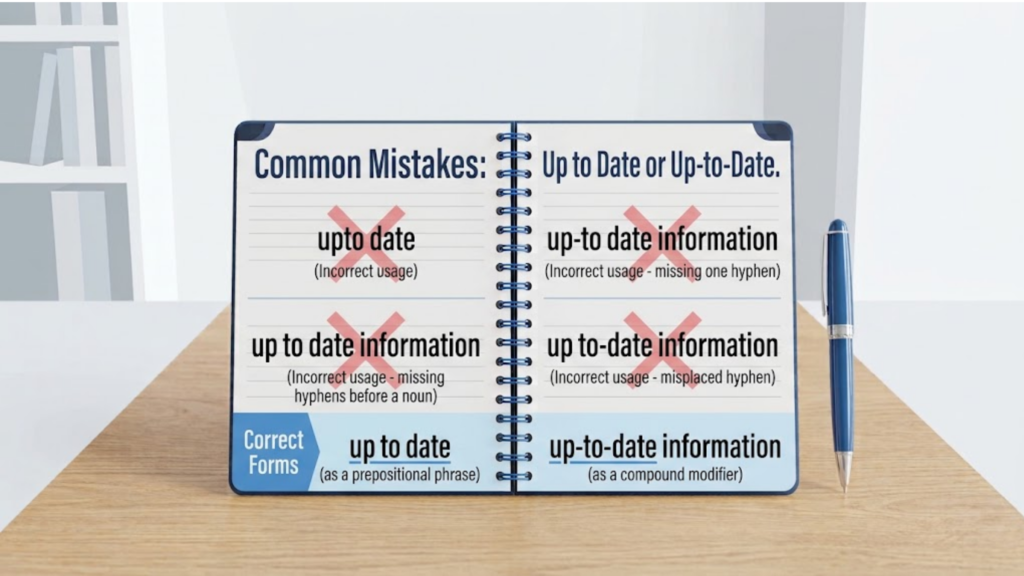
There are a few forms you should avoid.
1. Upto date
Do not combine up and to into one word.
Incorrect:
The website is upto date.
Correct:
The website is up to date.
2. Up to Date Information” Without Hyphens
When the phrase directly modifies “information,” use the hyphenated form:
up-to-date information
Not:
up to date information
Cambridge uses “up-to-date information” as a dictionary example.
3. Up-to date
Do not use only one hyphen.
Incorrect:
up-to date information
Correct:
up-to-date information
4. Up to-date
This form also has the hyphen in the wrong place.
Incorrect:
up to-date information
Correct:
up-to-date information
If you use the compound modifier before a noun, write all three parts together with two hyphens.
See Also: Of Course or Ofcourse: The Correct Way to Write It
Common Expressions With “Up to Date”
Some expressions appear frequently in everyday English.
Keep up to date
This means keeping your knowledge or information current.
Students should keep up to date with changes to the exam schedule.
I try to keep up to date with new English vocabulary.
Stay up to date
This has a similar meaning.
Teachers need to stay up to date with changes in their subjects.
I want to stay up to date with the latest course information.
Bring someone up to date.
This means giving someone the latest information about a situation.
Can you bring me up to date on today’s class?
She brought her colleague up to date on the changes.
Keep something up to date.
This means making sure something contains current information.
Please keep your profile up to date.
The school should keep its website up to date.
These expressions are useful to learn because the open form appears naturally in all of them.
What About “Most Up-to-Date”?
You will often see most up-to-date before a noun.
For example:
We need the most up-to-date information available.
This is the most up-to-date version of the textbook.
Here, the phrase comes before the nouns “information” and “version,” so the hyphenated form is used.
However, hyphenation can vary depending on the sentence structure and style guide. Cambridge uses the hyphenated form in examples such as “the most up-to-date picture.”
So it is better not to treat the hyphenation rule as an unbreakable law. For ordinary writing, though, most up-to-date information is a clear and standard choice.
Up to Date vs. Updated
Updated and up to date are related, but they focus on slightly different ideas.
Updated usually focuses on something that has been changed.
The teacher updated the course page yesterday.
Up to date describes something as current.
The course page is up to date.
You can use both in the same sentence:
The teacher updated the course page, so the information is now up to date.
The difference is useful when you are writing about websites, documents, records, notes, or course materials.
For example:
I updated my notes last night, so they are now up to date.
The first part tells us that a change was made. The second tells us that the notes are current.
See Also: Long Term or Long-Term: A Complete Guide to Getting the Hyphen Right
Examples for Students and Teachers
This phrase comes up often in education because course information, research, schedules, and learning materials can change.
For example:
Students should use up-to-date sources when researching a topic.
But:
Make sure your sources are up to date before submitting the assignment.
With textbooks:
The teacher recommended an up-to-date textbook.
The textbook is up to date.
With course information:
Check the website for up-to-date course information.
The course information on the website is up to date.
You can also use the phrase when discussing research:
The paper uses up-to-date research.
The research database is up to date.
These examples show the pattern in situations students may actually encounter in school or university writing.
Is “Up to Date” Suitable for Academic Writing?
Yes. You can use the phrase in assignments, reports, research writing, emails, and other formal contexts.
For example:
Students should use up-to-date sources when discussing recent research.
Make sure your reference list is up to date before submitting the paper.
One useful distinction is that up-to-date means current. It does not automatically mean that every piece of information is correct.
For example, a webpage may have been updated recently but still contain an error. “Updated” tells you that something was changed. “Up to date” describes the information as current.
That difference matters when evaluating sources for academic work.
What Do Dictionaries and Style Guides Say?
The basic pattern is supported by major reference sources, although hyphenation can vary depending on the construction and style guide.
Cambridge gives up-to-date information and up-to-date equipment as examples. Its dictionary also uses the open form in expressions such as “keep … up to date.”
Oxford gives examples such as up-to-date information and expressions using “keep” and “bring.”
The Chicago Manual of Style gives more specific advice about the position of the phrase. It recommends up-to-date before a noun and up to date when the phrase is used after the noun or verb. Chicago also notes that Merriam-Webster’s treatment differs in some cases.
So if you are following a particular school, publisher, or workplace style guide, use its rules consistently.
For general English writing, this is a useful guideline:
Before a noun → usually up-to-date
After a verb → usually up to date
It is a practical rule, not a reason to assume every style guide will hyphenate the phrase in the same way.
A Simple Way to Remember It
When you are unsure, look at what the phrase is doing in the sentence.
If it directly describes a noun before it, use up-to-date:
an up-to-date dictionary
up-to-date information
an up-to-date report
If it follows a verb and describes the current state of something, use up to date:
The dictionary is up to date.
The information is up to date.
The report is up to date.
You can also remember one simple pair:
an up-to-date book
the book is up to date
That pair covers the main distinction most writers need.
Up to Date or Up-to-Date: Final Answer
Both up to date and up-to-date are used in English. The form you choose depends mainly on how the phrase works in the sentence.
Use up-to-date when it comes directly before a noun and describes it:
up-to-date information
an up-to-date textbook
an up-to-date report
Use up to date when it follows a verb or appears in another open construction:
The information is up to date.
The textbook is up to date.
Keep your notes up to date.
Also avoid upto date. “Up” and “to” should remain separate words.
If you are unsure, check the position of the phrase first. Before a noun, the hyphenated form is usually the right choice. In other common constructions, especially after a verb, the open form is generally used.
FAQs
1. Is “up to date” one word?
No. The open form is written as three words: up to date. When it is used as a compound modifier before a noun, it is commonly written up-to-date.
2. Is “up-to-date” always correct?
No. It is normally used before a noun when the phrase works as a compound modifier:
up-to-date information
After a verb, the open form is generally used:
The information is up to date.
Some dictionaries and style guides differ in specific constructions, so follow any style guide required for your writing.
3. Is “upto date” correct?
No. Upto date is not the standard form. Use up to date or up-to-date, depending on the sentence.
4. Should I write “up to date information”?
When the phrase directly describes the noun “information,” the usual form is up-to-date information.
We need up-to-date information.
When the phrase follows a verb, leave it open:
The information is up to date.
5. Is “most up-to-date” correct?
Yes. Most up-to-date is commonly used before a noun:
We need the most up-to-date information available.
Hyphenation can vary in some constructions and according to style guides, but this form is a standard choice when the phrase directly modifies a noun.

[…] See Also: Up to Date or Up-to-Date Examples: Easy Rules to Get It Right […]