
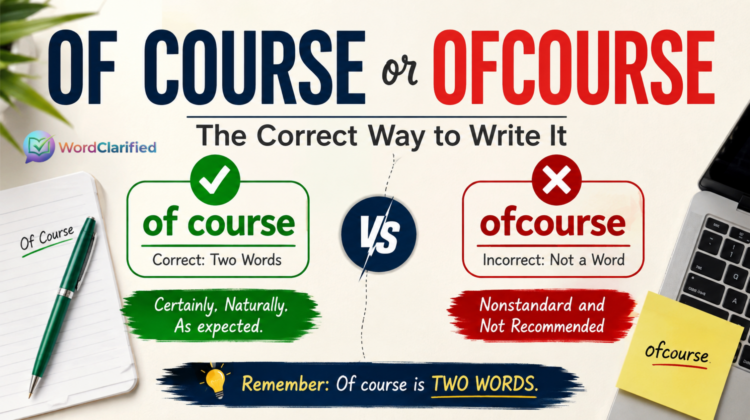
If you have ever been unsure whether to write Of Course or Ofcourse, you are not alone. Both forms look similar, so it is easy to see why people get confused. However, there is a clear answer in standard English: of course is the correct form. It is written as two separate words.
Ofcourse is not the standard spelling of this expression. You may still see it in text messages, comments, social media posts, or other informal online writing, but that does not make it correct. If you are writing an email, school assignment, article, résumé, or professional message, use of course.
Of Course: The Correct Spelling
The correct spelling is of course, with a space between of and course. It is a common English expression used to show agreement, certainty, or that something is expected or already understood.
For example:
- Of course, guiding you through this is my top priority.
- Of course, she remembered his birthday.
- You can, of course, call me tomorrow.
- Of course, we should check the details first.
You can use the phrase at the beginning, middle, or end of a sentence. Its position can affect the way the sentence sounds, but the spelling stays the same.
When choosing between Of Course or Ofcourse, remember one simple rule: if you mean “certainly,” “naturally,” or “as expected,” write of course as two words.
What Does “Of Course” Mean?
Of course has a few related meanings. In many situations, it means “certainly” or “yes.” It can also show that the speaker thinks something is obvious, expected, or already known.
Imagine that a friend asks:
“Can you help me carry these boxes?”
You might answer:
“Of course!”
Here, of course is a friendly way to say yes.
The phrase can also point to something the speaker considers obvious:
Are you required to use your phone when making a voice call?
“Of course I do.”
In this example, the speaker believes the answer is clear.
Context and tone matter, too. A friendly of course can sound warm and helpful. But if you use it to suggest that someone should already know the answer, it can sound impatient or dismissive.
For example:
“Why does the price change?”
“Of course it changes.”
That answer may sound as if the question was unnecessary. A more neutral response would be:
“The cost depends on the size you choose.”
So, of course is not automatically rude. The way it sounds depends on the situation and the speaker’s tone.
See Also Long Term or Long-Term: A Complete Guide to Getting the Hyphen Right
Of Course as an Expression of Agreement
One of the most common uses of of course is to agree with someone or accept a request.
Consider this conversation:
A: Can I borrow your notebook?
B: Of course.
The answer is short, but it clearly shows that the request is accepted.
You can also use the phrase in a longer response:
- Of course, you can borrow my notebook.
- Of course, I’ll send it tonight.
- Of course, we can meet after work.
In these examples, of course adds a sense of willingness or certainty. It can make a simple “yes” sound more reassuring.
How “Of Course” Works at the Beginning of a Sentence
Of course can appear at the beginning of a sentence as an introductory expression. A comma is commonly used after it in this position.
Examples:
- Of course, you can ask another question.
- Of course, mistakes happen sometimes.
- Of course, we need more information before making a decision.
The comma separates the introductory expression from the main statement.
However, you do not need to put of course at the beginning of every sentence. If it does not add anything, the sentence may be clearer without it.
Compare:
Of course, you should check your spelling before submitting the assignment.
You should check your spelling before submitting the assignment.
Both are correct. The second version is more direct.
See Also: Writing or Writting: Which Spelling Is Correct?
How to Use “Of Course” Mid-Sentence
You can also insert ‘of course’ right into the middle of a sentence. When it acts as a quick aside, wrap it in commas to separate it from the main thought.
For example:
- The final price, of course, depends on the size you choose.
- She will, of course, be there tomorrow.
- We can, of course, discuss the issue later.
In the first example, you could remove of course and still have a complete sentence:
The price will depend on the size.
That is a useful way to understand why commas are used around the phrase in these examples.
You may also see of course without commas when it is closely connected to the rest of the sentence:
She is of course welcome to join us.
In everyday writing, the main point is to understand how the phrase fits into the sentence rather than applying one punctuation rule to every example.
How “Of Course” Works at the Sentence End
The phrase can also appear at the end of a sentence, particularly in conversational writing.
Examples:
- I will help you, of course.
- You can come with us, of course.
- We should check the report first, of course.
At the end, of course can add reassurance or suggest that the statement is expected.
Tone matters here as well. Saying:
“You can come with us, of course.”
can sound welcoming.
But depending on the speaker’s tone, the same words could sound sarcastic or impatient.
This is why it is useful to consider the whole sentence and situation instead of learning the phrase from a dictionary definition alone.
“Of Course” vs. “Certainly”
Of course and certainly can sometimes express the same basic idea, but they do not always sound the same.
Compare:
“Certainly, I can provide the information.”
“Of course, I can provide the information.”
Certainly can sound more formal in some situations, while of course often feels more conversational.
The choice depends on the context. If you are having a casual conversation, of course is a very natural choice. In formal writing, certainly may sometimes fit better when you want a more neutral or formal tone.
This does not change the spelling rule. When you use this expression, write of course as two words.
Why Is “Ofcourse” Incorrect?
The problem with ofcourse is simple: it joins two words that are written separately in the standard form of the expression.
The correct form is:
of course
Not:
ofcourse
You may see similar mistakes with other common expressions, such as alot instead of a lot. A phrase can sound connected when spoken without becoming one word in writing.
The important thing to remember is that spoken pronunciation does not change the standard spelling.
If you are writing something that needs to be correct and clear, keep the space:
of course
Common Mistakes With “Of Course”
Writing “Ofcourse”
This is the main spelling mistake.
❌ Ofcourse, I can help.
✅ Of course, I can help.
The two words should remain separate.
Confusing “Of Course” With “Off Course”
These phrases look alike, but their meanings differ completely.
❌ The plane went of course.
✅ The plane went off course.
Here, off course means that the plane moved away from its planned route.
But when you mean “certainly,” use of course:
✅ Of course, I’ll help you.
Unnecessary Capitalization
In the middle of a sentence, of course is normally lowercase:
I will, of course, check the document.
Whenever you start a new sentence, ensure the opening word is capitalized:
Of course, I remember.
You may see unusual capitalization online, but that does not change the standard form.
Using “Of Course” Too Often
A phrase can be correct and still become annoying when it is repeated too much.
For example:
Of course, we need good content. Of course, we need good research. Of course, we need to edit the article.
There is nothing grammatically wrong with those sentences, but repeating the phrase adds little.
A cleaner version would be:
Good content needs research and careful editing.
Use of course when it adds meaning, emphasis, or tone. If removing it does not change the point, you may not need it.
Is “Of Course” Formal or Informal?
Of course is used in both everyday conversation and written English.
For example:
Of course, I’d be happy to help.
You can also find it in more formal writing:
The final cost will, of course, depend on the materials used.
So you do not need to avoid the phrase simply because you are writing something formal.
At the same time, formal writing often benefits from direct wording. If of course adds nothing to the sentence, removing it can make the statement cleaner.
Compare:
The final cost will, of course, depend on the materials used.
Final pricing depends entirely on your choice of materials
Both are correct. The second version is simply more direct.
See Also: Up to Date or Up-to-Date Examples: Easy Rules to Get It Right
How to Remember the Correct Spelling
There is no complicated spelling rule to memorize.
Just remember:
Of course = two words
Use ‘of course‘ as a natural alternative to words like ‘certainly,’ ‘naturally,’ or ‘as expected.
A simple memory sentence can help:
Of course, I know it is two words.
If you regularly type ofcourse by mistake, your spell checker may also flag it as an error. Still, learning the correct form is better than relying on automatic corrections.
Examples of “Of Course” in Everyday English
Here are some natural examples showing different uses of the phrase:
- Of course, I’ll call you when I arrive.
- Can I sit here? Of course.
- She was, of course, surprised by the news.
- Of course, we need to finish the work today.
- You can ask me anything, of course.
- Of course, they knew about the meeting.
- I can explain it again, of course.
- Of course, he wants to come along.
- We should, of course, check the instructions.
- Of course, there is another option.
Notice that of course keeps the same spelling in every example. What changes is its position and role in the sentence.
Is “Ofcourse” Ever Acceptable?
In standard English writing, ofcourse should be avoided.
You may see the letters ofcourse in a username, hashtag, informal message, or other online format. For example, a username may combine words because spaces are not available. A hashtag may also remove spaces as part of its format.
That does not make ofcourse the standard spelling of the expression.
If you are writing an essay, article, academic assignment, email, or other edited text, use:
of course
Quick Comparison: Of Course or Ofcourse
| Form | Correct? | Meaning or use |
| of course | Yes | Standard English expression |
| ofcourse | No | Nonstandard spelling of of course |
| off course | Yes | Away from the planned route or direction |
The distinction becomes easy once you remember the meanings.
Of course = certainly
Off course = away from the planned direction
Ofcourse = incorrect spelling
Final Answer: Of Course or Ofcourse
So, Of Course or Ofcourse? The correct choice is of course.
Write it as two separate words when you mean “certainly,” “naturally,” or “as expected.”
Ofcourse is not the standard spelling, even though you may see it in casual online writing. Off course is a different expression and should not be confused with it.
If you’re writing a school assignment, email, article, résumé, or professional message, choose of course.
The rule is simple:
Of course is two words.
FAQs
1. Is “of course” one word or two?
Of course is two words. There is a space between of and course.
2. Is “ofcourse” grammatically correct?
Never write ‘ofcourse’ as a single word; ‘of course’ is always two separate words.
Is “of course” suitable for formal writing?
While grammatically correct, it is often best to avoid “of course” in formal contexts like academic papers or business reports. It can make your writing sound overly casual or assume something is obvious to the reader. Words like “naturally,” “certainly,” or “evidently” are better formal alternatives.
4. What does “of course” mean?
Of course can mean “certainly,” “naturally,” or “as expected.” It can also be used to agree with a request or show that the speaker considers something obvious.
5. What is the difference between “of course” and “off course”?
Of course means certainly or naturally:
Of course, I’ll help.
Off course means away from the planned route or direction:
The plane went off course.
6. Should I put a comma after “of course”?
When of course introduces a sentence, a comma is commonly used:
Of course, I’ll help you.
When it appears in the middle as an aside, commas can surround it:
She will, of course, be there.
Punctuation placement is determined by the grammatical role the phrase plays in the sentence.
7. Can “of course” sound rude?
It can, depending on the context and tone. If you use it to suggest that another person’s question should have been obvious, it may sound dismissive.
8. Why do people write “ofcourse”?
People sometimes join the words when typing quickly or because the phrase sounds connected in speech. You may also see it in usernames or hashtags where spaces are not used. The standard spelling remains of course.

[…] See Also: Of Course or Ofcourse: The Correct Way to Write It […]