
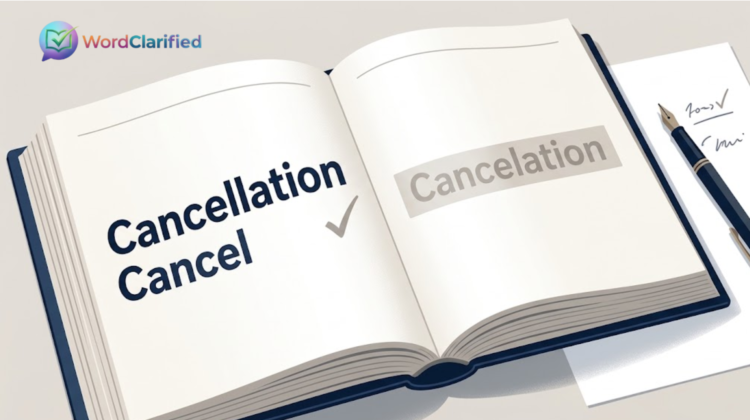
Cancellation and cancelation describe the same thing, but one version is used much more often.
Most readers will encounter cancellation more frequently. Cancelation is also accepted, but it is used far less often.
For school assignments, workplace writing, and general American English, cancellation is the better choice.Cancellation vs Cancelation: What Is the Difference
Cancellation vs Cancelation: What Is the Difference?
What sets the two forms apart is their spelling, not their meaning.
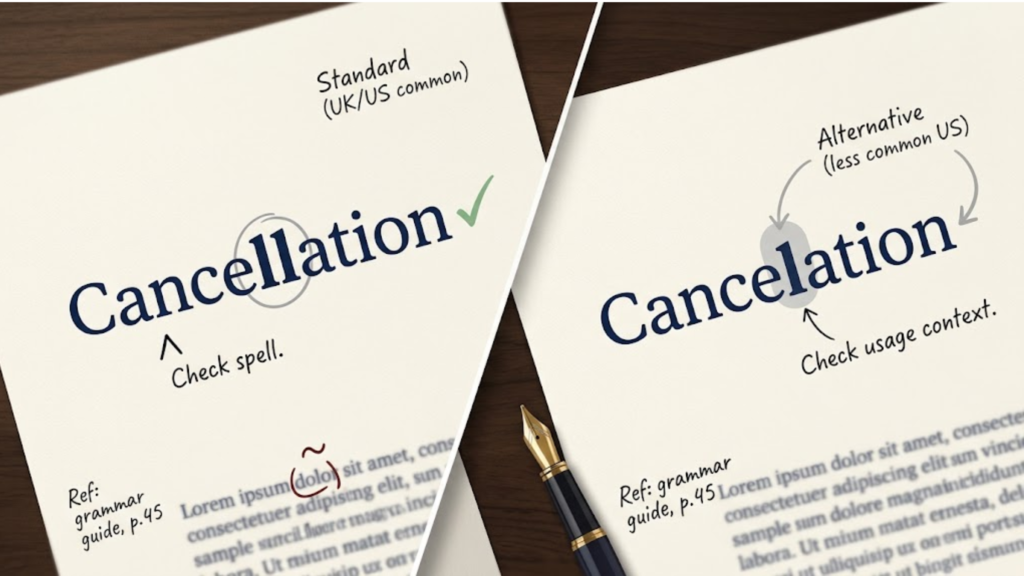
- Cancellation — the usual spelling
- Cancelation — a less common accepted variant
Both forms describe the act of calling something off.
For example:
The flight cancellation caused problems for several passengers.
You could also write:
The flight cancelation caused problems for several passengers.
The meaning does not change. The first version will look more familiar to a typical reader.
See Also: Pick Up or Pickup: Which One Is Correct?
Is “Cancellation” Correct?
Yes. Cancellation is the usual spelling of the noun.
This form appears in informal messages as well as more formal documents. It works for canceled classes, flights, appointments, events, orders, and subscriptions.
For example:
We received a cancellation notice this morning.
The school announced the cancellation of Friday’s class.
I requested the cancellation of my subscription.
When you are not sure which form to write, go with cancellation.
Is “Cancelation” Correct?
Yes, cancelation is a recognized spelling.
It occurs much less often than cancellation. Since cancellation appears more often in everyday writing, it is usually the safer option.
For school assignments and professional messages, cancellation is generally the preferred form.
Switching between these spellings does not change what the sentence means.
Example
Less common:
The event cancelation was announced yesterday.
More common:
The event cancellation was announced yesterday.
Both sentences express the same idea.
See Alos: Arose vs Arisen: What’s the Difference?
Why Does “Cancellation” Have Two Ls?
The noun follows its own established spelling pattern based on cancel.
The usual noun form is cancellation, with two Ls.
This can seem confusing because American English commonly uses canceled and canceling with one L.
Compare these forms:
| Word | Common American English spelling |
| Verb | cancel |
| Past tense | canceled |
| -ing form | canceling |
| Noun | cancellation |
The spelling changes depending on the form of the word.
So, seeing canceled with one L does not mean the noun should be spelled cancelation.
Cancellation in American English
American English usually spells the past tense as canceled and the -ing form as canceling.
For example:
The teacher canceled the class.
The airline is canceling several flights.
But when the word works as a noun, the usual spelling is:
The flight cancellation surprised everyone.
British English commonly uses cancelled and cancelling, with two Ls. The noun cancellation is also widely used.
Here is the pattern:
| Form | American English | British English |
| Verb | cancel | cancel |
| Past tense | canceled | cancelled |
| -ing form | canceling | cancelling |
| Noun | cancellation | cancellation |
So cancellation is not a British-only spelling. American writers use it too.
Examples of “Cancellation”
The sentences below give a few everyday examples of cancellation.
Class cancellation
The school sent an email about the class cancellation.
Flight cancellation
The airline canceled several flights because of bad weather.
Appointment cancellation
I called the office about my appointment cancellation.
Event cancellation
The event cancellation disappointed many people who had bought tickets.
Subscription cancellation
You can request a subscription cancellation through your account.
Order cancellation
The store confirmed my order cancellation by email.
In each example, cancellation functions as a noun.
Cancellation vs Cancelation vs Canceled
These forms come from the same word, but each has a different grammatical use.
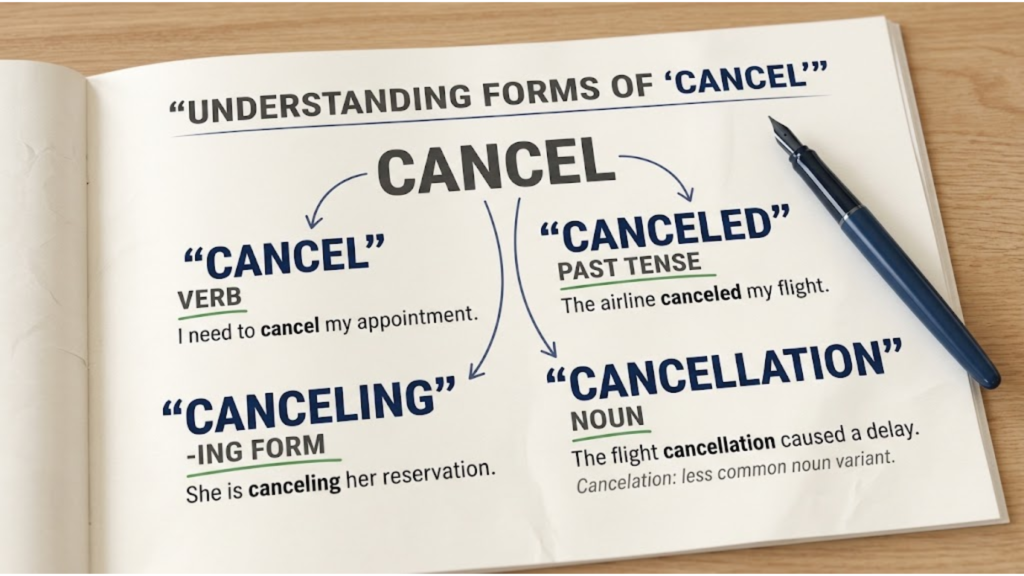
Cancel is a verb:
I need to cancel my appointment.
Canceled is the past tense and past participle commonly used in American English:
The airline canceled my flight.
Canceling is the standard -ing form commonly used in American English:
She is canceling her reservation.
Cancellation is a noun:
The flight cancellation caused a delay.
Cancelation can also serve as the noun, although writers use it much less often.
Look at the word’s function in the sentence before choosing its form.
If you are describing the action, you may need cancel, canceled, or canceling.
If you are naming the action or its result, cancellation is the usual noun form.
Common Mistakes
Mistake 1: Assuming “cancelation” is always wrong
Calling cancelation completely wrong would be misleading.These forms come from the same word, but each has a different grammatical use.
The spelling is recognized, but cancellation remains the far more common choice.
If you want the version that will seem most familiar, use cancellation.
Mistake 2: Writing “cancelled” in American English without a reason
Cancelled is common in British English, while American English usually uses canceled.
For example:
American English:
The teacher canceled the meeting.
British English:
The teacher cancelled the meeting.
The noun remains:
The meeting cancellation was unexpected.
Mistake 3: Using “cancelation” because “canceled” has one L
The one-L spelling in canceled does not determine how the noun is spelled.
American English commonly uses:
canceled
but:
cancellation
These forms follow different spelling patterns.
Mistake 4: Giving different meanings to the two noun forms
Cancellation and cancelation represent the same noun and carry the same meaning.
What separates them is mainly their frequency of use.
See Also: Skillset or Skill Set: What’s the Difference?
Which Spelling Should Students Use?
Students should generally use cancellation.
It is the more familiar spelling for essays, assignments, emails, and other school writing.
For example:
The cancellation of the school event affected several students.
If your teacher or school follows a particular style guide, follow its spelling preferences.
Which Spelling Is Better for Work?
For workplace writing, cancellation is usually the better choice.
You might use it in emails, notices, schedules, customer messages, or internal documents.
For example:
We apologize for the cancellation of your appointment.
Or:
Please get in touch with us if you need to request a cancellation.
Cancelation is not automatically wrong, but cancellation will be more familiar to most readers.
Quick Answer: Cancellation or Cancelation?
Cancellation is the spelling most readers are familiar with, so it is the usual choice for writers.
Cancelation is recognized as well, though it is considerably less common.
Both forms have the same meaning.
A simple rule is:
Cancellation = usual spelling
Cancelation = less common accepted variant
For American English, remember this pattern:
- cancel
- canceled
- canceling
- cancellation
Frequently Asked Questions
Is “cancellation” or “cancelation” correct?
Both spellings are accepted, but cancellation is the one you will encounter more often. Cancelation is used less frequently.
Is “cancelation” a real word?
Yes. Cancelation is an accepted noun spelling. Still, cancellation is the version most writers use.
Why does “cancellation” have two Ls?
The noun is normally spelled cancellation. The spelling does not simply copy the American forms canceled and canceling.
Is “canceled” or “cancelled” correct?
In American English, canceled is the usual form; British English commonly uses cancelled.
Is “cancellation” American or British?
Cancellation appears in both American and British English. American English uses it as the standard noun form as well.
Does cancellation have one L or two?
Cancellation has two Ls.
Can I use “cancelation” in an essay?
Yes, but cancellation is the better choice for most essays and academic writing because it is much more common.
Final Answer
Cancellation is the spelling that will usually serve you best.
Cancelation is valid too, but you will see it much less often. Both forms have the same meaning.
For American English, remember:
- cancel
- canceled
- canceling
- cancellation
So, if you are writing an essay, school assignment, email, or professional message, cancellation is the spelling to choose.

[…] See Also: Cancellation vs Cancelation: The Easy Way to Get It Right […]