
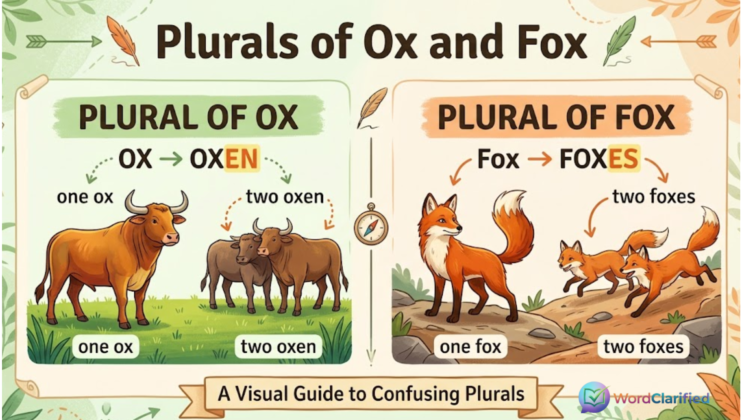
The plural of ox is oxen, while the plural of fox is foxes.
These two words look similar because both end in -x, but they do not form their plurals in the same way.
- one ox → two oxen
- one fox → two foxes
For English learners, this difference can be confusing. Why does fox take -es, while ox changes to oxen*? The answer comes down to the history of the two words and the way modern English forms plurals.
Plural of Ox
The plural of ox is oxen.
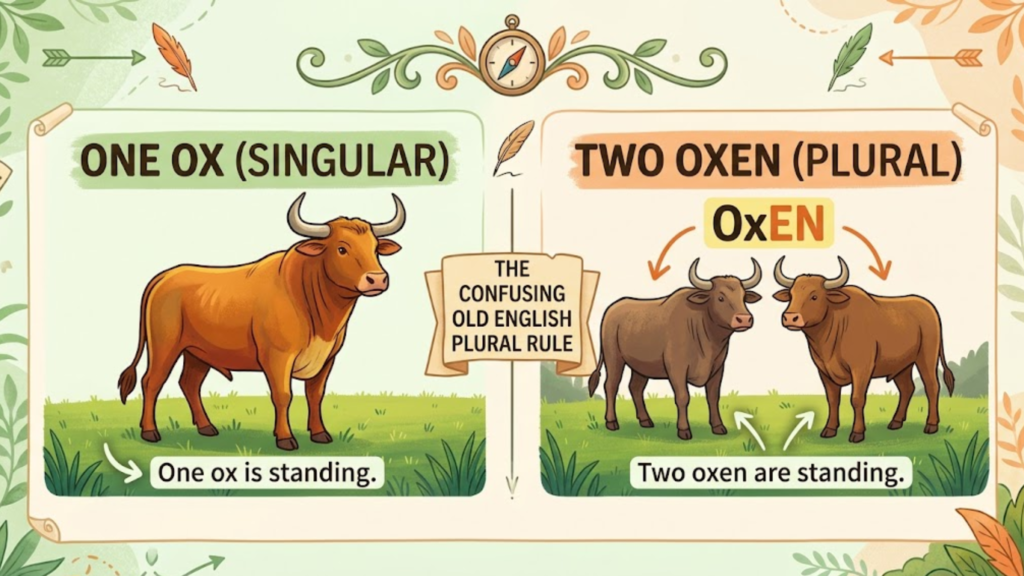
One ox is standing in the field.
Two oxen are standing in the field.
Oxen is an irregular plural. It does not follow the usual rule of adding -s or -es.
It is also important to remember that oxen is already plural. You should not add another ending.
Correct: The farmer has five oxen.
Incorrect: The farmer has five oxens.
When talking about one animal, use ox:
The ox is pulling the cart.
When talking about more than one, use oxen:
The oxen are pulling the cart.
Plural of Fox
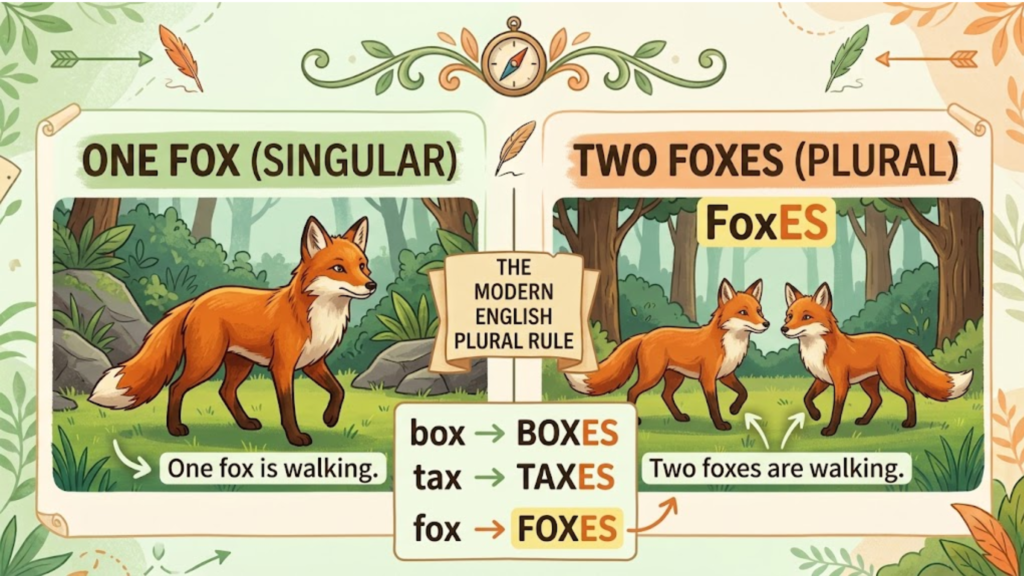
The plural of fox is foxes.
We saw one fox near the woods.
We saw two foxes near the woods.
Unlike ox, fox follows a common modern English plural pattern. Words ending in -x normally take -es.
For example:
- box → boxes
- tax → taxes
- mix → mixes
- fix → fixes
- fox → foxes
So you can form the plural naturally:
fox + es = foxes
You may also see the same -es pattern with words ending in other sounds:
- bus → buses
- dish → dishes
- watch → watches
- quiz → quizzes
Why Is “Oxen” Different?
The unusual plural oxen comes from an older form of English.
Old English had several ways to form plural nouns. One of those older patterns used an -an ending. The Old English word for ox was oxa, and its plural was oxan.
As English changed over time, that old plural form changed too. Oxan eventually developed into the modern form oxen.
The regular -s plural became much more common in English, but oxen survived.
That is why modern English has:
ox → oxen
rather than the expected:
ox → oxes
You do not need to learn Old English to use the word correctly. The useful point for modern English is simple: ox has an irregular plural, and that plural is oxen.
See Also: Cancellation vs Cancelation: The Easy Way to Get It Right
Why Isn’t the Plural of Fox “Foxen”?
It is easy to make this mistake after learning that ox becomes oxen.
You might think:
ox → oxen
fox → foxen
But foxen is not the standard plural of fox.
The correct form is:
fox → foxes
The -en ending is not a general plural ending in modern English. It survives in a small number of older irregular forms, so you cannot add it to any noun you choose.
For example:
- box → boxes, not boxen
- book → books, not booken
- dog → dogs, not dogen
- fox → foxes, not foxen
If you are unsure about a new word, do not assume that -en will work just because you have seen it in oxen.
Is “Oxen” Singular or Plural?
Oxen is plural.
This can be confusing because many English plurals end in -s. Oxen does not, but it still refers to more than one animal.
Compare these sentences:
One ox is in the field.
Two oxen are in the field.
The verb also gives you a useful clue. We use is with the singular ox and are with the plural oxen.
Do not write:
One oxen is in the field.
Write:
One ox is in the field.
And when there is more than one:
Several oxen are in the field.
A simple memory trick is:
ox = one
oxen = more than one
Other English Words With Irregular Plurals
Oxen is not the only English plural that looks different from the singular.
You may already know some of these:
- child → children
- man → men
- woman → women
- foot → feet
- tooth → teeth
- mouse → mice
- goose → geese
These plurals do not simply add -s or -es.
Some involve a change inside the word, such as:
foot → feet
Others use an older plural ending, as in:
ox → oxen
English has kept many of these older forms even though regular -s and -es plurals are now much more common.
For learners, this means that some plurals need to be learned as individual vocabulary items. There is no modern rule that lets you predict every irregular plural.
See Also: Hoodie or Hoody: The Clear Answer on Which Spelling Is Correct
Common Mistakes With Ox and Fox
“Oxes”
Oxes may seem logical because many words ending in -x take -es.
For standard modern English, however, use oxen.
Correct: The farmer owns four oxen.
“Foxen”
The plural of fox is foxes, not foxen.
Correct: We saw two foxes in the forest.
“Oxens”
Oxen is already plural, so it does not need another plural ending.
Correct: The oxen are working in the field.
Using “oxen” for one animal
Remember that oxen refers to more than one ox.
Correct: One ox is near the barn.
Correct: Two oxen are near the barn.
This distinction is especially useful when choosing the right verb.
A Simple Way to Remember Ox and Fox
You can remember the two words as separate patterns:
ox → oxen
fox → foxes
For fox, connect it with another familiar -x word:
box → boxes
fox → foxes
That gives you a useful pattern.
For ox, there is no similar modern spelling rule. Treat oxen as an irregular plural and learn it with the singular form.
When studying vocabulary, it can help to learn irregular nouns together with their plurals:
ox — oxen
child — children
mouse — mice
tooth — teeth
This saves you from having to work out the plural later.
Test Yourself
Choose the correct answer for each sentence.
1. The farmer bought two ______.
- A. oxes
- B. oxen
Answer: B. oxen
2. We saw three ______ crossing the road.
- A. foxes
- B. foxen
Answer: A. foxes
3. Several ______ were standing near the barn.
- A. oxen
- B. oxens
Answer: A. oxen
4. The photographer took pictures of two ______.
- A. foxen
- B. foxes
Answer: B. foxes
5. Which sentence is correct?
- A. One oxen is in the field.
- B. One ox is in the field.
Answer: B. One ox is in the field.
6. Which sentence is correct?
- A. The two oxen are pulling the cart.
- B. The two oxes are pulling the cart.
Answer: A. The two oxen are pulling the cart.
See Also: Cacoon or Cocoon: The Ultimate Guide to the Correct Spelling
Plurals of Ox and Fox: Quick Answer
If you only need the answer, remember these two forms:
| Singular | Plural |
| ox | oxen |
| fox | foxes |
Oxen is the irregular plural of ox. It comes from an older English plural pattern that has survived into modern English.
Foxes is the regular plural of fox. Like other nouns ending in -x, it normally takes -es.
So:
one ox → two oxen
one fox → two foxes
FAQs
1. What is the plural of ox?
The plural of ox is oxen. For example, “The farmer has three oxen.”
2. What is the plural of fox?
The plural of fox is foxes. For example, “Two foxes were walking through the woods.”
3. Is “oxes” a correct plural?
Oxen is the standard plural in modern English. Oxes is not the usual form.
4. Is “foxen” the plural of fox?
No. The correct plural is foxes. Foxen is not the standard modern English form.
5. Is oxen singular or plural?
Oxen is plural. The singular is ox. For example, “One ox is in the field” and “Two oxen are in the field.”
Conclusion
The plurals of ox and fox are easy to mix up, but the difference is simple to remember. The plural of ox is oxen, while the plural of fox is foxes.
Oxen is an irregular plural that comes from an older English form. Foxes follows the common modern pattern for nouns ending in -x.
So keep these two forms in mind:
one ox → two oxen
one fox → two foxes
Once you remember this difference, you can avoid common mistakes such as oxes, foxen, and oxens.

[…] See Also: Plurals of Ox and Fox: Get It Right […]