
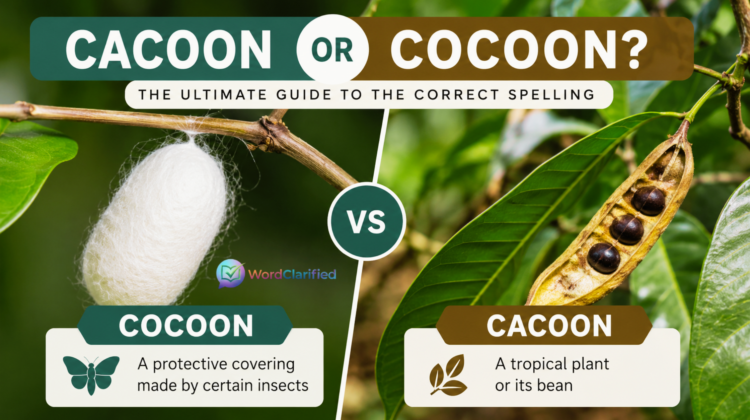
When you mean the covering that certain insects make during development, cocoon is the spelling you want.
Cacoon is a real word too, but it has a completely different meaning. It names a tropical plant and its bean. For writing about insect development or a moth’s covering, cocoon is the correct choice.
The two words look almost identical, which makes them easy to mix up. Here is how to tell them apart.
Cocoon Is the Correct Word for an Insect Covering
Certain insects make a cocoon around themselves as they develop. Moths are commonly associated with cocoons.
For example:
The moth stayed protected inside its cocoon as it developed.
You might also write:
We spotted a small cocoon hanging from a branch.
For a school assignment about insects, use cocoon when you mean this type of covering.
The word can also be used in a broader, non-scientific sense. It may describe a place or situation that makes someone feel protected, comfortable, or separated from the outside world.
For example:
Her quiet room felt like a cocoon after a busy day.
Here, cocoon is being used figuratively to suggest comfort and protection rather than an insect covering.
What Does Cocoon Mean?
Cocoon usually functions as a noun, although it can also be used as a verb.
In its noun form, it names the protective case that some insects produce during development. A A cocoon is a protective covering that some insects produce during development.
For example:
The insect made its cocoon beneath the leaf.
The word also has a figurative meaning:
During the winter, the small cabin felt like a warm cocoon.
Here, the cabin is compared to a cocoon because it provides a sense of shelter and comfort.
As a verb, cocoon means to surround or protect someone or something. It can also describe staying in a private, comfortable space.
For example:
He cocooned himself in a blanket and settled down to read.
So, you may see cocoon used in science, everyday descriptions, and figurative writing.
Is Cacoon a Real Word?
Yes. Cacoon is a real English word.
This matters because calling cacoon an incorrect spelling in every case would be misleading. It has its own meaning and refers to a tropical plant or its bean.
The difference is simple:
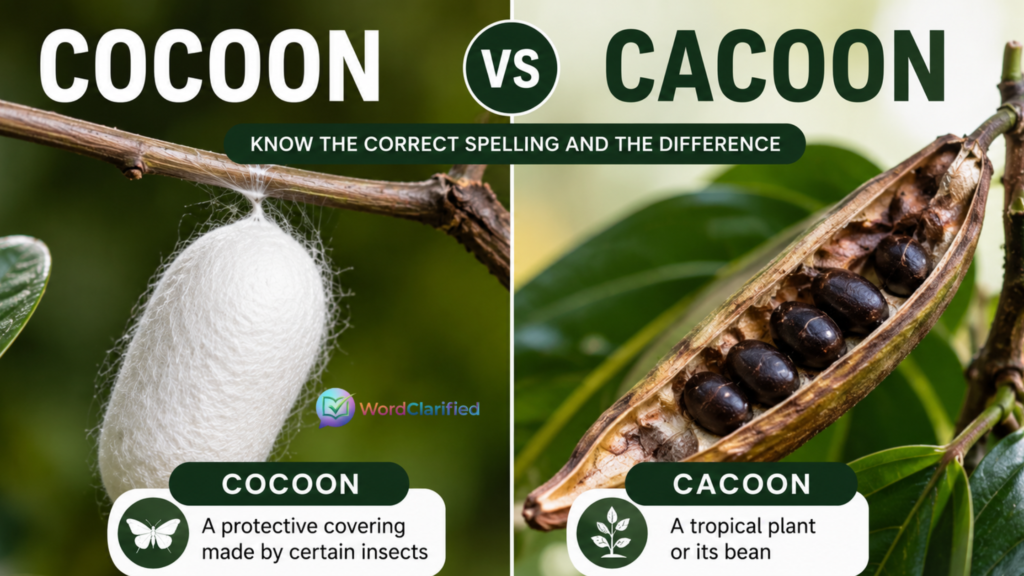
- Cocoon = the covering formed by certain insects
- Cacoon = a tropical plant or its bean
The second word is uncommon in everyday writing. Most students and general readers are much more likely to encounter cocoon.
So if you write:
The moth built a cacoon.
In that context, cacoon does not express the meaning you intended.
The correct sentence is:
The moth built a cocoon.
But if you are specifically writing about the plant or bean called a cacoon, then cacoon is the appropriate spelling.
Why Do People Confuse Cacoon and Cocoon?
The difference between the two words is only one letter, so the confusion is understandable.
Someone who has mostly heard the word cocoon spoken may not remember exactly how it is spelled. When writing it from memory, cacoon can seem like a reasonable choice.
Typing mistakes can cause the same problem. A misspelling can become familiar after you see or type it repeatedly.
A useful way to avoid the mix-up is to link each spelling to its meaning.
If you mean an insect covering, remember:
Cocoon = insect covering
That is the spelling you will normally need in schoolwork, general writing, and everyday discussion of insects.
Cocoon and Chrysalis: What’s the Difference?
Cocoon and chrysalis are sometimes treated as if they mean the same thing, but they do not.
Some insects produce a cocoon as part of their development. Moths are often associated with these coverings.
A chrysalis is the pupal stage of a butterfly.
The distinction is useful when you are writing about insect biology. Not every protective covering around a developing insect should be called a cocoon.
For example:
The moth developed inside a cocoon.
For a butterfly, you would normally say:
The butterfly developed inside a chrysalis.
Knowing this distinction can help you avoid a second common mistake when writing about insect life cycles.
See Also: Cancellation vs Cancelation: The Easy Way to Get It Right
How to Use Cocoon in a Sentence
Here are some examples showing different uses of cocoon.
For science:
The moth remained in its cocoon throughout its development.
For a nature description:
A small cocoon rested on the tree branch.
For a figurative meaning:
She created a quiet cocoon where she could study without distractions.
As a verb:
He cocooned himself in a blanket on the cold evening.
For school writing:
Some insects form cocoons during part of their life cycle.
The form of the word does not change between these uses, even though its meaning can be literal or figurative.
Common Mistakes With Cocoon
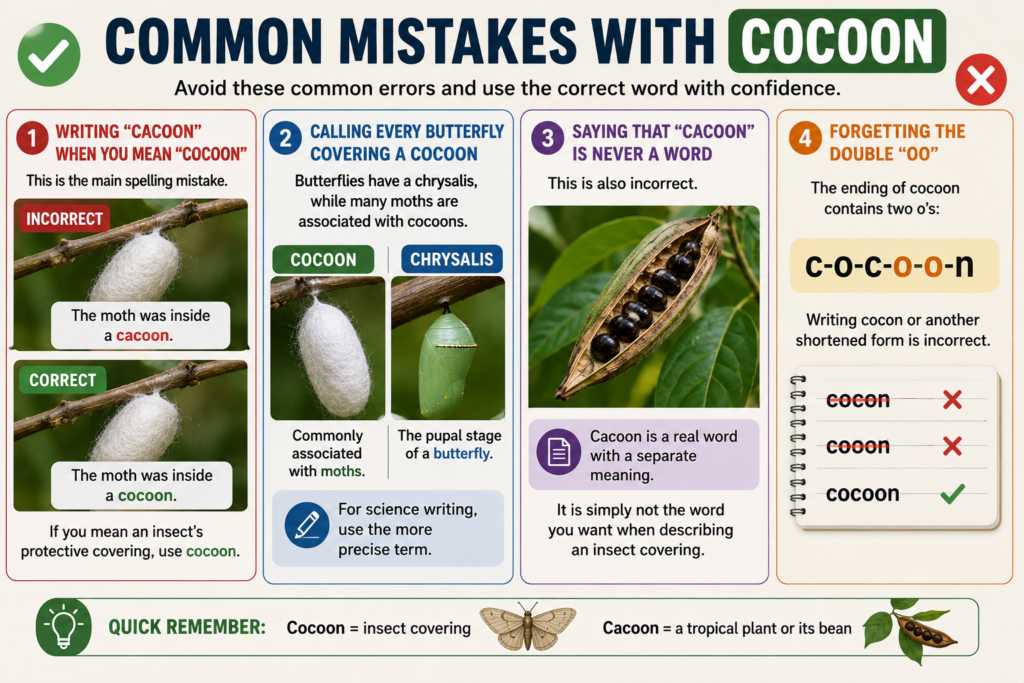
Writing “cacoon” when you mean “cocoon”
This is the main spelling mistake.
Incorrect:
The moth was inside a cacoon.
Correct:
The moth was inside a cocoon.
If you mean an insect’s protective covering, use cocoon.
Calling every butterfly covering a cocoon
Butterflies have a chrysalis, while many moths are associated with cocoons.
If you are writing a science assignment, using the more precise term is better.
Saying that “cacoon” is never a word
This is also incorrect.
Cacoon is a real word with a separate meaning. It is simply not the word you want when describing an insect covering.
Forgetting the double “oo”
The ending of cocoon contains two o’s:
c-o-c-o-o-n
Writing cocon or another shortened form is incorrect.
An Easy Way to Remember the Spelling
If you often confuse the two spellings, break cocoon into two parts:
co + coon = cocoon
You can then connect the word with its most familiar meaning:
The moth is inside a cocoon.
Using the word in a sentence can make the spelling easier to remember than trying to memorize the letters alone.
Cacoon vs. Cocoon: Quick Comparison
| Word | Meaning | Example |
| Cocoon | A protective covering made by certain insects | The moth formed a cocoon. |
| Cacoon | A tropical plant or its bean | The article discussed the cacoon plant. |
For most spelling questions, the key point is simple: cocoon is the word for the insect covering.
See Also: Pick Up or Pickup: Which One Is Correct?
Frequently Asked Questions
Is “cacoon” a misspelling of “cocoon”?
It can be a misspelling if you intend to write cocoon, but cacoon is also a separate word. It refers to a tropical plant or its bean.
Which spelling should I use in school writing?
Use cocoon when you are writing about an insect’s protective covering. If your subject is the plant or bean called a cacoon, use cacoon.
Do butterflies make cocoons?
Butterflies develop in a chrysalis. Cocoons are associated with certain other insects, including many moths.
Are a cocoon and a chrysalis the same thing?
No. A cocoon is a protective covering produced by certain insects, while a chrysalis is the pupal form of a butterfly.
Can “cocoon” be used as a verb?
Yes. You can use cocoon as a verb when describing someone or something being surrounded or protected. For example:
She cocooned herself in a warm blanket.
Is “cacoon” ever correct?
Yes. Cacoon is correct when you are referring to the tropical plant or its bean. It is not the spelling to use for an insect covering.
Final Answer
If you mean the protective covering associated with certain insects, use cocoon.
Cocoon → insect covering
Cacoon → a tropical plant or its bean
So, for a sentence about a moth, write:
The moth formed a cocoon.
That is the spelling you should choose for this meaning.

[…] See Also: Cacoon or Cocoon: The Ultimate Guide to the Correct Spelling […]