
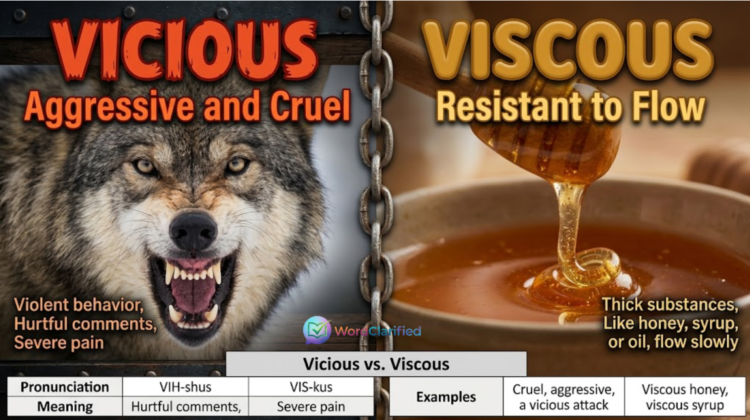
Vicious and viscous look almost identical, but they have very different meanings.
Vicious describes something cruel, violent, aggressive, or harmful. Viscous describes a substance that resists flowing easily.
For example, an attack can be vicious, while honey can be viscous.
Because the spelling and pronunciation are similar, English learners often mix them up. The easiest way to choose the right word is to look at what you are describing.
Vicious vs. Viscous at a Glance
| Word | Meaning | Common use | Example |
| Vicious | Cruel, violent, aggressive, or harmful | Behavior, attacks, words, animals, situations | The dog gave a vicious growl. |
| Viscous | Resistant to flowing easily | Liquids and other substances | The syrup was thick and viscous. |
A related word is viscosity, which refers to a substance’s resistance to flow.
What Does “Vicious” Mean?
Vicious is an adjective that describes something cruel, violent, aggressive, or deliberately harmful.
It can describe physical behavior, hurtful language, or something especially severe or unpleasant.
Vicious can describe violent behavior
When a person or animal acts in a cruel or aggressive way, vicious may be the right word.
- The attacker launched a vicious assault.
- The animal became vicious when it felt threatened.
- The two dogs began fighting viciously.
- The guard dog gave a vicious growl.
In these examples, vicious suggests serious aggression, cruelty, or danger.
Vicious can describe hurtful words
The word does not only apply to physical violence. It can also describe comments, rumors, criticism, or other forms of harmful speech.
- She made a vicious comment about her classmate.
- A vicious rumor spread through the school.
- His criticism became increasingly vicious.
- The article included a vicious personal attack.
Here, the harm comes from words or behavior rather than physical force.
Vicious can mean very severe
Vicious can also describe something extremely unpleasant, intense, or severe.
- He woke up with a vicious headache.
- The town faced a vicious winter storm.
- She had a vicious stomach cramp.
- The team suffered a vicious defeat.
These uses do not necessarily involve physical violence. The word adds a strong negative sense to the description.
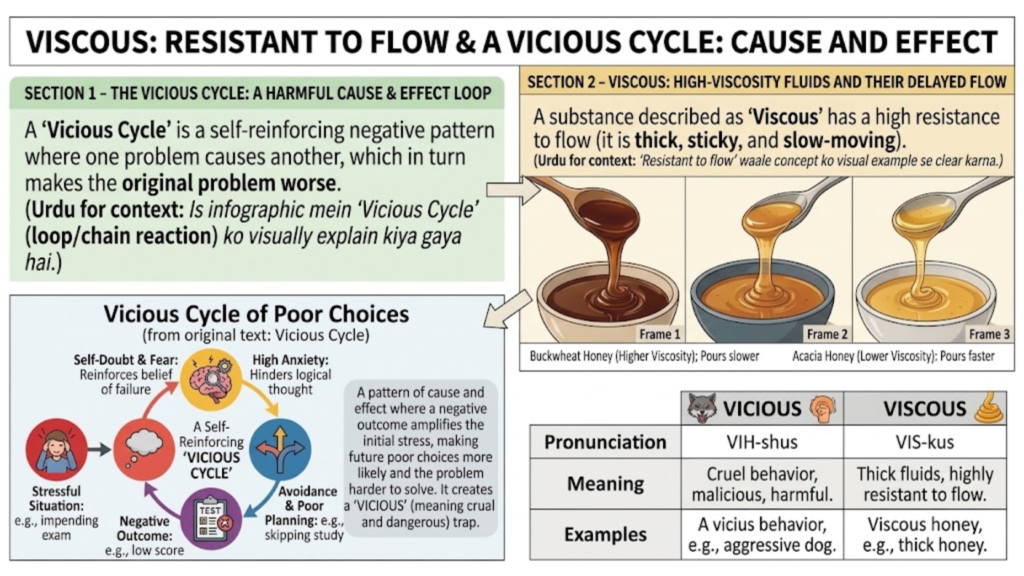
What is a vicious cycle?
You may also come across vicious cycle or vicious circle.
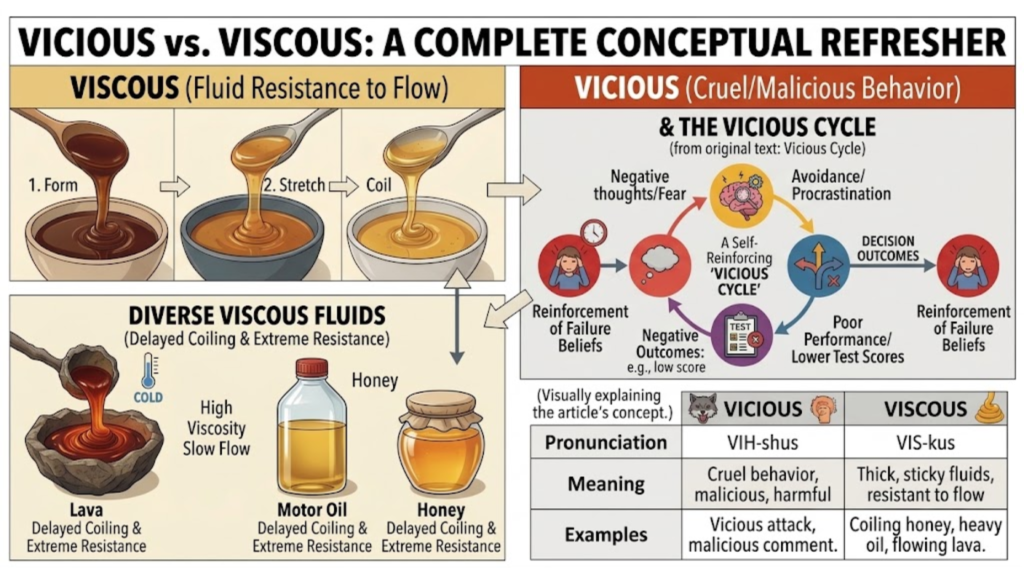
A vicious cycle is a situation where one problem causes another, and that new problem makes the first one worse.
For example, a student might fear that they will fail an exam. The stress makes studying harder, which can lead to poor preparation and even more worry.
That repeating pattern can become a vicious cycle.
What Does “Viscous” Mean?
Viscous describes a substance that does not flow easily.
In everyday English, a viscous substance is often described as thick or sticky. Honey, syrup, glue, and some oils are familiar examples.
- The honey was too viscous to pour quickly.
- The syrup was thick and viscous.
- The paint became more viscous as it dried.
- The machine uses a viscous oil for lubrication.
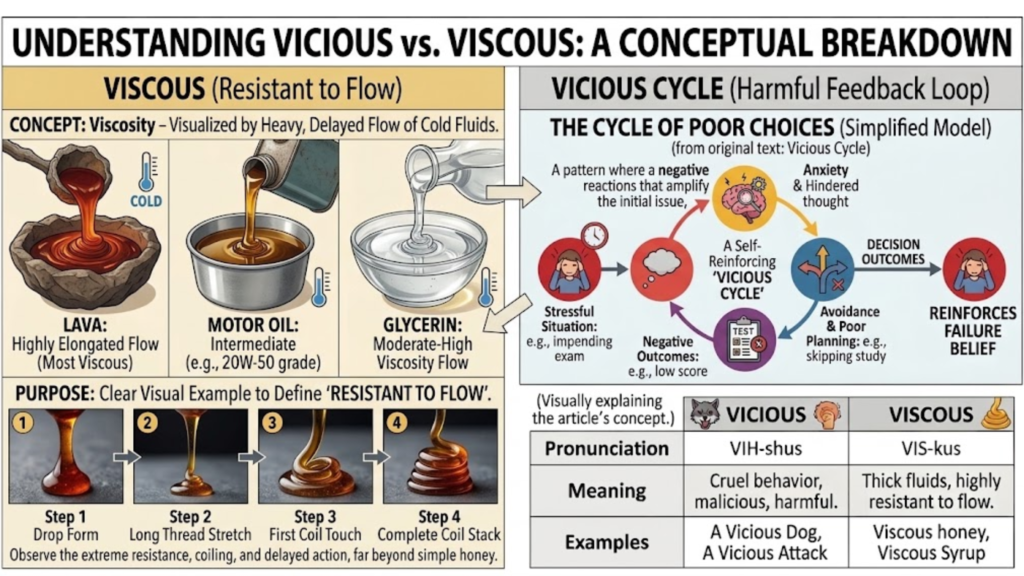
The more precise meaning relates to resistance to flow. A substance with higher viscosity generally flows less easily than one with lower viscosity.
What is viscosity?
Viscosity is the noun related to viscous. It describes how strongly a substance resists flowing.
For example:
Honey has a higher viscosity than water.
Water flows easily, while honey moves more slowly. Their different flow behavior is related to viscosity.
This connection gives you a useful way to remember the spelling: viscous → viscosity.
Why Are Vicious and Viscous So Easy to Mix Up?
These words are easy to confuse because their spellings are almost identical.
They also sound similar, and both are adjectives. You might use vicious to describe an attack and viscous to describe a liquid.
There is one more problem: both words are correctly spelled English words. A spellchecker may accept either one, even when you have chosen the wrong word for your sentence.
Context is what tells you which word you need.
If you are describing cruelty, aggression, or harm, choose vicious.
If you are describing how easily a substance flows, choose viscous.
Vicious vs. Viscous Pronunciation
The two words are similar in sound, but they are not homophones.
The key difference is in the middle:
- Vicious has a sh sound.
- Viscous has a sk sound.
You can hear the difference when you say the words aloud. This sound difference is also a useful clue when learning their spelling.
Common Mistakes With Vicious and Viscous
The following examples show how changing one letter can change the meaning completely.
Describing honey
Incorrect: The honey was vicious.
Correct: The honey was viscous.
Honey is a substance that can flow slowly, so viscous is the appropriate word.
Describing an attacker
Incorrect: The attacker was viscous.
Correct: The attacker was vicious.
The sentence describes aggressive or harmful behavior, so vicious is correct.
Describing oil
Incorrect: The oil was vicious.
Correct: The oil was viscous.
Here, the sentence concerns the oil’s physical flow, so viscous is the right choice.
Describing a cruel comment
Incorrect: She made a viscous comment.
Correct: She made a vicious comment.
The comment is described as cruel or hurtful. Vicious fits that meaning.
Describing an attack
Incorrect: It was a viscous attack.
Correct: It was a vicious attack.
An attack can be violent or cruel, so vicious is correct.
See Also: Plurals of Ox and Fox: Get It Right
How to Remember the Difference
Two simple word connections can help:
Vicious → violence
Viscous → viscosity
You can also use this short reminder:
Vicious can hurt; viscous can stick.
It is not a definition, but it can help you recall which spelling belongs to each meaning.
Vicious or Viscous? Choose by Context
When you are unsure, ask yourself what the word is describing.
Choose vicious for:
- cruelty
- violence
- aggression
- malicious behavior
- hurtful words
- severe or unpleasant conditions
- a harmful cycle
Choose viscous for:
- liquids
- thick or sticky substances
- resistance to flow
- physical properties related to how a substance moves
Compare these examples:
The snake launched a vicious attack.
The sentence describes aggressive behavior, so vicious is correct.
The liquid was too viscous to move through the narrow tube.
The sentence describes resistance to flow, so viscous is correct.
The journalist faced vicious criticism.
The criticism was harsh and hurtful, so vicious works.
The laboratory tested a highly viscous liquid.
The sentence describes a liquid’s physical behavior, so viscous is correct.
Vicious and Viscous in Real Sentences
Here are a few examples showing how these words work in different settings.
Everyday English
The stray dog became vicious when someone approached it.
Vicious describes the dog’s aggressive behavior.
The caramel was too viscous to spread easily.
Viscous describes how the caramel flows.
School and academic writing
The character becomes trapped in a vicious cycle of fear and poor decisions.
Here, vicious cycle describes a harmful pattern.
The experiment compared liquids with different levels of viscosity.
Viscosity is the noun used for resistance to flow.
Workplace English
The employee received vicious comments from an angry customer.
The comments were cruel or hostile.
The engineer selected a more viscous lubricant for the equipment.
The word describes the lubricant’s physical properties.
Science and technical writing
Viscous is common when discussing fluids and how they move.
The more viscous fluid moved more slowly through the pipe.
In technical use, viscous is more precise than simply saying a liquid is “thick.” Its key idea is resistance to flow.
Quick Practice Quiz
Choose vicious or viscous for each sentence.
- The attacker launched a ___ assault.
- The syrup was too ___ to pour quickly.
- The discussion became ___ after the disagreement.
- The scientist studied a highly ___ liquid.
- The animal became ___ when threatened.
Answers
- Vicious — The assault was violent or harmful.
- Viscous — The syrup resisted flowing easily.
- Vicious — The discussion became hostile and hurtful.
- Viscous — The sentence describes the physical behavior of a liquid.
- Vicious — The animal became aggressive and potentially dangerous.
You can also use the related noun viscosity:
The scientist measured the liquid’s viscosity.
See Also: Cacoon or Cocoon: The Ultimate Guide to the Correct Spelling
Vicious: Meaning, Synonyms, and Examples
The best synonym for vicious depends on the meaning you want.
For physical violence, brutal or savage may fit.
For cruel or hurtful behavior, malicious or spiteful may be more precise.
For an aggressive animal, ferocious can work in some contexts.
For calculated cruelty, ruthless may be a better choice.
These words have similar meanings in some situations, but you cannot use them in every sentence.
- A vicious attack — a cruel or violent attack
- A brutal attack — an extremely violent attack
- A malicious comment — a comment intended to hurt someone
- A ruthless decision — a decision made without concern for others
So, there is no single synonym that works in every sentence. Use the word that fits the meaning of the sentence.
FAQs
How are vicious and viscous different?
Vicious refers to cruel, violent, aggressive, or harmful behavior. Viscous describes a substance that does not flow easily and is often thick or sticky.
Is viscous the same as thick?
Not exactly. Viscous is often described as thick, but its more precise meaning relates to resistance to flow. Honey is a familiar example of a viscous substance.
How do you pronounce vicious and viscous?
Vicious has a sh sound in the middle, while viscous has a sk sound. They sound similar, but they are not homophones.
Is honey viscous or vicious?
Honey is viscous because it is thick and flows more slowly than water. Vicious would be the wrong word because it describes cruelty, aggression, or harm.
Is it a vicious attack or a viscous attack?
The correct phrase is vicious attack. An attack can be violent, cruel, or aggressive. Viscous describes a substance’s resistance to flow.
Final Thought
Vicious describes cruelty, aggression, harm, or something intensely unpleasant. Viscous describes how a substance flows.
Remember the two connections:
Vicious → violence
Viscous → viscosity
Once you know what each word means, it is easier to use the right one.

[…] See Also: Vicious or Viscous: What’s the Difference? […]