
Imagine you moved to a new country last month. The weather is different. The food is different. Even the way people talk to strangers on the street feels different. After a few weeks, you start to feel normal again. You got used to it.
English has three words for that process: acclimate, acclimatize, and acclimatise. They look almost the same, and they mean the same thing. So why does English need three versions of one word? Here’s the answer, in plain terms.
The Simple Truth First
All three words mean: to get used to a new place, climate, or situation.
There’s no hidden meaning in one spelling that’s missing from the others. If someone tells you “acclimatize” means something different from “acclimate,” that’s not correct. The only real differences are where each word is used and how it’s spelled.
Acclimate
This is the word most common in American English. Say it like this: ACK-luh-mate. You’ll hear it in US newspapers, workplaces, and everyday conversation.
Example: “My new coworker just moved here from Brazil. It’s taking her some time to acclimate to the cold winters.”
Notice the word “to” right after “acclimate.” That pattern almost always holds when you’re naming the thing someone is adjusting to. A lot of learners drop the “to” and say “acclimate the cold winters,” which sounds off to a native speaker.
Acclimatize
This word also works in American English, and it’s the standard spelling in British English too. Pronounce it: uh-KLY-muh-tize.
People often assume “acclimatize” is the formal, scientific version and “acclimate” is the casual one. That’s a common belief, not a strict rule — you’ll find “acclimatize” in relaxed conversation and “acclimate” in formal writing just as often. Either word is safe in American English. Just don’t switch between them halfway through the same piece of writing, since that looks inconsistent, like changing your handwriting mid-sentence.
“Example: ‘Before the tournament begins, the visiting team is arriving three days early — the city sits nearly two thousand meters up, and their coach doesn’t want anyone gasping for air in the final minutes of the match.’
See Also: Affective or Effective? Learn the Difference Easily
Acclimatise
Acclimatise isn’t a separate word with its own rules — it’s acclimatize spelled the British way. English has a pattern where American “-ize” endings become “-ise” endings in British, Australian, and most Commonwealth English. You’ve likely seen this before:
- organize → organise
- realize → realise
- recognize → recognise
Once you notice the pattern, “acclimatise” stops looking like a mystery word.
Example: “When Priya moved from Mumbai to Manchester, it took her a full season to acclimatise to the rain.”
If you’re taking a test that uses British spelling — IELTS, for example — use “acclimatise,” not “acclimatize” or “acclimate.” Mixing American and British spelling within one essay can cost you points, even though every word you chose is technically real.
Which One Should You Use?
- Studying American English, or writing for an American reader? Use “acclimate” or “acclimatize.” Both are correct — pick one and stay with it in that piece of writing.
- Studying British English, or preparing for IELTS? Use “acclimatise.”
- Not sure who’s reading? “Acclimatize” works in both American and British contexts, so it’s the safest middle choice.
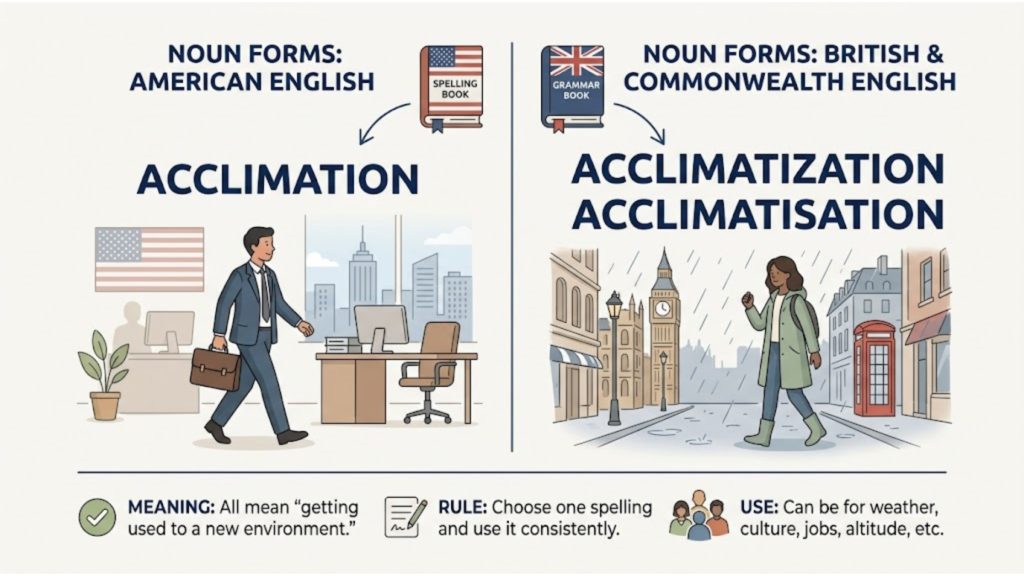
The noun forms follow the same split: “acclimate” pairs with “acclimation,” while “acclimatize” pairs with “acclimatization” (American) or “acclimatisation” (British). Using “acclimate” as your verb and then “acclimatization” as your noun in the same paragraph is a small mismatch — like wearing one brown shoe and one black shoe. It won’t confuse anyone, but a careful reader will notice.
A Mistake Many Learners Make
The word “climate” sits right inside all three verbs, so people sometimes assume they only apply to weather. They don’t. You can acclimate, acclimatize, or acclimatise to plenty of things that have nothing to do with weather:
- A new job: “It took him about a month to acclimatize to the fast pace of the office.”
- A new school: “The exchange student is still acclimating to the grading system here.”
- High altitude: “Climbers usually spend a few days acclimatizing before attempting the summit.”
- A new culture: “Refugee families often need extra support while they acclimatise to a completely new way of life.”
The meaning grew wider over time to cover any kind of adjustment, not just weather — which is fairly common in English; plenty of words start narrow and end up covering much more.
See Also: Re-sign or Resign? The Easy Way to Get It Right
One Word That’s Different: “Adapt”
Learners often confuse these three words with “adapt.” Adapt is broader — it can describe a short adjustment, but it also covers long-term or permanent change, like a species adapting over generations or a person reshaping their whole approach to a new life. Acclimate, acclimatize, and acclimatise usually describe something more temporary and physical: weather, altitude, time zones, a new environment. If someone is adjusting to a new city over a few weeks, these three words fit. If you’re describing evolution or a lifelong shift, “adapt” is the better choice.
FAQ
Do acclimate, acclimatize, and acclimatise mean different things? No. All three mean the same thing — to get used to a new place, climate, or situation. The difference is regional spelling, not meaning.
Which spelling should I use for IELTS or other British-English tests? Use “acclimatise.” Mixing it with “acclimate” or “acclimatize” in the same essay can look inconsistent to an examiner, even though none of the words are wrong on their own.
Is “acclimatize” more formal or scientific than “acclimate”? Not really. That’s a common assumption, but both show up in casual and formal writing in American English. Pick one and use it consistently rather than choosing based on formality.
Can these words be used for anything besides weather? Yes. They cover any adjustment — a new job, a new school, a new culture, or high altitude — not just climate.
What are the noun forms? “Acclimate” goes with “acclimation.” “Acclimatize” goes with “acclimatization” (American spelling) or “acclimatisation” (British spelling).
Is “acclimate” or “acclimatize” more common in the US? Both are used in American English. There isn’t a strict rule about when to use one over the other — consistency within a single piece of writing matters more than the individual choice.
What’s the difference between “acclimate” and “adapt”? “Acclimate” (and its variants) usually describes a shorter, more physical adjustment — to weather, altitude, or a new environment. “Adapt” is broader and can describe long-term or permanent change, including evolutionary change.
Conclusion
There’s no wrong choice among these three words — only a choice that fits your audience. Use “acclimate” or “acclimatize” for American English, “acclimatise” for British English, and stay consistent once you’ve picked one. Remember that “to” almost always follows the verb, and that these words apply to far more than just weather. Once that clicks, you’ll use all three as naturally as a native speaker does — mostly because native speakers don’t think about this choice much either. They use whichever version sounds normal where they grew up.

[…] See Also: Acclimate vs Acclimatize vs Acclimatise: Which One Should You Use? […]