

Afterward and afterwards are two correct forms of the same word. Both refer to something that happens later, usually following another event.
The difference is mainly linked to regional English. Afterward is used more often in American English, while afterwards is especially common in British English.
Afterward vs Afterwards: The Quick Answer
Both words tell us that one thing happens after another.
For example:
I finished the meeting and called my manager afterward.
The same idea can be written with afterwards:
I finished the meeting and called my manager afterwards.
There is no change in meaning between these two sentences. The spelling is the only noticeable difference.
American English often favors afterward, while British English commonly uses afterwards. However, neither form is wrong.
What Does “Afterward” Mean?
Afterward means at a time following an event or action.
For example:
Lena finished her exam and went to the café afterward.
Here, afterward tells us that Lena went to the café after finishing her exam.
The word can appear at the end of a sentence:
We discussed the issue afterward.
It can also appear at the beginning:
Afterward, we went back to work.
Its position may change, but its meaning stays the same.
What Does “Afterwards” Mean?
Afterwards expresses the same idea as afterward. It points to something that happens later.
For example:
Tom finished his appointment and went home afterwards.
You can also place afterwards at the beginning of the sentence:
Afterwards, Tom went home.
The two examples show the events in the same order.
The choice between the two forms is often based on the variety of English you use.
Afterward or Afterwards: American vs British English
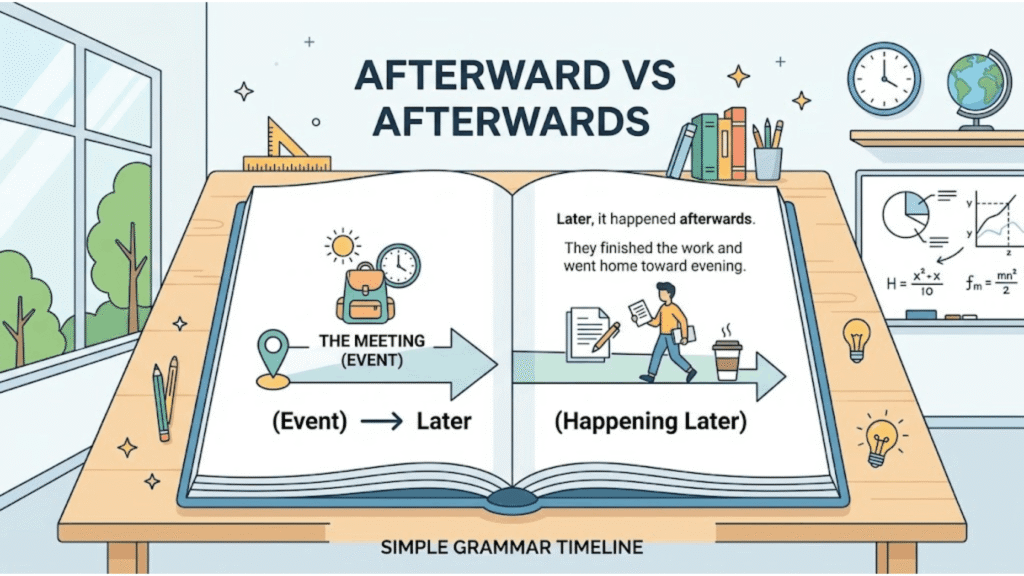
The two forms are used in both American and British English, but their frequency differs.
Afterward is more common in American English.
Afterwards is more common in British English.
For example:
I checked the results afterward.
Or:
I checked the results afterwards.
Both versions are grammatically correct.
American speakers and writers can use afterwards, and British speakers and writers can use afterward. The difference is a matter of common usage rather than correctness.
If you are writing for a particular audience, following the variety of English you normally use can help keep your writing consistent.
How to Use Afterward and Afterwards
Afterward and afterwards are adverbs. They tell the reader that an action takes place following something else.
Look at these examples:
She finished the presentation and answered questions afterward.
We toured the gallery and grabbed lunch afterwards.
In both cases, the second action happens after the first one.
You can also use these words with soon or shortly:
The mistake was discovered soon afterward.
He apologized shortly afterwards.
These phrases show that the next event happened after only a short period.
Both forms can also refer to something that will happen later:
I’ll send the documents afterward.
We can talk about the plan afterwards.
The earlier event gives the reader the context needed to understand what happens next.
See Also: Acclimate vs Acclimatize vs Acclimatise: Which One Should You Use?
After vs Afterward vs Afterwards
After, afterward, and afterwards are related words, but they do not have the same grammatical use.
After can be followed by a noun:
We left after lunch.
It can also introduce a clause:
We left after the concert ended.
Afterward and afterwards, however, function as adverbs:
We had lunch and left afterward.
We had lunch and left afterwards.
You cannot place afterward directly before a noun in the same way as after.
For example:
We left after lunch.
Not:
We left afterward lunch.
When the earlier event has already been mentioned, afterward or afterwards can refer back to it:
We had lunch at noon. We left afterward.
Afterward vs Later
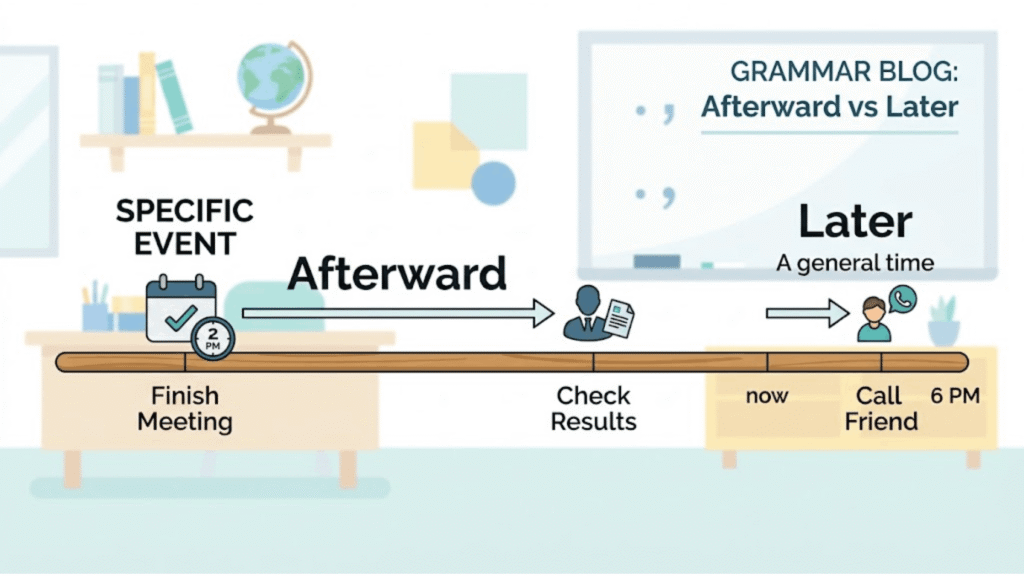
Later and afterward can both refer to a time that comes after the present or another event. However, they are not always interchangeable.
Later can refer to a future time without saying what event comes first:
I’ll call you later.
The sentence does not tell us what the call will follow.
Afterward usually refers back to a specific event:
I’ll finish the report and call you afterward.
Here, afterward means the call will take place after the report is finished.
This context helps show the difference between the two words.
See Also: i.e. or e.g.: How to Use Them Correctly
Common Mistakes With Afterward and Afterwards
Thinking “Afterwards” Is Incorrect
The extra s in afterwards does not make the word wrong.
For example:
We went for coffee afterwards.
This is a standard and correct sentence.
Assuming the Two Forms Have Different Meanings
Afterward and afterwards generally express the same idea.
She left afterward.
She left afterwards.
Both sentences say that she left after something that had already happened.
Treating One Form as More Formal
The difference between these words is not mainly about formal and informal writing.
It is more closely connected with regional usage. Afterward is common in American English, while afterwards is common in British English.
Mixing Up “Afterward” and “Afterword”
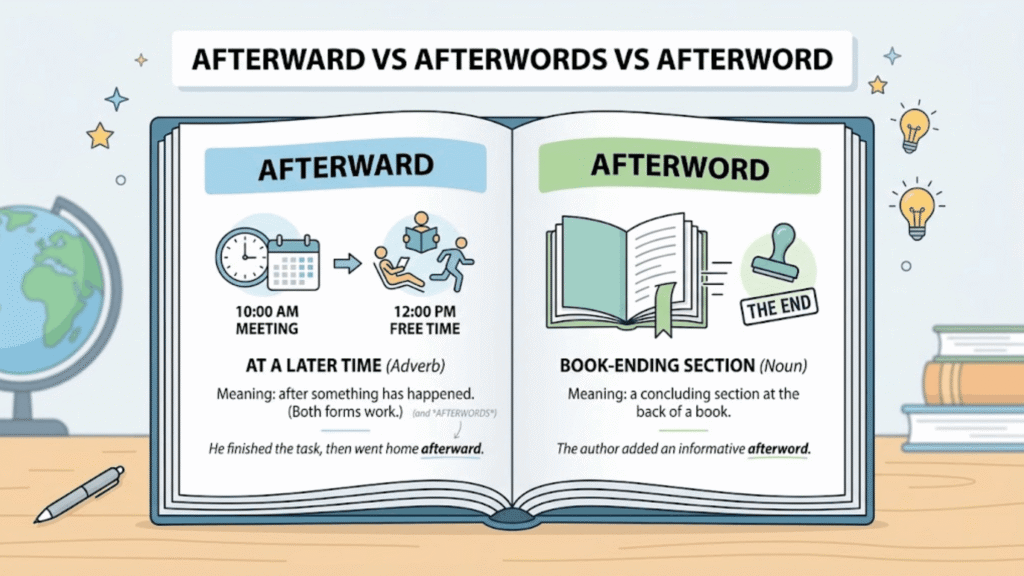
Afterward and afterword look similar, but they have completely different meanings.
Afterward refers to a later time.
An afterword is a section that appears at the end of a book.
For example:
The writer explained the history of the novel in the afterword.
We discussed the novel afterward.
So, use afterward or afterwards when you mean “later.” Use afterword when you mean the section at the end of a book.
See Also: Is It There or Their? The Correct Spelling Explained
Which One Should You Use?
There is no single correct choice between afterward and afterwards. Both are accepted forms.
If you normally write American English, afterward will usually be the more familiar choice.
If you normally write British English, afterwards will fit naturally with that variety.
Readers will understand either form, so you do not need to worry about choosing the “wrong” one. Keeping your spelling consistent with the variety of English you use is a simple approach.
More Examples
Here are a few examples showing how both forms work:
- We cleaned the kitchen and watched television afterward.
- Sarah sent me a message afterwards.
- Afterward, they returned to the hotel.
- Afterwards, he went back to his desk.
- I noticed the error soon afterward.
- She spoke to her teacher shortly afterwards.
- We’ll discuss the results afterward.
- He checked his notes afterwards.
Final Thought
Afterward and afterwards have the same basic meaning. Both refer to something that happens following an earlier event.
The main distinction is regional usage. Afterward is more common in American English, while afterwards is especially common in British English.
Both forms are correct, so choose the one that matches the variety of English you normally write.

[…] For another British and American English spelling question, see Afterward vs. Afterwards. […]