
Have you ever stopped while writing because you were unsure whether to use i.e. or e.g.? The two abbreviations are easy to mix up because both add extra information to a sentence.
Their jobs are different, though.
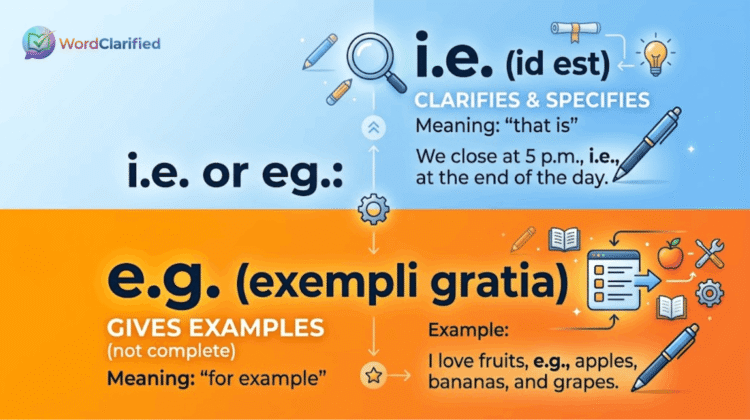
i.e. is used to explain or specify an idea.
e.g. is used to introduce examples.
A quick way to remember them is:
- i.e. = that is / in other words
- e.g. = for example
Look at the difference:
The office opens late on Friday, i.e., at 10 a.m.
Here, 10 a.m. tells us exactly what “late” means in this sentence.
Now consider:
We sell several hot drinks, e.g., coffee, tea, and hot chocolate.
The drinks named are only examples. There may be other drinks on the menu.
Once you understand this basic difference, choosing between i.e. and e.g. becomes much easier.
What Does i.e. Mean?
i.e. is short for the Latin expression id est. Its meaning is “that is.”
Writers use i.e. when they want to make a previous statement more precise. It can also introduce a restatement that helps the reader understand the intended meaning.
For example:
The payment must arrive before the deadline, i.e., by Friday at 5 p.m.
The words after i.e. give the exact deadline.
Here is another example:
Only one person can access the account, i.e., the account owner.
The second part identifies the person being discussed.
More Examples of i.e.
The museum is closed one day each week, i.e., Monday.
Please choose the final option, i.e., the one marked “Submit.”
She works in the UK capital, i.e., London.
In each case, the information after i.e. narrows down or explains the meaning of the statement before it.
A helpful test is to replace i.e. with “that is” or “in other words.” If the sentence still gives the meaning you intend, i.e. is likely suitable.
What Does e.g. Mean?
e.g. comes from the Latin expression exempli gratia. It means “for example.”
Use e.g. when you want to mention examples without suggesting that your list is complete.
For instance:
Several vegetables can be eaten raw, e.g., carrots and cucumbers.
Carrots and cucumbers are examples. This does not mean you can only eat these vegetables raw.
Another example:
You can review your English in different ways, e.g., by reading a short article or listening to a podcast.
The activities mentioned are two possible methods. Other methods are possible too.
More Examples of e.g.
Some animals, e.g., horses and cows, eat plants.
You can carry school supplies such as notebooks and folders, e.g., for your daily classes.
Several forms of transport, e.g., buses and trains, can take you into the city.
The main idea is simple: e.g. opens the door to examples.
i.e. vs. e.g.: The Main Difference
The easiest distinction is this:
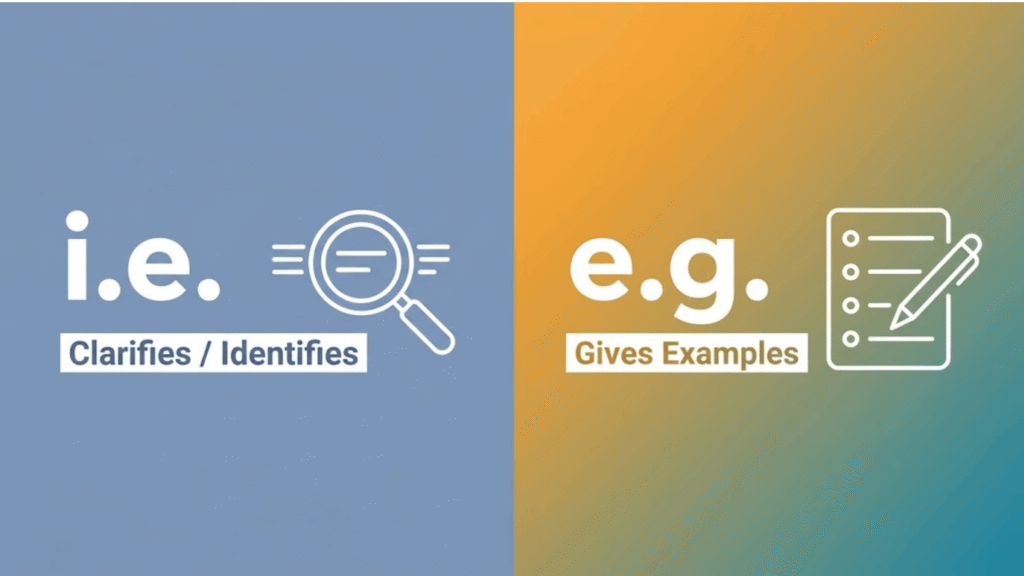
i.e. clarifies.
e.g. gives examples.
Consider these two sentences:
I need a form of photo identification, i.e., my passport.
The passport is the specific document the writer means.
Now change the abbreviation:
I need a form of photo identification, e.g., a passport or driving licence.
Now the writer is mentioning possible examples. A passport is not the only option.
Here is another comparison:
She studies a science subject, e.g., biology.
Biology is one example of a science subject.
She studies the science subject required for her course, i.e., biology.
Here, biology identifies the particular subject being discussed.
This is the key difference to remember:
Use i.e. to tell the reader exactly what you mean.
Use e.g. to show the reader one or more examples.
See Also: Is It There or Their? The Correct Spelling Explained
How to Remember Which One to Use
You can remember the difference without knowing Latin.
Think of these two clues:
I → In other words → i.e.
E → Example → e.g.
There is another easy method. Say the full meaning in your head before choosing the abbreviation.
Suppose you write:
Some sports, ___, require special equipment.
If you mean “for example”, you need e.g.
Some sports, e.g., skiing and diving, require special equipment.
But if you are explaining exactly which sport you mean:
My favorite winter sport is the one I learned last year, i.e., skiing.
The substitution test can help you make the choice quickly.
Where Do i.e. and e.g. Appear in a Sentence?
Both abbreviations can be placed within a sentence.
For example:
Some students, e.g., those preparing for exams, prefer quiet study spaces.
The shop shuts before dinner, i.e., at 6 p.m.
They can also be placed inside parentheses:
You may need basic equipment (e.g., a notebook and pen).
She has one clear aim (i.e., to improve her writing).
Different style guides may have their own preferences about punctuation and placement. If you are writing for a school, company, journal, or publication with a style guide, follow that guide.
Should You Put a Comma After i.e. and e.g.?
Punctuation differs somewhat between American and British writing.
In American English, a comma after the abbreviation is common:
The lesson starts at noon, i.e., at 12 p.m.
Bring some stationery, e.g., paper and pens.
In British English, the comma is often left out:
The lesson starts at noon, i.e., at 12 p.m.
Bring some stationery, e.g., paper and pens.
Both patterns can be found in published English. The important point is to follow the style you are using consistently.
For readers using American English, i.e. and e.g. are familiar forms.
Do i.e. and e.g. Have Periods?
The usual written forms are:
- i.e.
- e.g.
The periods are part of the standard abbreviations.
When learning formal written English, avoid treating ie and eg as the normal forms.
You may encounter different conventions in some digital or informal settings, but i.e. and e.g. are the standard forms most learners should recognize.
Common Mistakes With i.e. and e.g.
Mistake 1: Using i.e. Before Examples
Imagine you want to say that you enjoy several outdoor activities.
This sentence may confuse:
I enjoy outdoor activities, i.e., hiking and cycling.
The wording can suggest that hiking and cycling are the specific activities meant.
If they are simply two examples from a larger group, write:
I enjoy outdoor activities, e.g., hiking and cycling.
The second sentence makes the intended meaning clearer.
Mistake 2: Using e.g. for a Specific Explanation
If you are identifying something specific, e.g. may give the wrong impression.
Compare:
The company has offices in several cities, e.g., New York and Chicago.
These are examples of cities where the company has offices.
Now:
The company moved its main office to the city where it was founded, i.e., Chicago.
Here, Chicago identifies the particular city being discussed.
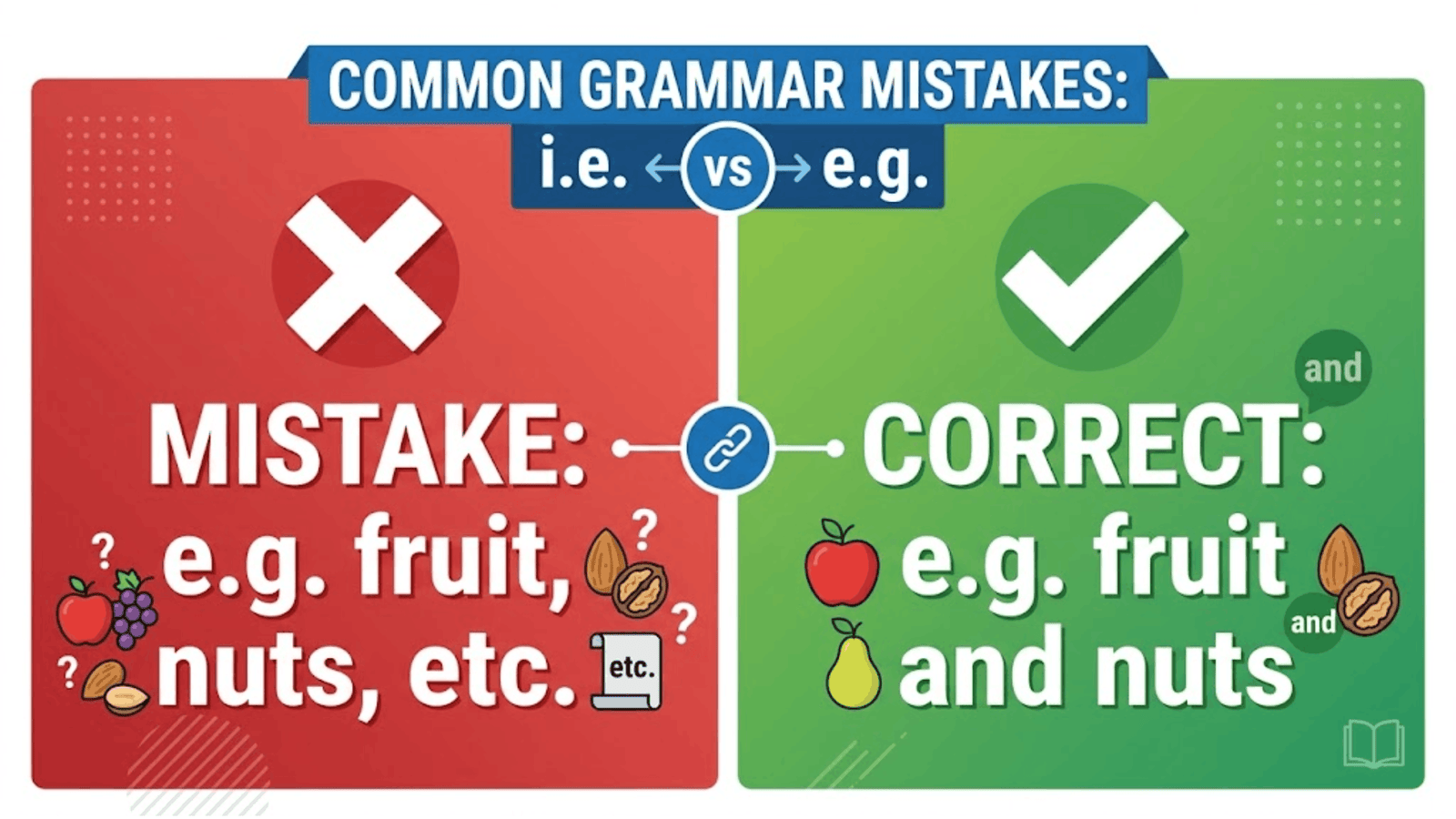
Mistake 3: Adding “etc.” After e.g.
Because e.g. already introduces examples, adding etc. at the end of the same list is usually unnecessary.
Less effective:
You can bring snacks, e.g., fruit, crackers, and nuts, etc.
Better:
You can bring snacks, e.g., fruit, crackers, and nuts.
The abbreviation already tells the reader that the list is not necessarily complete.
Mistake 4: Using Abbreviations When Full Words Read Better
Sometimes the full expression is easier for the reader.
For example:
For example, you could read the paragraph aloud.
This may be more natural than:
E.g., you could read the paragraph aloud.
The same idea applies to i.e. In ordinary prose, “that is” or “in other words” may make a sentence easier to follow.
i.e. vs. “That Is”
i.e. and “that is” can serve the same basic purpose.
Compare:
The test is scheduled for the first working day, i.e., Monday.
and:
The test is scheduled for the first working day, that is, Monday.
Both versions clarify which day the writer means.
The choice often depends on the style and tone of the writing. “That is” is usually more natural in general prose, while i.e. is common in academic, technical, and other written contexts.
e.g. vs. “For Example”
The same idea applies to e.g. and “for example.”
Compare:
Some hobbies, e.g., painting and gardening, can be relaxing.
with:
Some hobbies, for example, painting and gardening, can be relaxing.
Both introduce examples.
For a general audience, the full phrase “for example” can sometimes make the sentence easier to read. The abbreviation is useful when the writing style calls for it.
Can You Use “Such As” Instead of e.g.?
Yes.
Such as can introduce examples in many sentences.
For example:
We offer several language courses, such as English, Spanish, and French.
You could also write:
We offer several language courses, e.g., English, Spanish, and French.
The meaning is similar in this context.
There is no need to force e.g. into a sentence when such as sounds more natural.
See Also: Acclimate vs Acclimatize vs Acclimatise: Which One Should You Use?
A Simple Way to Choose Between i.e. and e.g.
When you pause over the choice, ask yourself what the information after the abbreviation is doing.
If it explains, identifies, or makes the previous statement more exact, choose i.e.
The store closes at the end of the business day, i.e., at 5 p.m.
If it shows some members of a larger group, choose e.g.
The store sells office supplies, e.g., notebooks and folders.
Then perform the replacement test:
i.e. → “that is” / “in other words”
e.g. → “for example”
If the replacement gives you the meaning you intended, your choice is probably correct.
Quick Reference
Keep this distinction in mind:
i.e.
Meaning: that is / in other words
Purpose: Clarifies or specifies an idea
e.g.
Meaning: for example
Purpose: Gives one or more examples
A useful memory trick is:
I = In other words
E = Example
Final Thought
Although i.e. and e.g. may look alike, they are used for different purposes.
i.e. comes from id est and means “that is.” Use it when you want to clarify or specify an idea.
e.g. comes from exempli gratia and means “for example.” Use it when you want to provide examples.
When you cannot decide, replace the abbreviation in your head:
i.e. → “that is” / “in other words”
e.g. → “for example”
If you are clarifying, choose i.e. If you are giving examples, choose e.g. If you are unsure, replace the abbreviation with its full meaning. That quick check can help you choose the correct form without guessing.

Leave a Reply