
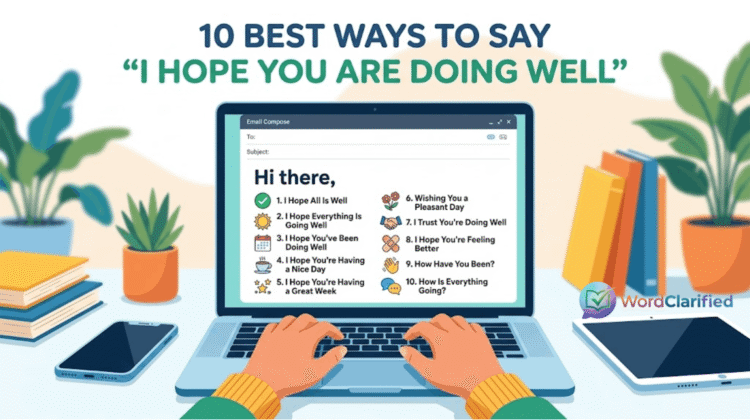
People often use this greeting at the beginning of an email or message to sound polite and friendly. However, you may want a different expression when you want your opening to sound more personal, casual, or formal.
The best choice depends on who you are writing to and why you are contacting them.
Best Ways to Say “I Hope You Are Doing Well
1. I Hope All Is Well
It is brief and courteous, making it suitable for both casual and professional messages.
Example:
“I hope all is well. Thanks for your reply.”
2. I Hope Everything Is Going Well
This sounds warm and conversational. It is useful when you are getting back in touch with someone.
Example:
“I hope everything is going well. We haven’t spoken in quite a while.”
3. I Hope You’ve Been Doing Well
This works especially well when you have not spoken to someone for some time.
Example:
“I hope you’ve been doing well. I wanted to reconnect about our previous discussion.”
4. I Hope You’re Having a Nice Day
This is a simple way to start a message on a friendly note.
Example:
“I hope you’re having a nice day. I wanted to ask about the project.”
5. I Hope You’re Having a Great Week
It is a friendly way to open your message.
Example:
“I hope you’re having a great week. I wanted to follow up on the project.”
6. Wishing You a Pleasant Day
This greeting adds a friendly touch without sounding too casual.
Example:
“Wishing you a pleasant day. I wanted to share a quick update with you.”
7. I Trust You’re Doing Well
This is more formal than most of the other options, so it can suit professional correspondence.
Example:
“I trust you’re doing well. I’m contacting you regarding the contract.”
8. I Hope You’re Feeling Better
Use this when you know the person has been sick or was not feeling well.
Example:
“I hope you’re feeling better. Please take the time you need before responding.”
9. How Have You Been?
This is a natural choice for friends, former coworkers, or people you know well.
Example:
“How have you been? I haven’t heard from you in a while.”
10. How Is Everything Going?
This friendly question can open a conversation without sounding too formal.
Example:
“How is everything going? I’d love to hear how your new course is going.”
See Also: Vicious or Viscous: What’s the Difference?
Which Alternative Should You Use?
The best expression depends on the situation.
For a professional email, “I hope you’re doing well,” “I hope all is well,” and “I trust you’re doing well” are good choices. The last one sounds more formal.
For a casual message, “How have you been?” and “How is everything going?” sound more conversational.
If you know the person has been sick, “I hope you’re feeling better” is more appropriate than a general greeting.
You can also tailor the greeting to something happening in the other person’s life:
“I hope your project is going well.”
“I hope you’re enjoying your trip.”
A specific greeting can sound more natural because it relates directly to the person.
Do You Always Need This Greeting?
No. You can skip a general well-being greeting when you want to get straight to the point.
For example:
“Could you please confirm the meeting time?”
“I’m following up on our conversation.”
“I wanted to check whether you received my last email.”
This approach works particularly well for short emails and specific requests.
See Also: Up to Date or Up-to-Date Examples: Easy Rules to Get It Right
Can You Use “I Hope You Are Doing Well” in a Professional Email?
Yes. “I hope you are doing well” is appropriate for professional emails and messages.
It can be used with coworkers, clients, managers, teachers, and other professional contacts. You do not need to replace it just because you have used it before.
The phrase is polite and clear. Choose another opening when it better fits the situation or gives your message a more personal tone.
Common Mistakes to Avoid
Do not choose an alternative simply because it sounds different. Make sure it fits the situation.
For example, “I hope you’re feeling better” is not a general greeting unless the person was unwell.
A highly cheerful greeting can also sound unsuitable when the subject of the email is serious. Match your opening to the situation.
FAQs
What Is a Professional Way to Use This Greeting?
“I hope you’re doing well” is already professional. For a more formal tone, you can use “I trust you’re doing well.”
Is “I hope this message finds you well” formal?
Yes. “I hope this message finds you well” has a formal, traditional tone and is often used in professional emails.
What is a casual alternative?
“How have you been?” and “How is everything going?” are natural choices for casual messages.
How can I make my greeting more personal?
Mention something specific about the person’s situation, such as a trip, project, course, job, or recent event.
Final Thought
“I hope you are doing well” works as a courteous opening in many situations, so there is no need to replace it every time.
If another greeting suits the situation better, use it. For a short email, you can also leave out the general greeting and begin with your main point.
See Also: Commonly Confused English Words

Leave a Reply