
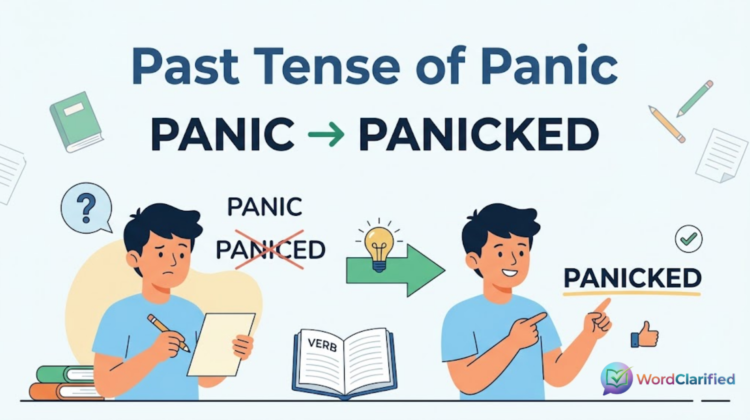
The past tense of panic is panicked.
I panicked when I couldn’t find my wallet.
The spelling can be confusing because panic becomes panicked, not paniced. The word also uses panicked as its past participle, while panicking is its present participle.
What Is the Past Tense of Panic?
The past tense is:
panic → panicked
Use panicked when the reaction happened in the past.
For example:
- I panicked when I missed the last bus.
- She panicked after losing her phone.
- We panicked when the lights went out.
- He panicked and called his brother.
- The passengers panicked when they heard the alarm.
Compare these two sentences:
I panic when I’m under pressure.
I panicked during yesterday’s interview.
The first describes a present or general reaction. The second describes a reaction that happened in the past.
Why Is It “Panicked” Instead of “Paniced”?
You might expect to form the past tense by simply adding -ed:
panic + ed = paniced
But standard English spelling uses:
panic + k + ed = panicked
The extra k helps keep the hard /k/ sound. When an ending beginning with e, i, or y is added to a word ending in c, English spelling can use k to preserve that sound. Panic → panicked is one example of this pattern.
So:
❌ paniced
✅ panicked
The base word remains panic. It is not spelled panick.
Panic Verb Forms
Here are the main forms of the verb:
| Form | Word | Example |
| Base form | panic | Don’t panic. |
| Third-person singular | panics | She panics easily. |
| Present participle | panicking | He is panicking. |
| Past tense | panicked | They panicked. |
| Past participle | panicked | She has panicked before. |
Panicked serves as both the simple past and past participle.
How to Use “Panicked” in a Sentence
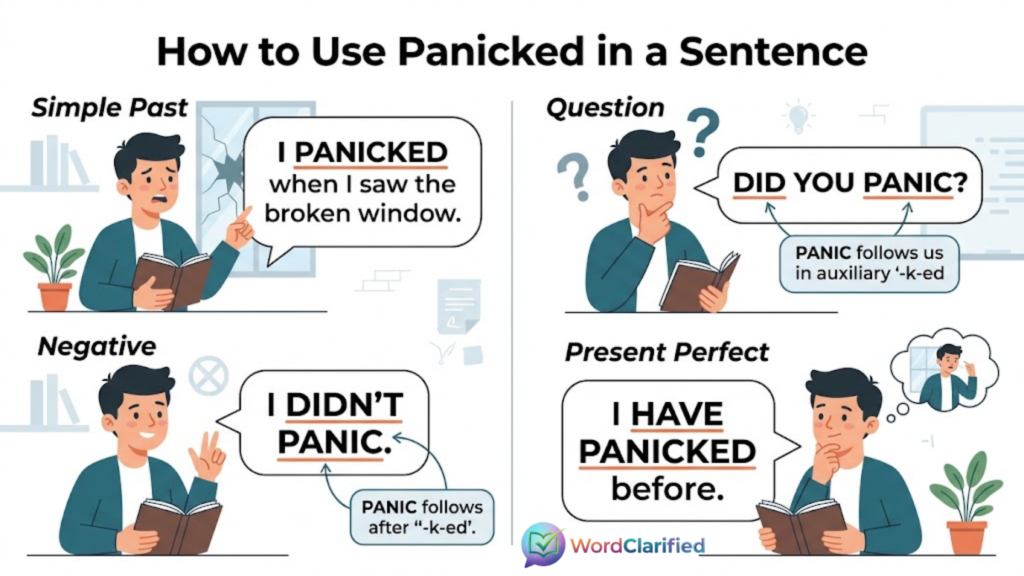
Simple Past
Use panicked when the reaction happened in the past.
I panicked when I saw the broken window.
She panicked when her flight was delayed.
He panicked when the car stopped.
You can also connect it to another past action:
She panicked and ran toward the exit.
This shows two actions that happened one after another.
Negative Sentences
After didn’t, use the base form panic, not panicked.
I didn’t panic.
She didn’t panic during the interview.
We didn’t panic because we had a backup plan.
So:
❌ I didn’t panicked.
✅ I didn’t panic.
Because did already shows that the sentence is in the past, the main verb stays in its base form.
Questions
The same rule applies to questions with did:
Did you panic when you heard the news?
Did she panic during the exam?
Did they panic after the alarm sounded?
Not:
❌ Did you panicked?
✅ Did you panic?
Present Perfect
Panicked is also the past participle, so it can follow have, has, or had.
I have panicked in situations like this before.
She has panicked over smaller problems.
They had panicked before the teacher arrived.
Here, panicked is the past participle rather than the simple past.
See Also: How Many Verb Tenses Are in English? The 12 Tenses Explained
Panicked vs. Panicking
These forms are related, but they emphasize different things.
Panicked presents the reaction as a past event:
I panicked when I lost my passport.
Was panicking shows that the reaction was continuing at a particular time:
I was panicking while I searched for my passport.
Compare:
She panicked when she couldn’t open the door.
She was panicking while she searched for the key.
The first treats the reaction as a completed event. The second shows that it was still happening during the search.
The present participle of panic is panicking.
See Also Long Term or Long-Term: A Complete Guide to Getting the Hyphen Right
Panic as a Noun and a Verb
The word panic can be used as either a noun or a verb.
As a verb, it describes a person’s reaction:
The passengers panicked.
She panicked when she heard the news.
Don’t panic.
As a noun, panic describes a sudden feeling or state of fear. Compare:
Panic spread through the crowd.
The announcement caused panic.
He was in a panic about the exam.
Compare:
The crowd panicked.
Here, panicked is a verb.
Panic spread through the crowd.
Here, panic is a noun.
Common Mistakes With Panic
| Incorrect | Correct |
| panick | panic |
| paniced | panicked |
| panicing | panicking |
| I didn’t panicked. | I didn’t panic. |
| Did you panicked? | Did you panic? |
The first three are spelling mistakes. The last two are grammar mistakes because did and didn’t are followed by the base form of the verb.
Panick vs. Panic
The base verb is panic:
Don’t panic.
When certain endings are added, the spelling can include k:
panicked
panicking
That does not make panick the base form.
Paniced vs. Panicked
The correct past-tense spelling is panicked:
She panicked when she lost her passport.
Not:
❌ She paniced when she lost her passport.
Panicing vs. Panicking
The correct spelling is panicking:
He is panicking about the test.
The k appears in this form as well.
Is “Was Panicked” Correct?
It can be correct in some sentences, depending on the structure and meaning.
For example:
The panicked passengers left the building.
Here, panicked describes the passengers.
You can also use it in a passive construction:
The investors were panicked by the sudden announcement.
But if you mean that someone was experiencing panic at a particular time, was panicking is often clearer:
She was panicking about her exam.
The two constructions are not always interchangeable.
See Also: When to Use a Colon or Semicolon: Simple Rules
Other Words With a Similar Spelling Pattern
The spelling in panicked also appears in some other English words:
- panic → panicked
- picnic → picnicked
- mimic → mimicked
In these forms, k helps preserve the hard /k/ sound when certain endings are added.
For panic, the easiest pattern to remember is:
panic → panicked → panicking
Panic, Panicked, Panicking, and Panicky
These words are related, but each one serves a different purpose in a sentence.
| Word | Use | Example |
| panic | Base verb or noun | Don’t panic. |
| panicked | Past tense or past participle | I panicked. |
| panicking | Present participle | She is panicking. |
| panicky | Adjective | He felt panicky. |
Panic can describe an action or a feeling:
Don’t panic.
There was panic in the crowd.
Panicked describes a past reaction:
I panicked when I saw the message.
Panicking describes an ongoing reaction:
I was panicking when I saw the message.
Panicky is an adjective:
I felt panicky before the interview.
Cambridge lists panicky as an adjective related to panic.
A Simple Way to Remember the Forms
The basic pattern is:
Present: I panic.
Past: I panicked.
Present continuous: I am panicking.
Past continuous: I was panicking.
Present perfect: I have panicked.
One rule is especially useful:
After did or didn’t, use panic.
So:
I panicked yesterday.
I didn’t panic yesterday.
Did you panic yesterday?
This gives you the correct form for three common past-tense sentence patterns.
Frequently Asked Questions
What is the past tense of panic?
The past tense of panic is panicked.
She panicked when she couldn’t find her phone.
Is it panicked or paniced?
Panicked is correct.
✅ I panicked.
❌ I paniced.
The k helps preserve the hard /k/ sound.
Is “panick” a correct word?
The standard base form is panic, not panick.
Don’t panic.
Forms such as panicked and panicking contain the added k.
What is the past participle of panic?
The past participle is also panicked.
She has panicked before.
So:
Past tense: panicked
Past participle: panicked
Is “panicking” spelled with CK?
Yes. The standard spelling is panicking.
He is panicking about the exam.
Is panic a noun or a verb?
It can be both.
As a verb:
The crowd panicked.
As a noun:
Panic spread through the crowd.
What is the difference between panicked and panicking?
Panicked is the simple past and past participle:
I panicked when I saw the message.
Panicking is the present participle:
I was panicking when I saw the message.
The first treats the reaction as a past event. The second shows that it was ongoing.
The Bottom Line
The past tense of panic is panicked.
Remember:
panic → panicked → panicking
The most common mistakes are paniced, panick, and panicing.
And when did or didn’t is already marking the past, use the base form:
I panicked.
I didn’t panic.
Did you panic?
Those patterns cover most situations where English learners need to use panic in the past.

[…] See Also: Past Tense of Panic: What Is the Correct Form […]