
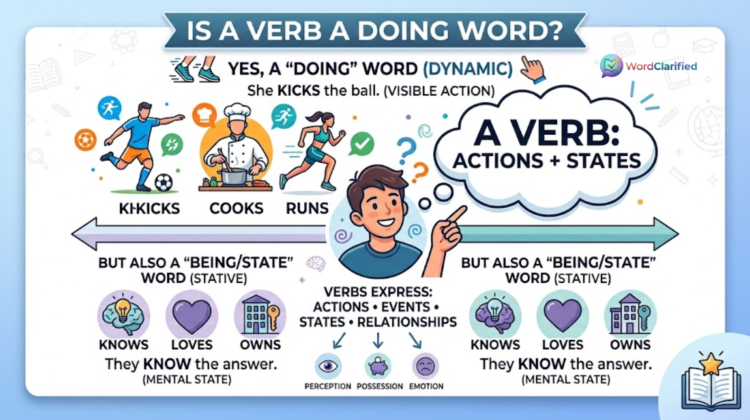
Yes, a verb can be a doing word, but not every verb describes an action.
You may have learned that a verb is a “doing word.” This is a simple way to introduce verbs to beginners. It works well with words such as run, jump, eat, write, swim, and dance.
For example:
Sarah runs every morning.
The word runs tells us what Sarah does. It is easy to see why someone might call it a doing word.
But look at these sentences:
I know the answer.
He owns a bicycle.
She is tired.
They belong to this club.
The bold words are verbs, but they do not describe physical actions. That is why “doing word” is useful for beginners, but it is not a complete definition of a verb.
What Is a Verb?
A verb tells us about an action, state, or event.
A verb can tell us what someone does, what happens, or what someone or something is like.
| Sentence | Verb | What it shows |
| Tom kicks the ball. | kicks | Action |
| The baby cried. | cried | Event or activity |
| I know her. | know | Mental state |
| We own a house. | own | Possession |
| The soup tastes good. | tastes | Perception |
| She is happy. | is | State |
This wider definition explains why many verbs do not fit the simple idea of a “doing word.”
Why Are Verbs Called “Doing Words”?
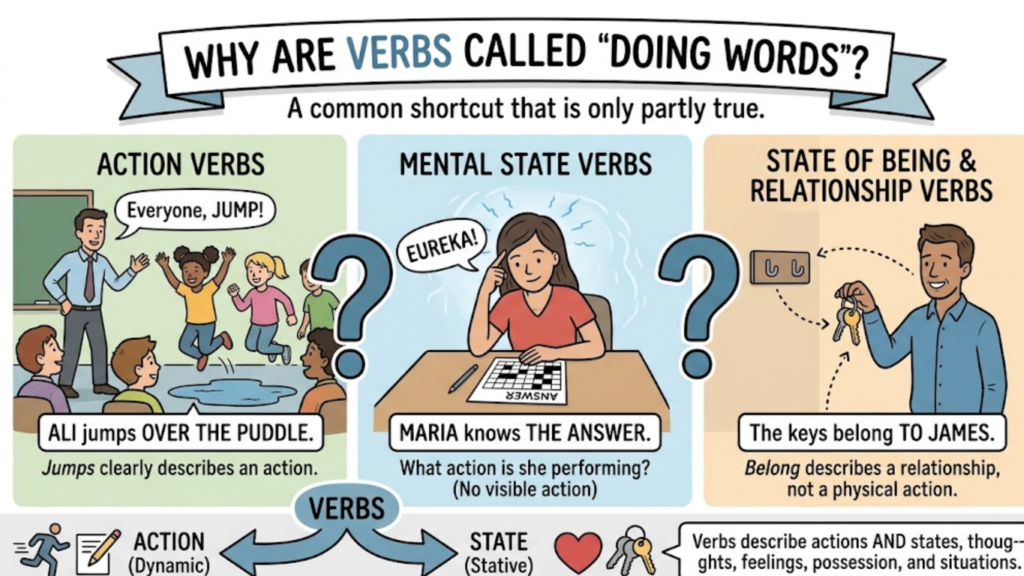
“Doing word” is mainly a teaching shortcut.
When children first learn grammar, action verbs are easy to demonstrate. A teacher can ask a student to walk, clap, jump, or write. The student acts, so the idea is easy to understand.
For example:
Ali jumps over the puddle.
The verb jumps clearly describes an action.
The problem starts when learners assume that every verb must describe something a person physically does.
Consider:
Maria knows the answer.
What action is Maria performing? There may be no visible action. Knows describes her mental state.
Now consider:
The keys belong to James.
Belong describes the relationship between James and the keys. It does not describe a physical action.
So, when someone asks, “Is a verb a doing word?” the best answer is:
Some verbs are doing words, but verbs can also describe states, events, thoughts, feelings, possession, and other situations.
See Also: How Many Verb Tenses Are in English? The 12 Tenses Explained
Action Verbs Are Doing Words
Action verbs, also called dynamic verbs, describe activities or actions.
Some involve physical movement:
- run
- walk
- kick
- open
- close
- drive
- swim
- throw
For example:
Daniel opened the door.
The children played outside.
My sister drives to work.
Some action verbs describe mental activities:
- think
- calculate
- plan
- study
- decide
- search
For example:
I studied for the exam.
She planned the trip.
These actions may not be visible, but they still describe an activity.
Some Verbs Describe States
Not everything expressed by a verb is an action.
Stative verbs describe a state or situation. They often relate to thoughts, feelings, possession, senses, or relationships.
Thoughts and beliefs
Common examples include:
- know
- understand
- believe
- remember
- realize
I understand the question.
Here, understand describes a mental state.
Feelings and preferences
Examples include:
- like
- love
- hate
- prefer
- want
She likes chocolate.
Likes describes a feeling or preference rather than a physical activity.
Possession and relationships
Examples include:
- have
- own
- possess
- belong
- contain
This bag contains my books.
They own a small shop.
Appearance and perception
Examples include:
- seem
- appear
- taste
- smell
- sound
- feel
The plan seems good.
The soup tastes salty.
These are verbs even though they do not describe a physical action.
See Also: Past Tense of Panic: What Is the Correct Form?
Is “Is” a Verb?
Yes.
This is a clear example of why the “doing word” definition is incomplete.
Look at this sentence:
Ahmed is a teacher.
The word “is” belongs to the verb “be.”
Now look at:
The children are tired.
I am ready.
Am, is, and are are forms of be. They can connect the subject with information about its identity, condition, or state.
There is no obvious physical action in:
She is happy.
Yet it is still a verb.
So you cannot decide whether a word is a verb only by asking, “Is someone doing something?”
Why Can’t We Always Use Stative Verbs With -ing?
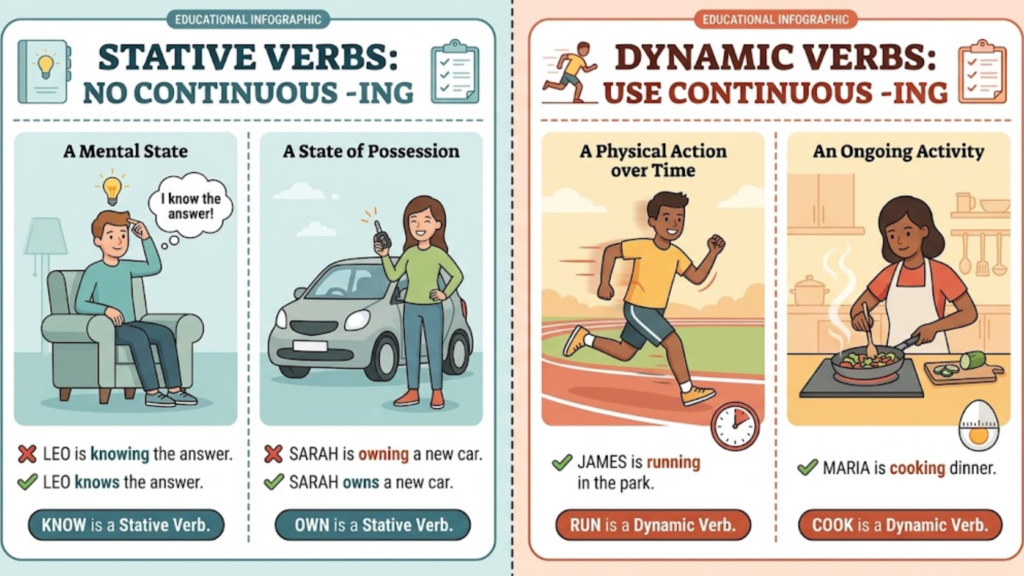
The difference between action and state verbs also helps explain a common grammar mistake.
Dynamic verbs can often appear in the continuous form:
I am running.
She is cooking dinner.
They are playing football.
The activity is happening over a period of time.
Stative verbs usually do not take the continuous form when they describe a state.
For example:
❌ I am knowing the answer.
✅ I know the answer.
And:
❌ He is owning three cars.
✅ He owns three cars.
However, this does not apply to every verb in every situation. Some verbs can have different meanings, and the meaning can affect how the verb is used.
Some Verbs Can Describe Both Actions and States
Some English verbs work differently depending on their meaning.
Take think.
When think means having an opinion, it describes a state:
This is a good idea.
When it describes an active mental process, the continuous form is natural:
I am thinking about your question.
The verb have can work in a similar way.
When it means possession:
She has a new laptop.
Here, has describes possession.
But when it refers to an activity:
We are having lunch.
Here, having describes an activity happening now.
Another example is taste:
The soup tastes salty.
Here, the verb describes the soup’s flavor.
But:
The chef is tasting the soup.
Here, tasting describes an action.
The meaning of the verb matters.
See Also: When to Use a Colon or Semicolon: Simple Rules
How Can You Find a Verb?
If “doing word” does not always work, how can you find a verb?
Start by looking at what the sentence says about the subject.
Look for an action
Jack runs quickly.
The verb is runs.
Look for a state
I know the answer.
The verb is know.
Look for a condition.
She is tired.
The verb is is.
Look for something happening.
The glass broke.
The verb is broke.
Also watch for helping verbs. Sometimes two or more verbs work together as a verb phrase.
She is reading a book.
They have finished their work.
We will visit them tomorrow.
The verb phrases are is reading, have finished, and will visit.
Common Mistakes English Learners Make
Mistake 1: Thinking every verb must show physical action
This can cause learners to overlook verbs such as know, believe, own, seem, and belong.
Mistake 2: Thinking “is” is not a verb
It is a form of be, one of the most common verbs in English.
Mistake 3: Using -ing with every verb
Not every verb normally works in the continuous form when it describes a state.
❌ I am understanding the lesson.
✅ I understand the lesson.
Mistake 4: Memorizing rigid lists
A verb can behave differently when its meaning changes. Think, have, taste, and feel can be used in more than one way.
Learning the meaning of a verb in its sentence is often more useful than memorizing a long list.
So, Is a Verb a Doing Word?
Sometimes, yes. But that is not the whole story.
Words such as run, write, cook, jump, and drive are action verbs, so calling them doing words makes sense.
But verbs such as know, love, own, belong, seem, and is show why the definition is too narrow.
A better definition is:
A verb is a word that expresses an action, event, state, or condition.
If you are starting to learn English, “doing word” can help you recognize simple action verbs. As your grammar improves, remember that verbs can describe much more than actions.
Quick Practice
Find the verb or verb phrase in each sentence.
- Emma writes every day.
- I know his name.
- The children are playing outside.
- This book belongs to me.
- He is a doctor.
- We are having dinner.
Answers
- writes — action
- know — mental state
- are playing — action happening now
- belongs — relationship or possession
- is — state or identity
- are having — activity
(FAQs)
1. Is a verb always a doing word?
No. Some verbs describe actions, but others describe states, feelings, thoughts, possession, or conditions. For example, run describes an action, while know describes a mental state.
2. Is “is” a doing word?
No, is does not describe a physical action. However, it is still a verb. Is is a form of the verb be and can describe a state, condition, or identity.
3. What are examples of doing words?
Common examples include run, jump, eat, write, swim, walk, cook, and drive. These are action verbs because they describe activities or actions.
4. What is a verb that is not a doing word?
Examples include know, like, own, belong, seem, and understand. These verbs describe states, feelings, possession, relationships, or thoughts rather than physical actions.
5. Can a verb be both an action and a state?
Yes. Some verbs change their use depending on their meaning. For example, think can describe an opinion in “I think it is good,” or an active mental process in “I am thinking about it.”
The key idea is simple: a verb can tell you what someone does, what happens, or what state someone or something is in. That is why verbs are sometimes called doing words, but they are much more than that.

Leave a Reply