
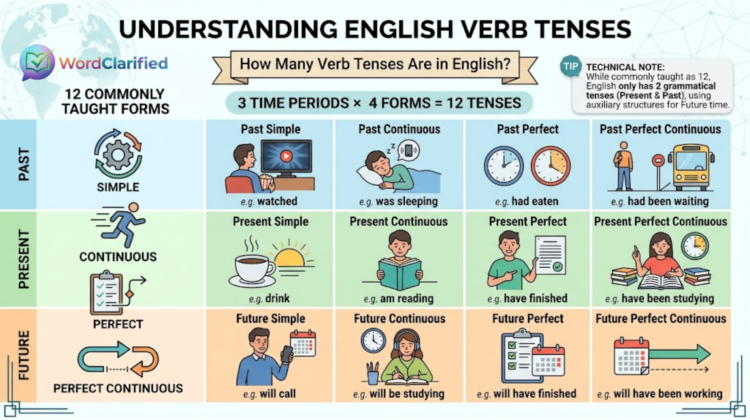
If you are learning English, you have probably heard that there are 12 verb tenses. That is the answer used in many English grammar lessons.
But there is a catch.
Some grammar books say English has only two grammatical tenses: present and past. Others use three time periods—past, present, and future—and divide them into 12 commonly taught forms.
So, which answer is correct?
For English learners, 12 is the most useful answer. These forms help you describe actions and situations at different times and show whether an action is regular, in progress, completed, or continuing.
The technical difference is worth knowing because it explains why different grammar resources give different numbers.
How Many Tenses Does English Have?
English is commonly taught as having 12 tense forms:
Present
- Present Simple
- Present Continuous
- Present Perfect
- Present Perfect Continuous
Past
- Past Simple
- Past Continuous
- Past Perfect
- Past Perfect Continuous
Future
- Future Simple
- Future Continuous
- Future Perfect
- Future Perfect Continuous
The 12 forms come from combining three time periods with four ways of describing an action:
- Simple
- Continuous
- Perfect
- Perfect Continuous
So the usual learning system is:
3 time periods × 4 forms = 12 commonly taught tense forms
For someone learning English, this system provides a practical way to understand how verbs describe time and actions.
Why Do Some People Say English Has Only 2 Tenses?
The difference comes from how the word tense is defined.
In a strict grammatical sense, English marks present and past tense through changes to the verb.
Compare:
I work here.
I worked here.
The verb changes from work to worked to show the past.
English does not have a separate future verb ending in the same way. Instead, it uses structures such as will, be going to, the present continuous, and the present simple to talk about future events.
For example:
I will call you tonight.
Here, will helps express future time. The verb call does not change to a special future form.
This is why you may see one grammar resource describe English as having two grammatical tenses while an English course teaches 12.
Both descriptions can be useful. For learning English, the 12-form system is easier to work with because it covers the patterns you will regularly see in grammar lessons.
The 12 Commonly Taught English Tense Forms Explained
Here is what each of the 12 commonly taught forms does.
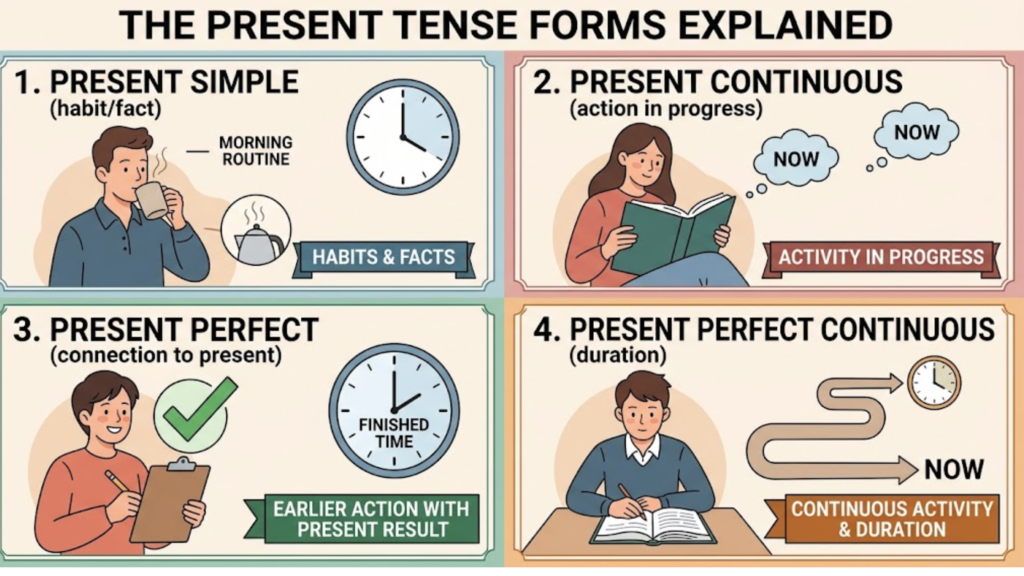
1. Present Simple
The present simple is used for habits, routines, facts, and situations that are generally true.
I drink coffee every morning.
It can also describe facts:
Water boils at 100°C.
Or regular situations:
She works at a hospital.
The present simple does not necessarily mean something is happening at this exact moment.
2. Present Continuous
The present continuous usually describes something happening now or around the current period.
I am reading a book.
The activity is in progress.
It can also describe a temporary situation:
He is staying with his brother this week.
Compare:
She works from home.
She is working from home this week.
The first sentence can describe her usual work arrangement. The second suggests that the arrangement is temporary.
3. Present Perfect
The present perfect connects something that happened earlier to the present.
I have finished my homework.
The action happened before now, and its result matters now.
It can also describe experiences:
I have visited Turkey twice.
Or an action that happened at an unspecified time:
She has seen that movie.
A common mistake is using the present perfect with a finished past time.
❌ I have visited him yesterday.
✅ I visited him yesterday.
When you mention a finished time such as yesterday, last year, or two days ago, the past simple is normally used instead.
4. Present Perfect Continuous
The present perfect continuous focuses on an activity that has continued over a period of time.
I have been studying for three hours.
The sentence tells us what the person has been doing and how long the activity has continued.
You can also use it without a specific duration:
She has been working hard lately.
The focus is on the activity and its connection with the present.
The 4 Past Forms
5. Past Simple
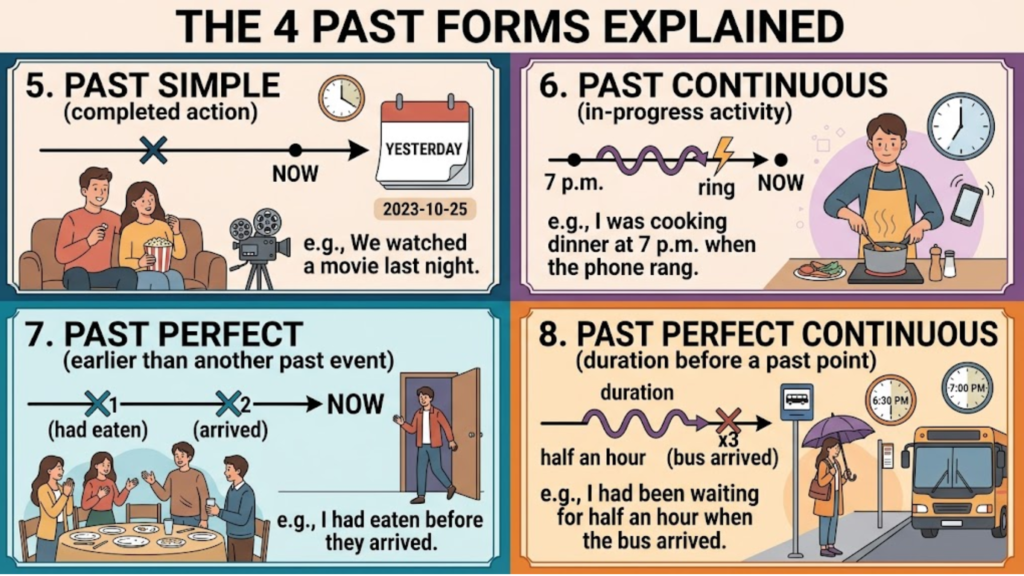
We use the past simple for an action that happened and was completed in the past.
We watched a movie last night.
Other examples include:
He bought a new phone yesterday.
They moved to London in 2022.
The past simple is one of the most useful forms for talking about completed past events.
6. Past Continuous
The past continuous describes an activity that was in progress at a particular time in the past.
I was cooking dinner at 7 p.m.
It can also show that one action was in progress when another happened:
I was sleeping when the phone rang.
The longer activity uses the past continuous, while the shorter event uses the past simple.
was sleeping → past continuous
rang → past simple
This combination is common when telling stories or describing past events.
7. Past Perfect
The past perfect shows that one past event happened before another past event.
I had eaten before they arrived.
There are two past events:
- I ate.
- They arrived.
Eating happened first, so we use had eaten.
Another example:
She had left the office when I called.
The past perfect helps make the order of past events clear.
8. Past Perfect Continuous
The past perfect continuous focuses on an activity that continued for some time before another past event.
I had been waiting for half an hour when the bus finally arrived.
The waiting had already gone on for 30 minutes when the bus arrived.
The main idea is duration before a point in the past.
Another example:
They had been living there for five years before moving away.
The form shows that the activity continued for a period before another past event.
The 4 Future Forms
The four forms below are commonly called future tenses in English lessons. English talks about future events using several structures instead of a distinct future verb ending.
9. Future Simple
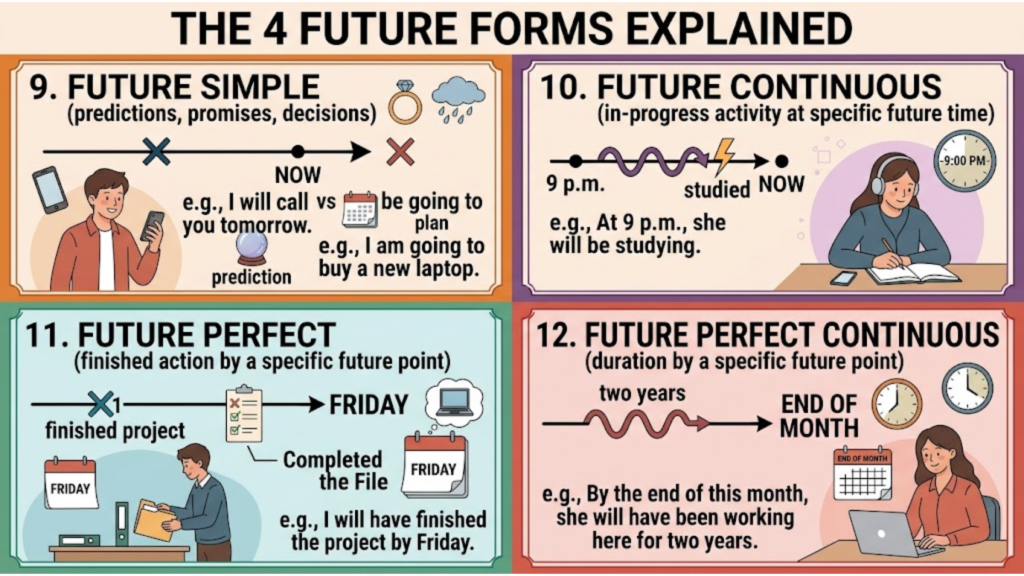
The future simple usually uses will. It is commonly used for predictions, promises, decisions made at the moment, and future events.
Example:
I will call you tomorrow.
Another example:
I think it will rain tonight.
When to Use “Going To”
Use be going to for a future plan or intention that has already been decided.
Example:
I am going to start a new course next month.
It can also describe a prediction when there is present evidence.
Example:
Look at those dark clouds. It is going to rain.
Compare:
I will buy a new laptop.
This can describe a decision made while speaking.
I am going to buy a new laptop.
This suggests the purchase was already planned.
10. Future Continuous
The future continuous shows that an action will be happening at a specific time in the future.
Example:
At 9 p.m., she will be studying.
The sentence tells us that her study session will still be underway at that time.
11. Future Perfect
The future perfect describes an action that will be finished by a specific point in the future.
Example:
I will have finished the project by Friday.
The project will already be finished when Friday arrives.
Another example:
They will have arrived by noon.
12. Future Perfect Continuous
The future perfect continuous tells us how long an activity will have continued by a future time.
Example:
By the end of this month, she will have been working here for two years.
The sentence focuses on the duration of the activity up to the end of the month.
See Also: When to Use a Colon or Semicolon: Simple Rules
What Do Simple, Continuous, Perfect, and Perfect Continuous Mean?
These four terms describe how an action or situation is viewed.
Simple
The simple form presents an action, event, habit, or state without focusing on its progress.
I study English.
Continuous
The continuous form focuses on an activity in progress.
I am studying English.
Perfect
The perfect form connects an earlier event or period with another point in time.
I have studied English for three years.
Perfect Continuous
The perfect continuous combines the time connection of the perfect with a focus on an ongoing activity or duration.
I have been studying English for three years.
Understanding these four ideas makes the names of the 12 forms easier to remember.
Are There 12, 16, or 2 Tenses in English?
You may see different numbers when studying English grammar. The difference usually comes from how tense, time, and aspect are defined.
| Number | What it usually refers to |
| 2 | Present and past grammatical tense forms |
| 3 | Past, present, and future time |
| 12 | Three time periods combined with four commonly taught forms |
| 16 | A teaching system that also includes four future-in-the-past forms |
For most English learners, the 12-form system is a practical place to start. What matters most is knowing when and why to use each form.
Common English Tense Mistakes
Knowing the names of the forms is only part of learning them. The harder part is choosing the right one for the meaning you want.
Mixing Past Simple and Present Perfect
Compare:
I lost my keys yesterday.
I have lost my keys.
The first sentence gives a finished past time. The second focuses on the current situation: the keys are still missing.
Using Continuous Forms With Every Verb
Some verbs normally describe states rather than actions in progress.
For example:
I know the answer.
Not:
I am knowing the answer.
Other verbs that commonly behave this way include believe, understand, need, and like.
There are exceptions and special uses, so it is better to learn these verbs in context rather than treat the rule as absolute.
See Also: Past Tense of Panic: What Is the Correct Form?
Assuming “Will” Is the Only Future Structure
English uses several structures to talk about future events.
Compare:
I will call you later.
I’m going to call you later.
I’m meeting Ali tomorrow.
The train leaves at 8 a.m.
All four sentences talk about the future, but each one uses a different structure.
Choosing a Tense Only Because of One Time Word
Words such as yesterday, now, already, and for can give you useful clues. However, they do not automatically determine the tense.
The meaning of the whole sentence matters.
Which Tenses Should You Learn First?
You do not need to memorize all 12 at once.
Start with the forms you are likely to use often:
- Present Simple
- Present Continuous
- Past Simple
- Common future forms
- Present Perfect
Once these feel comfortable, move on to the other forms.
A useful way to learn is to take one idea and change the time:
I work here.
I am working here today.
I worked here last year.
I have worked here for three years.
I will work here next year.
Seeing how the meaning changes can make the grammar easier to remember.
How to Remember the 12 Forms
Instead of memorizing a long list, use two questions.
First: When does it happen?
- Present
- Past
- Future
Second: How do I describe the action?
- Simple
- Continuous
- Perfect
- Perfect Continuous
Then combine the two.
Past + Continuous = Past Continuous
I was reading.
Present + Perfect = Present Perfect
I have read.
Future + Perfect = Future Perfect
I will have read.
This gives you a simple mental map of the 12-form system.
Frequently Asked Questions
How many verb tenses are in English?
English is commonly taught as having 12 tense forms. In a more technical grammatical analysis, English has two marked tenses: present and past. Future time is expressed through several constructions.
What are the 12 tenses in English?
They are Present Simple, Present Continuous, Present Perfect, Present Perfect Continuous, Past Simple, Past Continuous, Past Perfect, Past Perfect Continuous, Future Simple, Future Continuous, Future Perfect, and Future Perfect Continuous.
Does English really have a future tense?
English does not mark future time with a dedicated verb ending in the same way it marks past time. Instead, it uses structures such as will, be going to, and certain present forms. English courses commonly group these future constructions into four “future tenses.”
Which four forms are commonly used to describe tense?
The four commonly taught forms are simple, continuous, perfect, and perfect continuous. They can be combined with past, present, and future time to create the familiar 12-form system.
Are there 16 tenses in English?
Some grammar systems include four additional future-in-the-past forms, producing a list of 16. The 12-form system is more common in general English learning.
Is it necessary to learn all 12 tenses?
Not immediately. Learn the most common forms first and practice using them in sentences. Understanding what each form means and when to use it is more useful than memorizing its name.
Final Answer
For English learners, the standard answer is 12 commonly taught tense forms. They combine past, present, and future time with simple, continuous, perfect, and perfect continuous forms.
In more technical grammar, English has two grammatical tenses: present and past. Future time is expressed through several structures rather than a distinct future verb ending.
If you are learning English, start with the 12-form system. Focus on what each form means and when to use it rather than worrying about the terminology.

[…] See Also: How Many Verb Tenses Are in English? The 12 Tenses Explained […]