
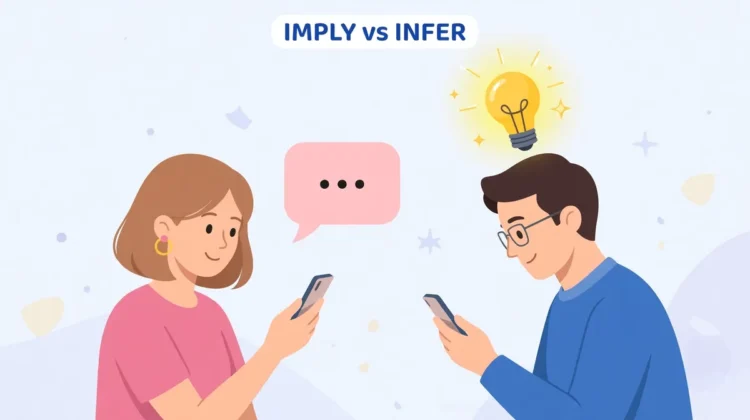
Your boss texts, “Interesting that you left at 4 on Friday.” No question mark, no accusation, nothing you can point to. She implied something, and now you’re inferring what it was. That’s the whole imply vs infer puzzle in one text message, and it takes about two minutes to sort out for good.
What’s the Difference Between Imply and Infer?
Imply means to hint at something without saying it. Infer means to reach a conclusion from clues. The person sending the message implies, and the person receiving it infers. If you’re sending the hint, use imply. If you’re catching it, use infer.
Imply: When You Hint Instead of Saying It
To imply is to suggest something without stating it. The words on the surface say one thing, and the real message sits underneath.
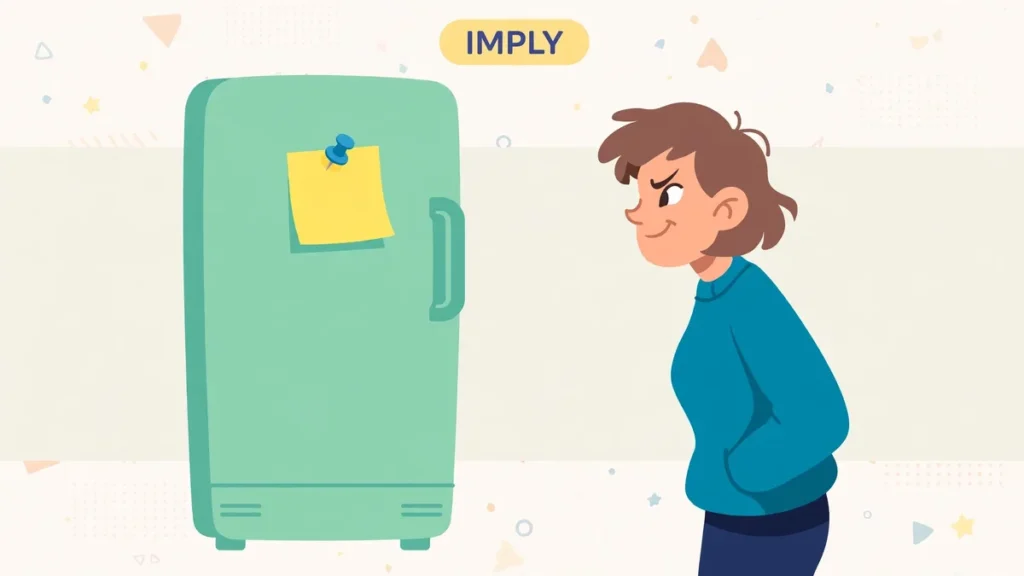
Say your roommate leaves a note on the fridge: “Some of us did dishes this week.” Nobody got named. She still implied that you didn’t.
People aren’t the only ones who imply. A $9 plain coffee implies a tourist area. A survey result can imply that most people skip the instructions. When the subject isn’t a person, imply works a lot like “point to” or “suggest.”
Here’s a quick check. Swap in “hint.” If the sentence still works, imply is the right verb.
Infer: When You Work It Out Yourself
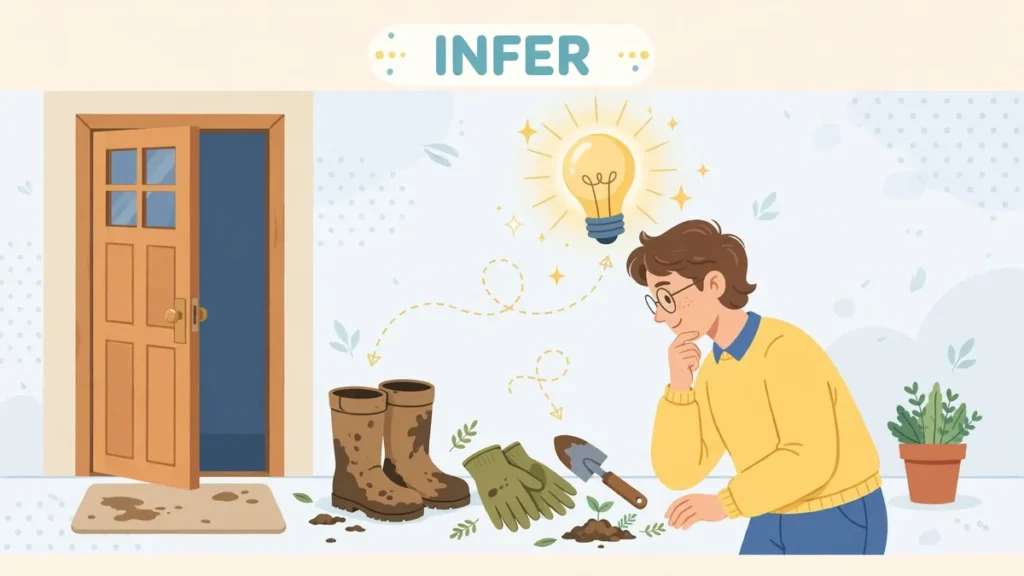
To infer is to draw a conclusion from evidence. You weren’t told. You figured it out.
Muddy boots by the back door, and your dad’s gardening gloves on the radiator? You infer he’s been out in the yard. Nobody hinted anything. The clues did the talking.
That’s why infer doesn’t need a speaker at all. You can infer something from a sales sheet, a weather map, or an empty fridge. Swap in “deduce” to test it. If the sentence still holds, infer fits.
It also sounds a bit more formal than imply, which is why you’ll see it in reports and logic problems more than in group chats.
One Message, Two Jobs
Now try a different note on the same fridge: “Whoever bought the oat milk, it’s gone. Again.”
The writer is implying that someone in the flat keeps finishing milk that isn’t theirs. The reader is inferring that the someone might be them. One message, two different jobs.
| Item | Meaning | Use it when | Example |
|---|---|---|---|
| Imply | Hint at something without saying it | You’re the one speaking or writing | “She implied the report was late.” |
| Infer | Reach a conclusion from clues | You’re the one listening or reading | “I inferred the report was late.” |
| Implication | The hidden message itself | You’re naming what was hinted | “The implication was clear.” |
| Inference | The conclusion you drew | You’re naming what you worked out | “That’s a fair inference.” |
See Also: Affect vs Effect: How to Pick the Right Word Every Time
The Mistake You’ll Hear Most Often
“Are you inferring that I’m lying?”
It sounds natural, and it’s wrong. The person asking wants to know whether you’re hinting at something, so the verb is implying: “Are you implying that I’m lying?”
The mistake runs the other way too. “I implied from your silence that you didn’t like it” gets it backwards, because you’re the one drawing the conclusion. That should be inferred.
My advice: before you pick, ask yourself who’s holding the pen. If you’re choosing the words, it’s imply. If you’re reading between the lines, it’s infer.
Can “Infer” Ever Mean “Imply”?
You’ll run into it. Some people use infer to mean imply, and some dictionaries note that this use has been around for centuries.
Plenty of style guides still call it an error, especially when a person is the subject. In published writing it shows up mostly in informal pieces.
So keep the two words apart. You lose nothing by doing it, and you won’t hand an editor or a picky reader a reason to wince. Just don’t be shocked if someone at the next table gets it backwards.
Spelling and Word Forms
Imply is simple: implies, implied, implying. The y becomes ied in the past tense and stays put in implying.
Infer asks a little more. It doubles the r before the ending, so you get inferred and inferring. Dropping that second r (infered) is an easy slip.
The adjective forms follow the same split. An implied meaning is one that was hinted at. An inferred meaning is one that a reader worked out, and it can vary from reader to reader.
See Also: Accept vs Except: Difference, Examples, and a Quick Test
Imply vs Insinuate
Insinuate also means to hint, but it usually has a sly or unfriendly edge. “He insinuated that she took the money” sounds like an accusation in disguise. “He implied she was late” sounds neutral.
Both words belong to the sender’s side. Whoever hears an insinuation still infers, just as they would with an implication.
When you want a plain, neutral hint, imply is the safe pick. Save insinuate for moments when the hint feels like a dig.
See Also: Loose or Lose: What’s the Difference? Meaning and Examples
Three-Question Quiz
Fill in each blank with a form of imply or infer.
1. The sign on the gym door says “Members only after 6 p.m.” I ______ that I shouldn’t bring a friend.
2. The test scores ______ that the new study method works.
3. “Are you ______ that I broke your lamp?”
Answers: 1. inferred (you worked it out from the sign). 2. imply (the scores point to a conclusion). 3. implying (the speaker is asking about a hint, not drawing a conclusion).
Quick Answers
Are imply and infer opposites?
They’re two sides of one exchange. One person hints, the other draws the conclusion.
Can you infer something nobody implied?
Yes. Evidence like muddy boots or a spreadsheet can lead you to a conclusion without anybody hinting at anything.
Can an object imply something?
Yes. A price, a sign, or a set of results can imply something. In those cases it usually means “point to.”
Is using infer to mean imply wrong?
Many writers and editors treat it as a mistake. Even where dictionaries record it, the safe move is to keep the two apart.
What are the noun forms?
Implication is the hinted message. Inference is the conclusion you reach.
A Final Thought
If you catch yourself typing “Are you implying…?” in a tense email, try “Do you mean…?” instead. It asks the same thing without the edge, and it gives the other person room to answer plainly.

Leave a Reply