
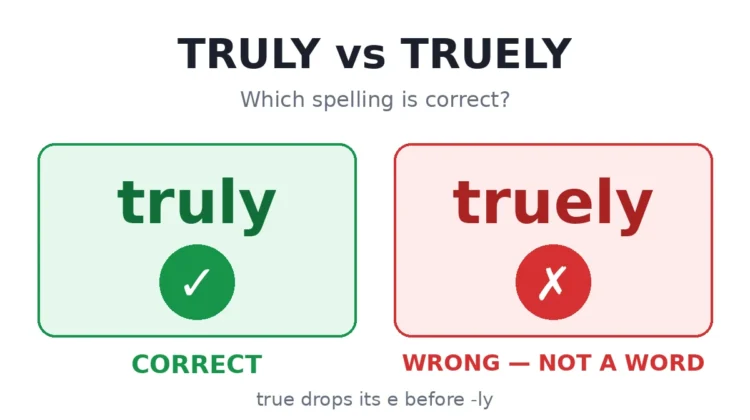
Truly is the correct spelling, and truely gets flagged as incorrect. Say you’re typing a thank-you note to a landlord who fixed your heater on a Sunday, and you write “I truely appreciate it.” The spellchecker underlines the word, and now you’re wondering which spelling your brain has been lying to you about.
Is it Truly or Truely?
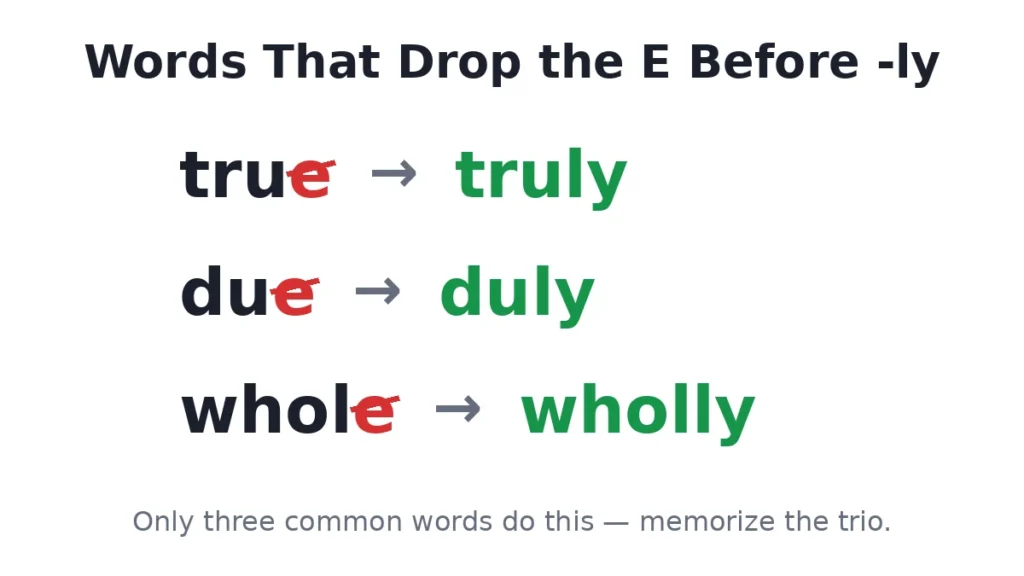
Truly is the correct spelling. Truely is a misspelling. The adjective true drops its silent e when -ly is added, so true becomes truly, the same way due becomes duly and whole becomes wholly. Truely is never correct in modern English. Use truly every time, including in “yours truly.”
The rule in one sentence
Take true, delete the e, add -ly. That’s the whole fix.
It trips people up because most words don’t work this way. Nice becomes nicely and sure becomes surely, so a writer’s instinct says true should become truely. It doesn’t.
Truly: what it means and how it’s used
Truly is an adverb built from true, and it does three jobs. It can mean sincerely, as in “I’m truly sorry I missed your call.” It can add emphasis, as in “That was a truly awful sandwich.” And it can mean “in fact” or “in reality,” like “Is the store truly closed on Mondays?”
It can also appear at the front of a sentence for a bit of weight: “Truly, nobody blames you for taking the day off.” That reads a little formal, but it’s fine in a note or a speech.
See Also: Continuous vs Continous? Which Is Correct? (3 Tricks, 2026)
Truely: a spelling that lost out
Spellcheckers flag truely, and dictionaries treat it as an error, so there’s no regional or casual variant where it’s acceptable.
It used to be fine, though. Shakespeare spelled it that way. English spelling was loose for centuries, and “truly” only became standard in the 1700s. “Truely” still turns up in print in the 1800s, sometimes next to “truly” in the same passage.
None of that is why people type the extra e today. The real cause is simpler: the word they’re building from, true, ends in one.
Why true loses its e
English usually keeps a silent e before a suffix that starts with a consonant. Three common words break that habit:
| E stays | E drops |
| nice → nicely | true → truly |
| sure → surely | due → duly |
| complete → completely | whole → wholly |
| sincere → sincerely |
I wouldn’t hunt for a pattern behind the three. There isn’t a tidy one, and memorizing them takes less time than looking them up. Truly, duly, wholly.
The same instinct causes a related mistake: argue + ment gives “argument,” not “arguement.”
Truly and truely side by side
| Item | Meaning | Use it when | Example |
| Truly | Sincerely, genuinely, in fact, or very (as an intensifier) | Always, anywhere you need the adverb form of true | “I truly miss the old bus route.” |
| Truely | Nothing. It’s a misspelling of truly | Never | ✗ “I truely miss the old bus route.” |
Truly in real sentences
| Situation | Example |
| A text to a friend | “Thanks for covering my shift. I truly owe you one.” |
| A hotel review | “The Wi-Fi was truly terrible, and the breakfast ended at 8:30.” |
| An apology email | “I’m truly sorry about the late payment. It went out this morning.” |
| A group chat | “Is that truly the last slice of pizza, or are you hiding one?” |
| A joke about yourself | “Yours truly spent forty minutes looking for keys that were in his pocket.” |
| A recommendation letter | “Priya is truly one of the most reliable people I’ve managed.” |
Where this mistake slips through
Typing fast is how it happens. A few situations make you do a lot of that.
Sign-offs. “Yours truly” always has truly in it. In the US, it’s a common closing for a business letter or email, whether you know the person or not. In British English, “Yours faithfully” is the usual choice when you don’t know the recipient’s name. “Yours truly” also works as a joking way to say “me,” as in the keys example above. Both uses are old: the letter closing is recorded by 1788, and the “me” sense by 1833.
Apologies and thank-yous. You type these quickly and with feeling, so “I truly appreciate it” and “we’re truly sorry” are easy to send without a glance. A misspelling in an apology costs you more than it should.
Reviews, captions, and bios. Gushing leans on intensifiers like truly, and intensifiers get typed on autopilot.
Quick check: spot the error
Two of these three contain the mistake.
- “I’m truely grateful for the ride home.”
- “She was truly surprised by the party.”
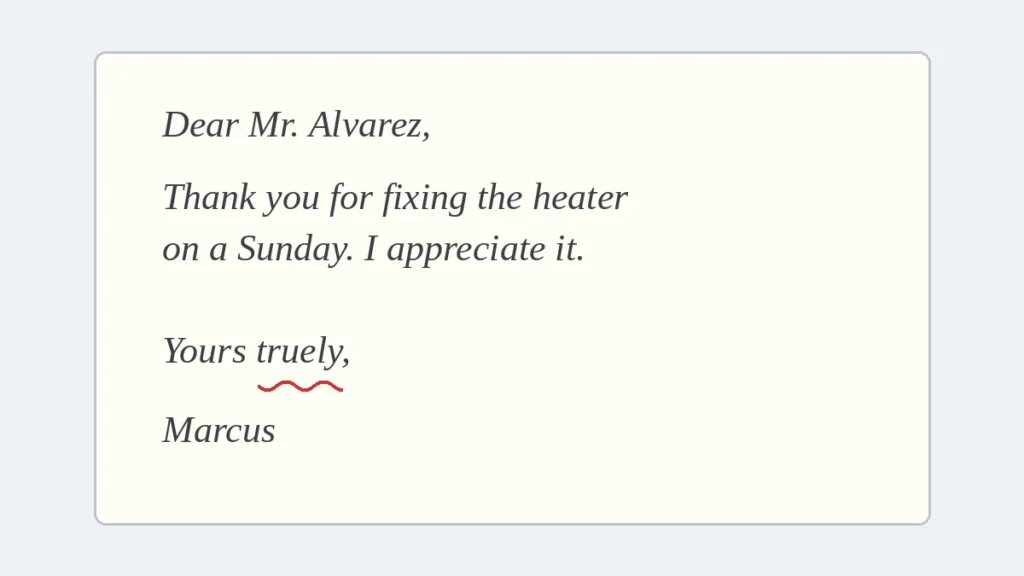
- “Yours truely, Marcus”
Sentences 1 and 3 have it. Sentence 2 is correct.
Another misspelling to watch: trully
“Trully” shows up too, and it’s wrong for the same reason truely is. The word is true minus its e, plus -ly—one l.
A memory trick that holds up
The usual one is that the e in truely stands for error. It works, but it only covers this word. Keeping the trio in mind (truly, duly, wholly) covers three, since all of them are adverbs that drop an e you’d expect them to keep.
See Also: Performed vs Preformed
Quick Answers
Is truely ever correct?
Not today. It was an accepted spelling centuries ago, and Shakespeare used it, but modern dictionaries treat it as an error.
Is it “yours truly” or “yours truely”?
Yours truly. The spelling doesn’t change inside the phrase.
Why does true lose its e?
English spelling settled that way in the 1700s, and no rule predicts it. It’s one of three common words that drop the e before -ly, along with due and whole.
Is Truely a real name?
It’s used as a given name, but that has nothing to do with the adverb, which is always truly.
What’s the difference between truly and really?
Both can mean “in fact.” Really is the more casual of the two, and truly tends to sound more sincere or formal. “I truly appreciate it” reads warmer than “I really appreciate it” in a thank-you note.
If this word keeps catching you, set a text-replacement shortcut on your phone so “truely” auto-corrects to “truly” as you type. It takes a minute to set up, and the red line stops showing up.

[…] See Also: Truly vs Truely: Which Spelling Is Correct? (Simple Rule) […]