
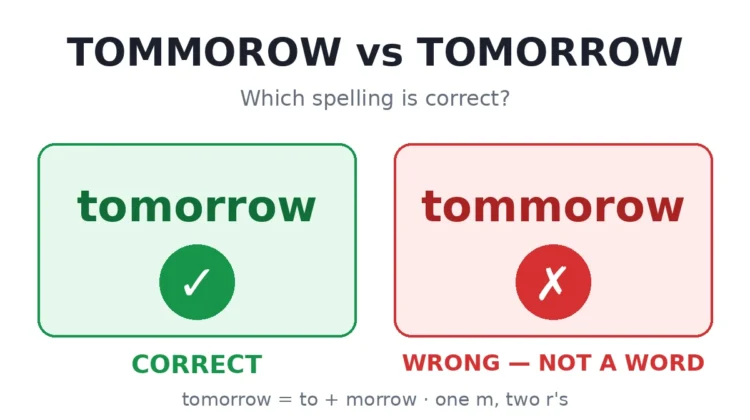
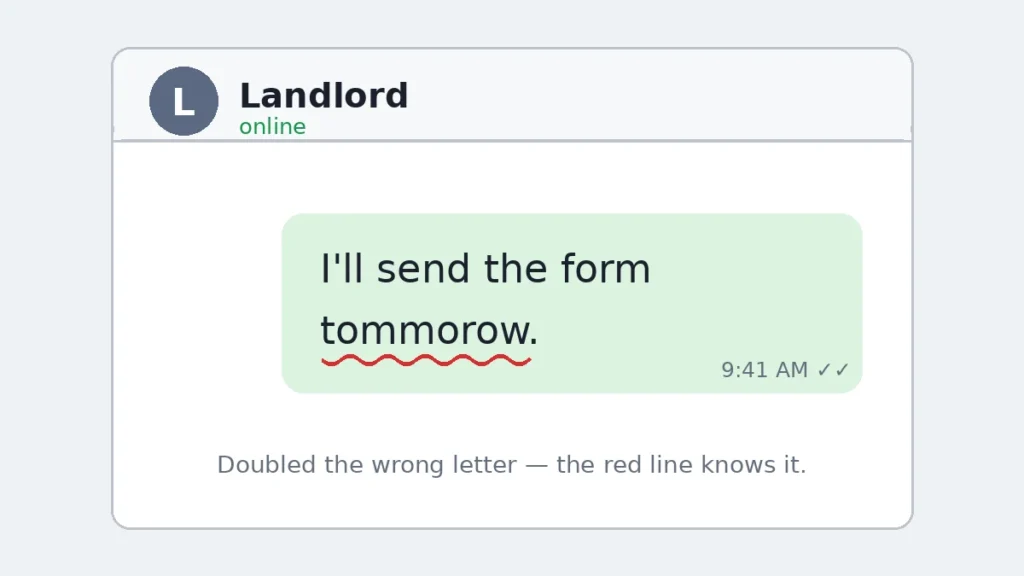
You’re typing a text to your landlord: “I’ll send the form tommorow.” The red squiggle appears, and you stare at the word, trying to decide between tommorow and tomorrow. Here’s the fix.
Is It Tommorow or Tomorrow?
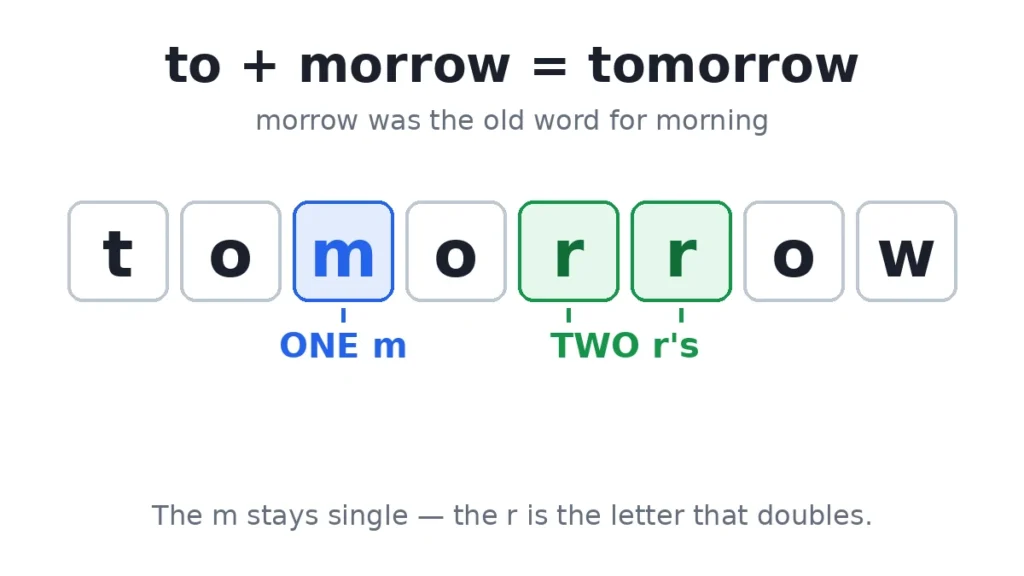
Tomorrow is the correct spelling: one m, two r’s. “Tommorow” is a misspelling, not a variant in American or British English. The word is “to” plus “morrow,” an old word for morning, so the doubled letter is the r. Example: “I’ll call you tomorrow.”
Tomorrow and Tommorow, One at a Time
Tomorrow
This is the standard spelling. It works as an adverb (“We’re leaving tomorrow”) and as a noun (“Tomorrow is Friday”). It means the day after today, and it can stretch to mean the future in general (“the leaders of tomorrow”).
Tommorow
This one isn’t a word. It’s what you get when the doubled letter lands on the m instead of the r. The writer almost always means “tomorrow,” so the meaning survives, but the spelling reads as a slip in an email, a résumé, or a school paper.
Tomorrow vs Tommorow Side by Side
| Item | Meaning | Use it when | Example |
|---|---|---|---|
| tomorrow | The day after today; the future | Every time, in every kind of writing | “The inspector comes tomorrow at nine.” |
| tommorow | Nothing. It’s a misspelling of tomorrow | Never | “The inspector comes tommorow at nine.” (incorrect) |
See Also: Truly vs Truely: Which Spelling Is Correct? (Simple Rule)
Why the Extra M Keeps Showing Up
Most people know the word has a doubled letter. They just double the wrong one. The m comes right after “to,” so your fingers already move to the next letter, while the r that needs doubling sits in the middle, where it’s easy to skim past.
Speed makes it worse. Texts, chat messages, and quick emails are where “tommorow” shows up most, because nobody checks letters one by one. And the mistyped word looks close enough to pass at a glance.
Where the Spelling Comes From
Tomorrow started as a phrase. Old English had to morgenne, roughly “on the morrow,” where “morrow” was a word for morning. By the 1200s it had fused into a single word. Older English also had “good morrow” as a greeting, which is why you still meet “morrow” in Shakespeare and old poems.
Once you see “to” plus “morrow,” the spelling stops looking random. The m belongs to “morrow,” and so do both r’s. “Today” and “tonight” are built the same way: “to” plus a time word.
Spot Your Mistake
Tommorow isn’t the only way to get this word wrong. Find the version you tend to write and see exactly what’s off.
| If you wrote | What’s off | The fix |
|---|---|---|
| tommorow | Extra m, and only one r | Drop one m, add an r |
| tommorrow | Extra m, though the r’s are right | Cut the second m |
| tomorow | Only one r | Add the second r |
| tomarrow | An a where the o belongs | Swap the a back to o |
| tomoro | Missing an r and the final w | Add an r and finish with “ow” |
If you wrote either of the first two, you’re doubling the m. Keep the m single.
Is Tomorrow Spelled Differently in the UK?
No. American and British English both use tomorrow. You may spot “to-morrow” with a hyphen in older books, but that form is archaic now, and “tommorow” isn’t a British spelling. Pronunciation shifts a bit by accent, but the spelling doesn’t.
Using Tomorrow Correctly
Once the spelling’s settled, the grammar is short. Tomorrow works as an adverb (“The plumber’s coming tomorrow”), as a noun (“Tomorrow looks packed”), and in the possessive (“tomorrow’s meeting”).
Skip the preposition “on.” You’d say “on Friday,” but not “on tomorrow.” Other prepositions are fine: “by tomorrow,” “until tomorrow,” “from tomorrow.”
Two idioms are worth knowing. “Jam tomorrow” is a British idiom for a promised reward that never arrives, and “here today, gone tomorrow” describes something that doesn’t last.
Here are a few realistic sentences:
| Situation | Example |
|---|---|
| Texting a dentist | “Can you move my appointment to tomorrow at 9?” |
| Tracking a package | “It says delivery by 8 p.m. tomorrow.” |
| School note | “Tomorrow’s bake sale starts at 7, so I’m making the cookies tonight.” |
| New habit | “Starting tomorrow, I’m walking to work.” |
| Rent reminder | “The rent’s due the day after tomorrow.” |
| Travel plans | “Our flight leaves tomorrow at 6:40 a.m.” |
The Memory Trick Worth Using
Most tricks ask you to count letters or invent a silly sentence. I’d skip those. The one that sticks is a rhyme: borrow, sorrow, tomorrow. All three share the same ending, and all three double the r. If the word feels wrong when you type it, say the rhyme in your head and check the middle.
See Also: Continuous vs Continous? Which Is Correct? (3 Tricks, 2026)
Quick Check
Try these three, then compare with the answers below.
- The bake sale is ___ morning. (tommorow / tomorrow)
- I’ll reply by ___. (tomorow / tomorrow / tommorrow)
- How many r’s does tomorrow have?
Answers: 1) tomorrow. 2) tomorrow. 3) Two.
Quick Answers
Is it tomorrow or tommorow?
Tomorrow. “Tommorow” is a misspelling.
Does tomorrow have one m or two?
One m. The doubled letter is the r.
Why does tomorrow have two r’s?
The word comes from “to” plus “morrow,” and “morrow” carries both r’s. They match the r’s in “borrow” and “sorrow.”
Is tomorrow spelled differently in British English?
No. It’s tomorrow in both British and American English.
Is tomorrow a noun or an adverb?
Both. It’s a noun in “Tomorrow is Friday” and an adverb in “I’ll see you tomorrow.”

[…] See Also: Tommorow vs Tomorrow: Which Spelling Is Correct? […]