
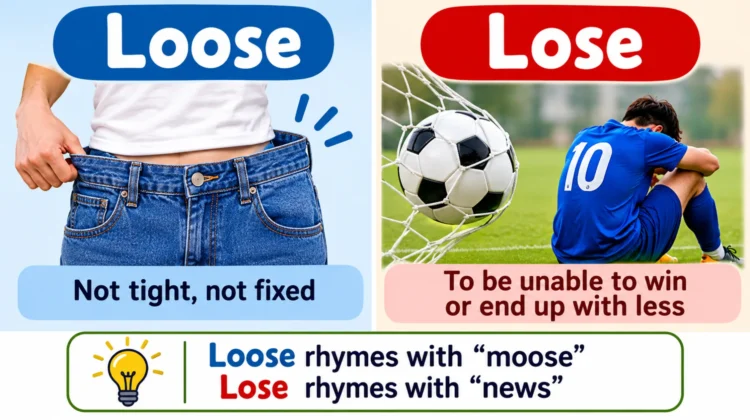
You’re texting your roommate: “Don’t loose that parking receipt.” Your thumb hovers. Two o’s or one? Loose or lose looks fine both ways, and that’s exactly why it trips people up.
Which Is Correct: Loose or Lose?
Lose is the one you do: you misplace keys, fail to win a game, or end up with less weight. Loose is the one you describe: a tooth or a pair of jeans that isn’t tight or fixed. Lose is a verb, and loose is mostly an adjective.
What “Lose” Means
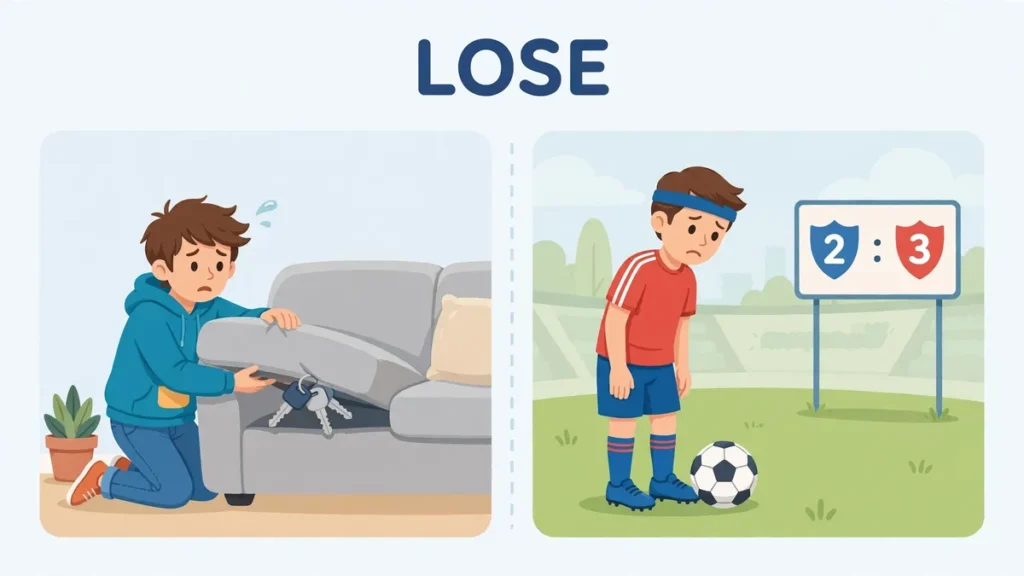
Lose is about something going missing or slipping away. You can lose a physical thing, a contest, or something you can’t hold in your hand.
- Keys, phones, umbrellas: “I lose my charger at least once a month.”
- Games and arguments: “Our team could lose the semifinal if the goalie’s still injured.”
- Weight: “He wants to lose ten pounds before the wedding.” It’s always lose weight, never loose weight.
- Time and money: “We lost forty minutes sitting in traffic on the bridge, and I’d hate to lose the hotel deposit too.”
- Feelings and states: lose hope after a rejection email, lose patience on hold, lose your temper in traffic.
The past form is lost, and so is the past participle. “Losed” isn’t a word. If your sentence is already in the past, you’re writing “lost,” with one o.
See Also: Affect vs Effect: How to Pick the Right Word Every Time
What “Loose” Means
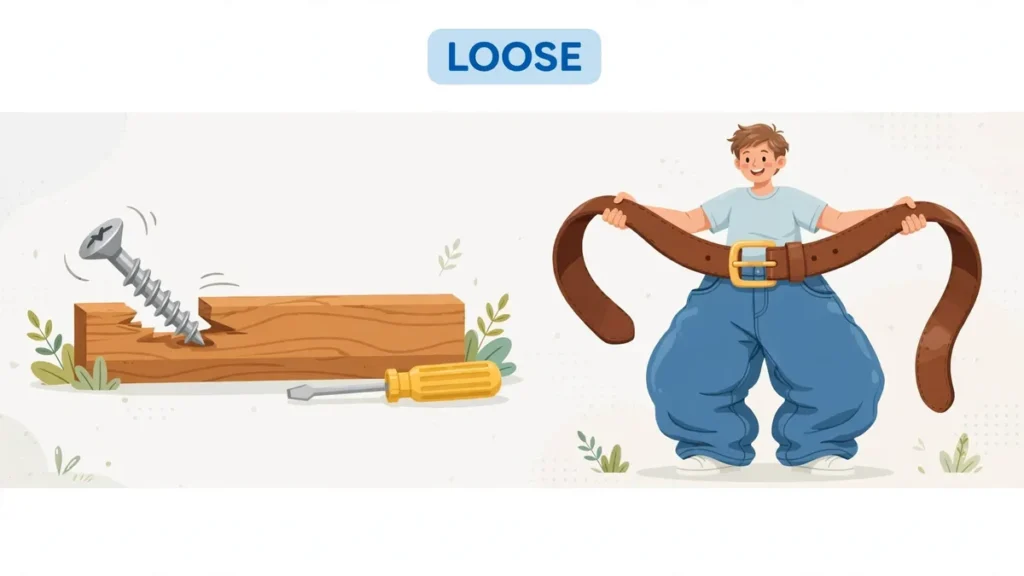
Loose mostly describes a condition. Something that isn’t tight, isn’t attached firmly, or isn’t tied down is loose.
A wobbly cabinet handle is loose. So are sweatpants a size too big, a dog that slipped its leash, or a rough guess (“a loose estimate”). Set phrases use it too: a lion that escapes the zoo is on the loose.
Loose works as a verb too, though it’s uncommon. It means to release or let fly, as in “The archer loosed an arrow.” If you simply mean to make something less tight, the word you want is loosen: “Loosen the lid before you hand me the jar.”
Watch the money phrases. Loose change uses loose, but lose money uses lose. Coins rattling in a cup holder are loose. Money vanishing from your account is lost.
Loose vs Lose Side by Side
| Item | Meaning | Use it when | Example |
| lose (verb, ends in a z sound) | to be unable to find something, not win, or end up with less | something goes missing, a contest isn’t won, or an amount drops | I always lose my earbuds on the bus. |
| lost (past of lose) | already misplaced, not won, or gone | you’re describing what happened | We lost by two points. |
| loose (adjective, ends in an s sound) | not tight, not fixed, or free | you’re describing how something fits, sits, or moves | The handle on the fridge is loose. |
| loose (verb, rare) | to release or let fly | you mean setting something free, like an arrow | The archer loosed an arrow. |
| loosen | to make something less tight | you’re undoing a belt, screw, or lid | Loosen the bolt a quarter turn. |
See Also: Leach vs Leech: Which Is Correct? (Easy Rule + Examples)
A Five-Second Swap Test
Spelling tricks fail when you’re typing fast. A meaning check works better, and it takes about five seconds.
Try swapping in misplace, fail to win, or have less of. If the sentence still makes sense, you need lose. “Don’t misplace your ticket” works, so “Don’t lose your ticket” is right.
Now try not tight or free. “The screw is not tight” and “the dog is free” both fit what loose means, so those sentences take loose.
My advice: lean on the swap test. It starts from what you mean, so you don’t have to recall which spelling has the extra o.
Say it out loud
The two words don’t sound alike, even though they look close. Lose ends in a z sound and rhymes with news, shoes, and choose. Loose ends in an s sound and rhymes with goose, moose, and juice. If you’d say “looz,” write lose. If you’d say “loos,” write loose.
Losing, Loosing, Loser, Looser
The same mix-up spills into the other forms, and one letter changes the meaning completely.
Losing is the -ing form of lose: “We’re losing daylight, so grab your jacket.” Loosing is the -ing form of the rare verb loose, so it means releasing: “loosing the hounds.”
That makes “I’m loosing my mind” a mistake. You’re losing your mind, with one o.
Loser is someone who loses: “Kevin was a gracious loser and shook the champion’s hand.” Looser just means more loose: “These jeans got looser after the wash.”
Both in one sentence: “The loser of the match wore looser shorts than the winner.” Different words, different jobs.
See Also: May vs Might: Difference, Meaning and Examples You Can Use
Why These Two Get Mixed Up
The sound is the real culprit. Lose has one o but carries the same long oo vowel as loose, so the two words match until the last consonant.
There’s an old link, too. Lose comes from Old English losian, while loose came into English from Old Norse lauss. Both go back to a very old shared root meaning to loosen or divide. They’re distant relatives that ended up with very different jobs.
Quick Quiz: Pick Loose or Lose
Fill each blank with the right word, then check the answers below.
- I keep ______ screws in a jar, and half of them don’t match anything.
- Dana didn’t want to ______ her place in line for the bathroom.
- The knot felt ______, so I pulled it tight.
- Hurry up, we’re ______ daylight.
- These jeans got ______ after one wash.
Answers: 1. loose. 2. lose. 3. loose. 4. losing. 5. looser.
Quick Answers
Is it “lose weight” or “loose weight”?
Lose weight. Your weight goes down, so you’re ending up with less of it, and that’s the job of the verb lose.
Do you lose or loose a game or time?
Lose in both cases. You lose a game, and you lose time. Loose only fits if you mean let go or set free.
How do you pronounce lose and loose?
Lose ends in a z sound, like “news.” Loose ends in an s sound, like “goose.”
Can loose be a verb?
Yes, but it’s rare. It means to release or let fly, as in “loosed an arrow.” For making something less tight, use loosen.
What’s the difference between loser and looser?
A loser is someone who loses. Looser means more loose. If a belt is a notch looser, nobody’s lost anything.
Final Thought: Search Your Draft for “Loose”
Spell check won’t flag this mix-up, because both words are real. Before you publish anything, search the draft for “loose” and “loosing” and run the swap test on each hit. That’s where the slip hides.

Leave a Reply