
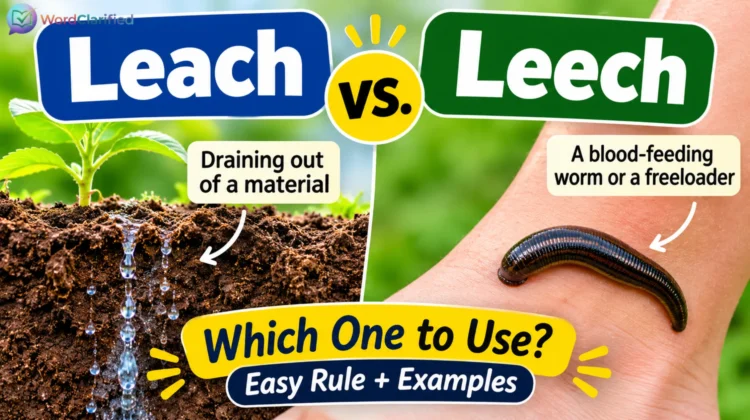
You’re texting your landlord about lead in the old pipes when you freeze on one word: leach or leech? Spell-check accepts both, and they sound identical, which is the whole trouble with leach vs leech.
What Is the Difference Between Leach and Leech?
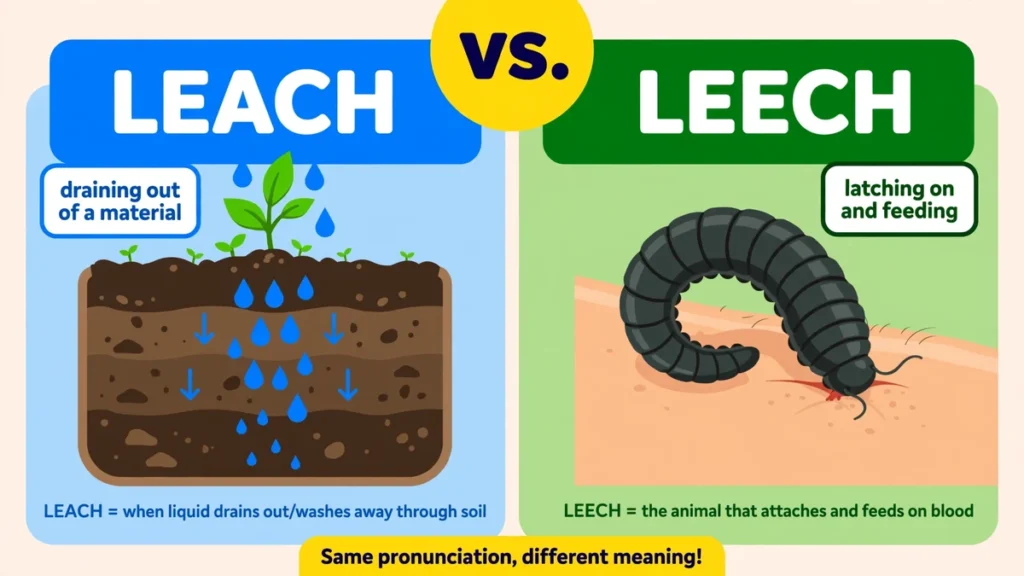
Leach is a verb for something draining out of a material, like nutrients from soil or lead from old pipes. Leech is the blood-feeding worm, or a person who clings to others and takes without giving. They sound identical, so ask which one is happening: seeping out, or latching on.
What Does Leach Mean?
Leach is a verb. A liquid, usually water, passes through something solid and carries part of it away. The solid loses something, and that something ends up where it wasn’t supposed to be.
Rain does it to a garden bed. After one soggy spring, a lot of the nitrogen can wash out before the tomatoes get to use any of it. Road salt does it too, slowly working its way toward a roadside well.
The word stretches past chemistry. Colour leaches out of a room once everything gets painted beige. Warmth leaches out of a conversation. In those uses, something drains away slowly.
Forms: leach, leaches, leached, leaching. It usually comes with a preposition: leach out of, leach from, leach into, leach away.
See Also: Principle vs Principal: Which One Do You Need? Examples
What Does Leech Mean?
Leech has more jobs, and they all involve something latching on.
As a noun, it’s the worm: a soft, segmented animal that lives in ponds, streams, and other damp places. Many leeches feed on blood. You’d meet one after wading through a marshy creek, usually when it’s already on your ankle.
It’s also a person. Calling someone a leech means they take money, favours, or free dinners and give nothing back. It’s informal, and it stings. Say it to a coworker’s face and expect a chilly lunch.
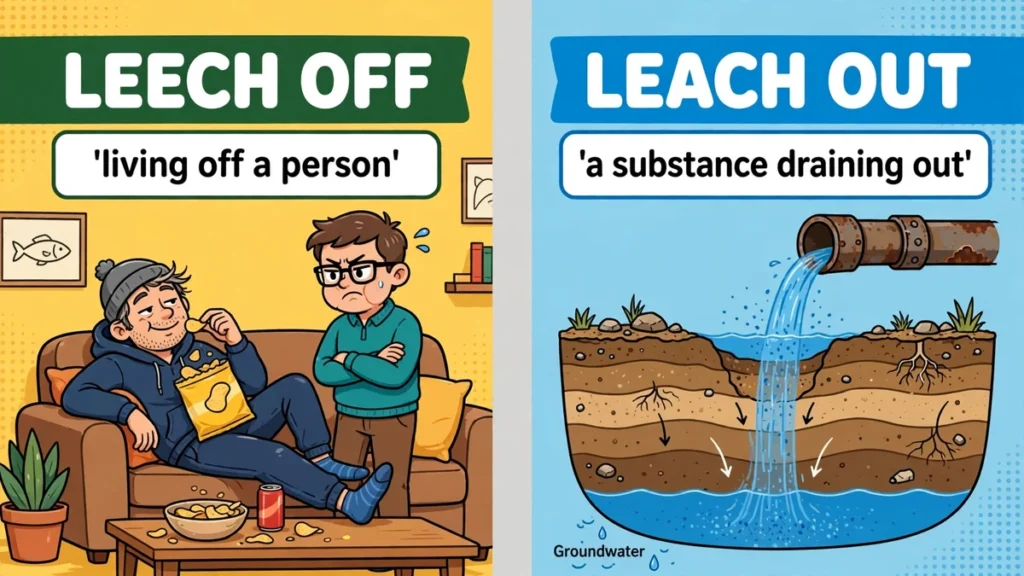
As a verb, leech goes with off: he leeches off his roommates; she’s been leeching off her parents’ phone plan. The verb can also mean draining the strength or substance out of something, and that’s where much of the mix-up with leach begins.
Medicinal leeches are still in use. The FDA cleared them as medical devices in June 2004, and surgeons use them to help blood flow after operations like reattaching a finger or toe.
See Also: Leaped or Leapt: Which Is Correct? (US vs UK Rule)
Leach vs. Leech Side by Side
| Item | Meaning | Use it when | Example |
| Leach (verb) | A liquid carries a substance out of a material | Something is draining out of soil, rock, pipes, or fabric | Rainwater leached the salt out of the old planter. |
| Leech (noun, animal) | A segmented worm, often a blood feeder | You mean the creature | She flicked a leech off her ankle. |
| Leech (noun, person) | Someone who takes without giving | You’re calling out a freeloader | Everyone knew Rick was the group’s leech. |
| Leech (verb) | To cling to someone and drain what they have | A person is living off another person | He’s been leeching off his cousin since March. |
Which Word Fits? Situations You’ll Actually Write
Most people don’t look up definitions. They look at their own sentence. Find the closest match here.
| Situation | Word | Example sentence |
| Dye running in the wash | leach | The new red towel leached dye into the whole white load. |
| Old pipes and tap water | leach | The inspector worried the old pipes might leach lead into the kitchen tap. |
| A friend who never pays | leech | Dev has leeched off the pizza fund all semester. |
| A worm after a swim | leech | A leech was clamped to her ankle when she climbed out of the pond. |
| A septic system | leach | We can’t plant a maple over the leach field. |
| Part of a sail | leech | Sailors call the trailing edge of a mainsail the leech. |
| Warmth leaving a conversation | leach | The warmth leached out of the call as soon as the budget came up. |
Why Do People Write “Leech” When They Mean “Leach”?
Spell-check won’t catch it. Both are real words, so nothing gets underlined. The slip turns up in sentences about soil, chemicals, and food, where “leeching” looks more familiar and slides through.
It’s easy to see why. A leech drains blood from a host, and leaching drains material from a solid. The verb leech even has a general “drain or exhaust” sense, so the two ideas rub up against each other. The spellings still don’t swap.
My rule is simple. If the thing being drained is a material, like soil, rock, a pipe, fabric, or a tea bag, write leach. If it’s a person or an animal host, write leech.
| Wrong | Fix | Why |
| Rain leeched the salt out of the soil. | leached | Rain is draining a material. |
| He’s leaching off his sister’s streaming account. | leeching | A person is living off another person. |
| A leach was stuck to the dog’s paw. | leech | It’s the animal. |
| The colour leeched out of the curtains. | leached | Colour is draining out of fabric. |
Leech Off or Leach Off?
Leech off. If someone is living on another person’s money, time, or patience, the word is leech: leech off, leeching off, leeched off. “Leach off” for a person reads as a misspelling.
For a substance moving out of a material, the usual pairings are leach out of, leach from, and leach into. Minerals leach out of the rock. Chemicals leach from a container into the water.
A Quick Check: Pick the Right Word
Fill in each blank, then check the answers below.
- After one wet spring, most of the nitrogen had ______ out of the garden bed.
- My cousin has been ______ off my Wi-Fi since January.
- We found a ______ stuck between his toes after the creek crossing.
- The warmth ______ out of the conversation after Marcus walked in.
Answers
- Leached. Water carried the nitrogen out of the soil.
- Leeching. A person is living off another person’s service.
- Leech. It’s the worm, a noun.
- Leached. Same draining-away idea as the garden bed, just not literal.
Where Did Two Look-Alike Words Come From?
Leach comes from an Old English verb meaning to water or moisten, and it’s usually linked to leak. Leech, the worm, comes from Old English lǣce. There was also a separate lǣce meaning a doctor, and by Middle English the two had merged, probably because doctors drew blood with leeches. The doctor sense had faded from everyday English by around 1700.
For a memory hook, think of leak. Leach and leak both start with “lea,” and both are about something slipping out. Leech has two e’s, like the “eek” you’d let out when you found one on your leg.
Quick Answers
Is it leeching or leaching?
Both are correct, for different things. Leeching is for the worm and the freeloader. Leaching is for a liquid carrying material out of something solid.
Is it a leach field or a leech field?
Leach field. That’s the spelling septic guides and plumbing sites use, and it fits the meaning, since liquid waste seeps out through the soil. Many plumbers also call it a drain field.
Do leach and leech sound the same?
Yes. Both are pronounced “leech,” rhyming with reach.
Can chemicals “leech” into water?
Use leach. Leech turns up in print for this, but leach is the standard word for a liquid draining something out of a material.
Is leach ever just another spelling of leech?
Only for the edge of a sail, where some dictionaries list leach as the rarer spelling of leech.
One Last Check Before You Hit Send
Before you publish, search your draft for “leech” and read each hit out loud. If there’s no worm or person in the sentence, it should be “leach.”

Leave a Reply