
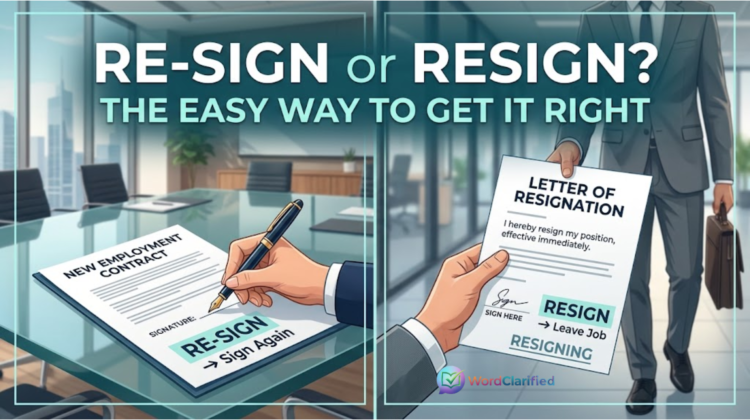
Re-sign and resign look almost the same, but they have different meanings.
Compare these two sentences:
- The coach decided to resign after the season.
- The team decided to re-sign the coach for another year.
In the first sentence, the coach is leaving the job. In the second, the team is signing the coach again.
The hyphen in re-sign helps show which meaning you intend. This difference matters in work, sports, contracts, and everyday writing.
Re-sign Means Sign Again
Re-sign means to sign again.
The prefix re- can mean “again.” So, re-sign means to sign something again. It is often used when someone signs a new or renewed contract.
For example:
- The company decided to re-sign the employee for another year.
- The player will re-sign with the team this summer.
- We need to re-sign the agreement before it expires.
- The club hopes to re-sign its goalkeeper.
- She agreed to re-sign with the company.
You may also see re-sign without an object when the meaning is already clear:
The player re-signed last week.
The reader understands that the player signed another contract.
Re-sign in Sports
Re-sign is common in sports. It often describes a team keeping a player after a contract ends.
The team plans to re-sign its starting quarterback.
This means the team wants the player to sign another contract.
The past tense is re-signed:
The team re-signed the player after a strong season.
The player signed again rather than leaving the team.
Resign Means Leave a Job or Position
Resign usually means to officially leave a job or position.
For example:
- Maria decided to resign from her job.
- The manager resigned after five years with the company.
- He plans to resign as team president.
- The director announced her decision to resign.
- I am thinking about resigning from my current position.
Two common patterns are:
resign from + job, company, or organization
She resigned from the company.
resign as + position
He resigned as CEO.
Both sentences say that the person is leaving a job or position.
See Also: Vicious or Viscous: What’s the Difference?
Re-sign vs. Resign at a Glance
| Word | Meaning | Example |
| re-sign | sign again | The player will re-sign with the team. |
| resign | leave a job or position | She decided to resign from her job. |
The hyphen in re-sign helps separate it from resign, which is a different word.
Why the Hyphen Matters
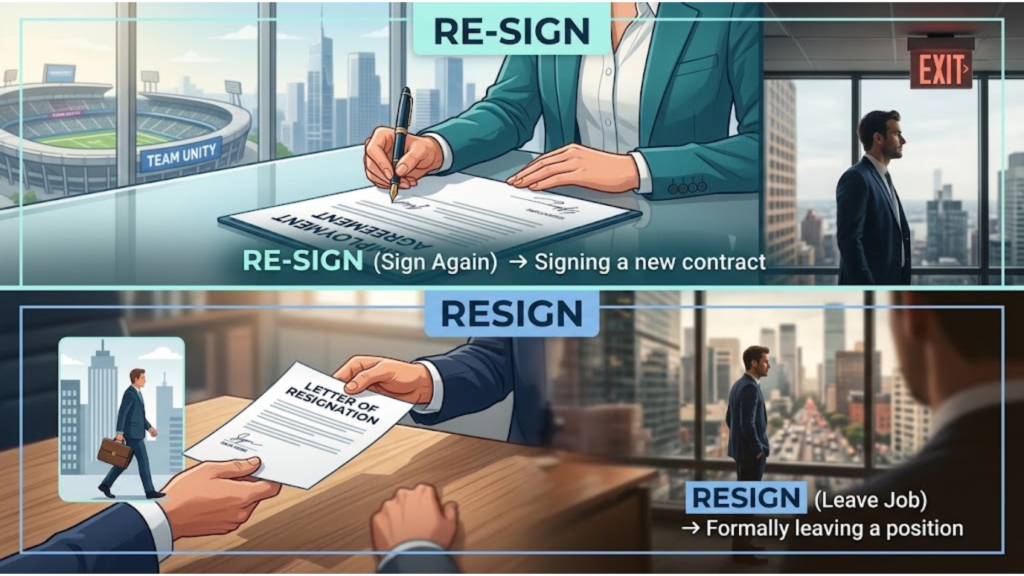
Look at these two sentences:
The player will re-sign with the team.
The player will sign another contract.
The player will resign from the team.
The player will leave the position or organization.
The words are easy to confuse because their spelling is almost identical. The hyphen makes the meaning of re-sign clearer.
This is especially useful in work emails, contracts, sports writing, and other formal situations.
Resign Has Other Meanings
Resign does not always refer to leaving a job.
It can also mean giving up a position or office.
The senator resigned from office.
There is also a special use of resign in chess.
Resign in Chess
In chess, a player can resign when they accept that they are going to lose.
After losing his queen, the player resigned.
Here, resigned means the player stopped the game and accepted defeat.
Another useful expression is resign yourself to something.
It means accepting something unpleasant because you do not expect the situation to change.
She was resigned to waiting another week.
She accepted that she would have to wait another week.
See Also: Plurals of Ox and Fox: Get It Right
Common Mistakes
A common mistake is leaving out the hyphen when you mean “sign again.”
Incorrect:
The company will resign the employee for another year.
This can be read as saying that the employee is leaving.
Better:
The company will re-sign the employee for another year.
Another mistake is using re-sign when you mean leaving a job.
Incorrect:
She decided to re-sign from her position.
Better:
She decided to resign from her position.
If someone is leaving a job or position, use resign.
If someone is signing another agreement, use re-sign.
Resigned vs. Re-signed
The past forms are easy to confuse too.
Resigned means left a job or position, gave something up, or accepted an unpleasant situation.
The manager resigned from his position.
Re-signed means signed again.
The manager re-signed his contract for another year.
The hyphen changes the meaning:
- resigned = left or accepted
- re-signed = signed again
Compare:
The player resigned from his position.
The player left.
The player re-signed with the team.
The player signed another contract.
How to Remember the Difference
The simplest way to remember these words is to focus on re-.
Re-sign = sign again.
If someone signs another contract, they re-sign.
If someone leaves a job, they resign.
For example:
The player re-signed with the team.
He signed another contract.
The manager resigned from his position.
He left his position.
So remember:
re-sign → sign again
resign → leave or give up
Re-sign or Resign in the Workplace
This difference can be important at work.
Suppose an employee’s contract is ending, and the company offers another contract.
You could say:
The company wants to re-sign the employee.
The employee is being offered another agreement.
Now imagine the employee wants to leave the company.
You could say:
The employee wants to resign from the company.
These two sentences describe very different situations.
Using the wrong word in a work email can make your meaning unclear. When discussing contracts, jobs, or positions, the hyphen in re-sign can help your reader understand exactly what you mean.
Re-sign or Resign: Pronunciation
Resign and re-sign are also pronounced differently.
In resign, the stress falls on the second syllable.
Re-sign is pronounced with a clear “re-” sound before “sign.”
Because the words have different meanings and spellings, context is also helpful when you hear them in conversation.
When you see re-sign, think:
sign again
When you see resign, think:
leave or give up
Frequently Asked Questions
Is re-sign one word or two?
Re-sign is written with a hyphen when it means “sign again.” The hyphen helps distinguish it from resign, which has a different meaning.
Does resign mean quit?
In a work context, resign means to officially leave a job or position. It can also mean giving up an office or accepting an unpleasant situation.
What is the past tense of re-sign?
The past tense is re-signed.
The player re-signed with the team.
It means the player signed again.
What is the past tense of resign?
The past tense is resigned.
She resigned from her job.
It means she left her job or position.
Do you say resign from a job?
Yes. Resign from is commonly used before a job, company, or organization.
He resigned from his job.
You can also use resign as before a position:
She resigned as manager.
Final Thought
Re-sign and resign may look almost the same, but they mean different things.
Re-sign means sign again.
Resign usually means leave a job or position. It can also mean giving something up or accepting an unpleasant situation.
When you are unsure, think about the action.
If someone is signing another agreement, use re-sign.
If someone is leaving a job or position, use resign.
That small hyphen can make your meaning much clearer.

[…] See Also: Re-sign or Resign? The Easy Way to Get It Right […]