
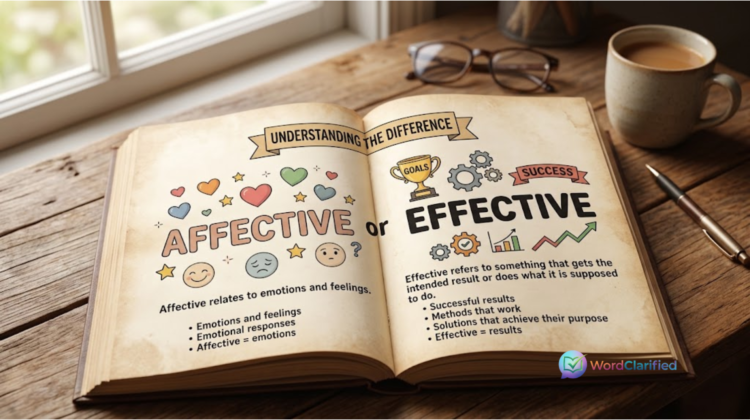
Affective and effective look and sound similar, but they have different meanings.
Affective relates to emotions and feelings.
Effective refers to something that gets the intended result or does what it is supposed to do.
For example, a student’s emotional response can be affective, while a study method can be effective if it helps the student learn.
There is another important use of effective. It can describe a rule, decision, or change that is officially in force.
Affective or Effective: What Is the Difference?
The easiest way to choose between these words is to look at what your sentence describes.
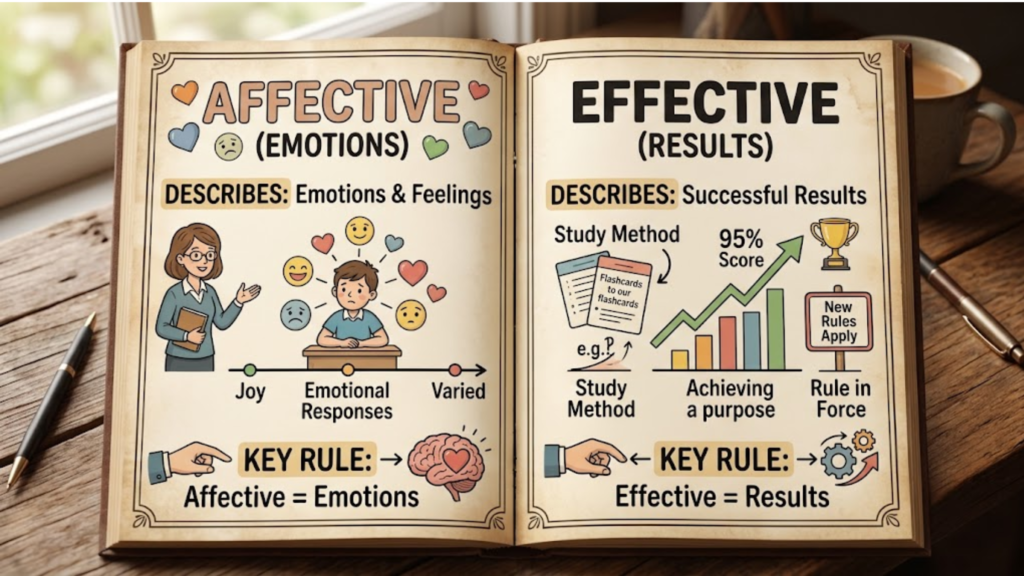
Use affective for:
- Emotions and feelings
- Emotional responses
- Emotional expression
- A person’s emotional state
Use effective for:
- Successful results
- Methods that work
- Solutions that achieve their purpose
- Rules or decisions that are in force
Compare these sentences:
The teacher noticed an affective change in the student.
The sentence refers to the student’s emotional state.
The new teaching method was effective.
The focus is on whether the method actually gets the desired result.
A simple rule can help:
Affective = emotions
Effective = results
What Does Affective Mean?
Affective describes things connected to emotions, feelings, or emotional reactions.
You are more likely to see it in psychology, education, and other writing about emotions than in everyday conversation.
For example:
The counselor asked about the student’s affective response.
The researchers examined the students’ affective development.
The patient showed an unusual affective response.
Teachers should consider students’ affective needs.
In everyday English, emotional is often more natural.
For example:
The movie had a strong emotional impact on me.
In a more specialized context, affective can describe the emotional side of an experience.
So, if you do not often use affective in daily conversation, that is normal. It is more common in specialized contexts than in everyday English.
See Also: Re-sign or Resign? The Easy Way to Get It Right
Affective in Psychology
You may see affective frequently in psychology and related subjects.
Terms such as affective response, affective development, and affective symptoms refer to the emotional side of a person’s experience.
This is why English learners may encounter affective in textbooks even if they rarely hear it in conversation.
What Does Effective Mean?
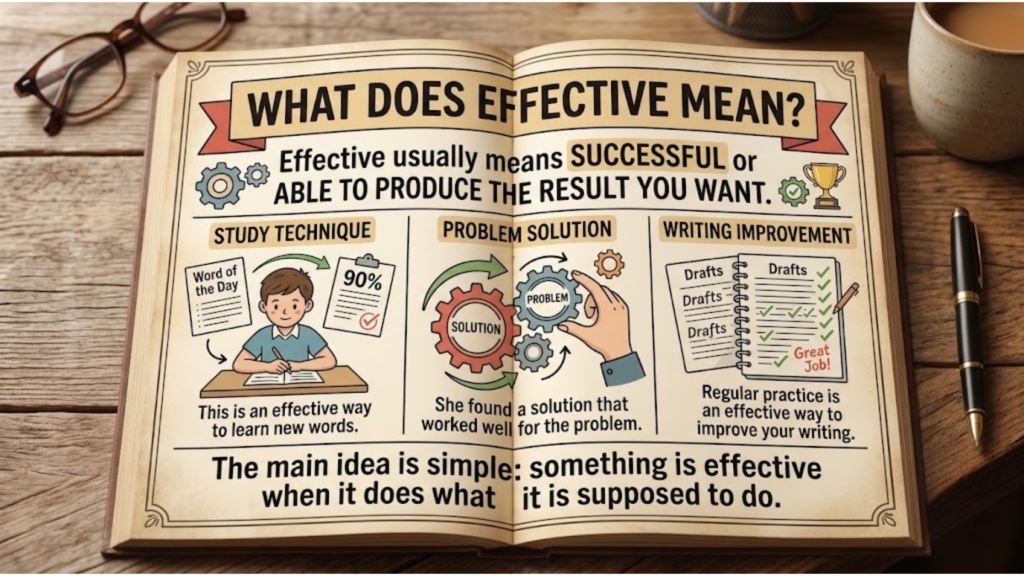
Effective usually means successful or able to produce the result you want.
It is much more common than affective in everyday English.
You can use effective to describe a method, plan, solution, tool, strategy, or treatment.
For example:
This is an effective way to learn new words.
She found a solution that worked well for the problem.
The teacher used an effective study technique.
Regular practice is an effective way to improve your writing.
The main idea is simple: something is effective when it does what it is supposed to do.
Effective Can Also Mean “In Force”
Effective has another important meaning.
When a rule, policy, agreement, decision, or change becomes effective, it starts to apply officially.
For example:
The new policy is effective immediately.
Here, effective does not mean that the policy works particularly well. It means the policy starts now.
You might also see:
The new rules will be effective next month.
The price change is effective January 1.
The agreement becomes effective today.
The correct phrase is:
effective immediately
Not:
affective immediately
How Affect and Effect Connect to These Words
Understanding affect and effect can make these words easier to remember.
In one common use, affect is a verb meaning to influence something.
Lack of sleep can affect your concentration.
Here, lack of sleep influences concentration.
Effect usually refers to the result or outcome of something.
Lack of sleep can have a negative effect on concentration.
Here, the negative effect is the result.
There is an important detail about affective. In psychology, affect is a noun related to emotional expression or emotional state. Affective is connected to this meaning.
So, affective is not simply the adjective form of the everyday verb affect.
Learning affective as a word connected with emotions is often easier than trying to work out its meaning from affect alone.
Affective or Effective in Real Examples
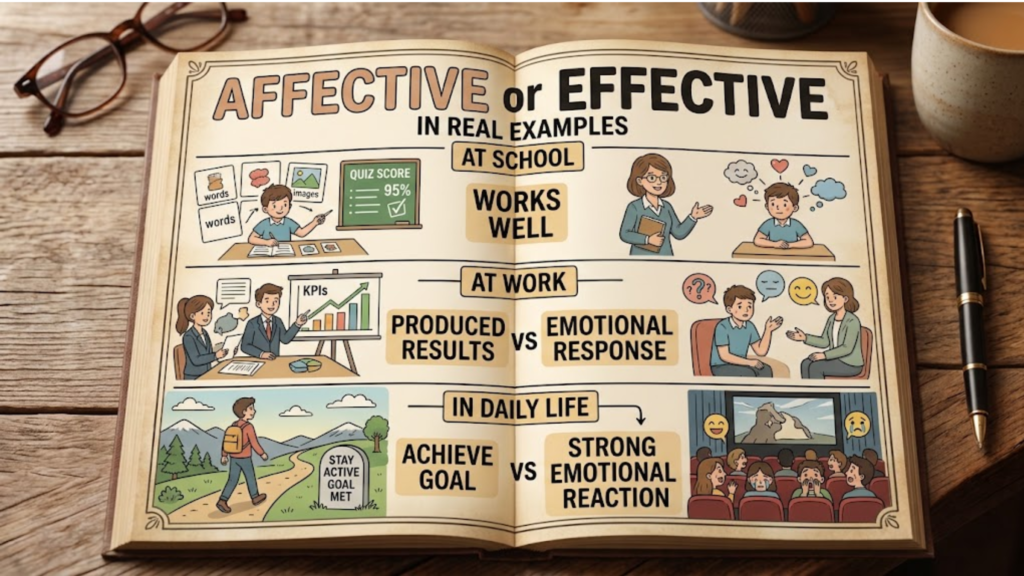
At School
Flashcards can be an effective way to review vocabulary.
The focus is on whether flashcards work.
The teacher noticed an affective change in the student’s behavior.
The focus is on the student’s emotional state.
At Work
The manager introduced an effective training plan.
The plan produced the desired result.
The counselor discussed the employee’s affective response to the stressful situation.
The sentence focuses on an emotional response.
In Daily Life
Walking is an effective way to stay active.
The activity can help achieve a goal.
The film brought out a strong emotional reaction from the audience.
The focus is on the audience’s emotions.
These examples show why the two words cannot normally replace each other. Their meanings are different.
See Also: Plurals of Ox and Fox: Get It Right
Common Mistakes With Affective and Effective
Using Affective When You Mean Successful
A common mistake is:
This method is very affective.
If you mean that the method works well, use effective:
This method is very effective.
The sentence is about the method’s success.
Using Effective for Emotions
If you are describing an emotional response, affective may be the correct choice.
The researchers recorded the participants’ affective responses.
The sentence is about emotions, not whether something worked.
Writing “Affective Immediately”
The correct expression is:
Effective immediately
For example:
The new parking rules are effective immediately.
The rules now apply.
Thinking Affective Is a Misspelling
Because effective is much more familiar, some learners assume that affective is a spelling mistake.
It is not. Affective is a standard English word with a meaning connected to emotions and feelings.
A Simple Way to Remember the Difference
Focus on the meaning rather than the spelling.
Ask yourself:
Am I talking about feelings or emotions?
If yes, affective may be the right word.
Then ask:
Am I talking about something working or producing a result?
If yes, effective is probably the right choice.
Remember:
Affective → feelings
Effective → results
There is also a useful connection between effective and effect. An effect is a result, so something that produces the desired result can be effective.
This rule will not cover every specialized use, but it works well in most situations.
Can Affective and Effective Be Used Together?
Yes. Both words can appear in the same sentence when they describe different things.
For example:
The program was effective at improving test scores, but its affective impact on students was less clear.
Effective describes the program’s results. Affective describes its emotional impact.
You can also write:
The teacher wanted an effective lesson that supported students’ affective development.
The lesson needs to work well, while the development concerns the students’ emotional side.
Affective vs. Effective Practice
Choose affective or effective in each sentence.
- The new study plan was very ______.
- The psychologist studied the patient’s ______ responses.
- The new policy is ______ immediately.
- The teacher wanted to improve students’ ______ development.
- Regular reading is an ______ way to build vocabulary.
- The experience produced a strong ______ response.
- The company needed a more ______ way to train new workers.
Answers
1. Effective
The study plan worked well.
2. Affective
The sentence refers to emotional responses.
3. Effective
The policy starts to apply immediately.
4. Affective
The sentence concerns students’ emotional development.
5. Effective
Reading is described as a successful way to build vocabulary.
6. Affective
The response is emotional.
7. Effective
The company wants a training method that works better.
Affective vs. Effective: Quick Comparison
Affective
- Related to emotions and feelings
- Often used in psychology and other specialized writing
- Describes emotional responses or expression
- Less common in everyday English
Effective
- Produces the desired result
- Means successful or useful for a purpose
- Common in everyday English
- Can also mean officially in force
The key is to focus on the meaning.
Frequently Asked Questions
Is it affective or effective?
Both are correct words, but they have different meanings. Use affective for emotions and feelings. Use effective when something works successfully or produces the desired result.
What is the main difference between affective and effective?
Affective relates to emotions, feelings, or emotional responses. Effective usually means successful or able to produce a desired result. It can also mean officially in force.
Is “effective immediately” correct?
Yes. Effective immediately is correct when a rule, policy, decision, or change starts to apply at once.
Is affective a real word?
Yes. Affective is a standard English adjective. It is used to describe things connected with emotions and feelings.
Is affective only used in psychology?
No. It can describe anything related to feelings or emotions. However, it is more common in specialized writing than in everyday conversation.
Which is more common, affective or effective?
Effective is much more common in general English. Affective has a narrower meaning and appears more often in writing about emotions.
How can I remember the difference?
Use this simple rule:
Affective = feelings
Effective = results
If you are talking about emotions, choose affective. If you are talking about whether something works, choose effective.
Final Thought
Affective and effective look similar, but their meanings are different.
Use affective for emotions, feelings, and emotional responses.
Use effective for something that works, produces a desired result, or is officially in force.
When you are unsure, ask what your sentence describes:
Feelings? Affective.
Results or success? Effective.

[…] See Also: Affective or Effective? Learn the Difference Easily […]