
Introduction
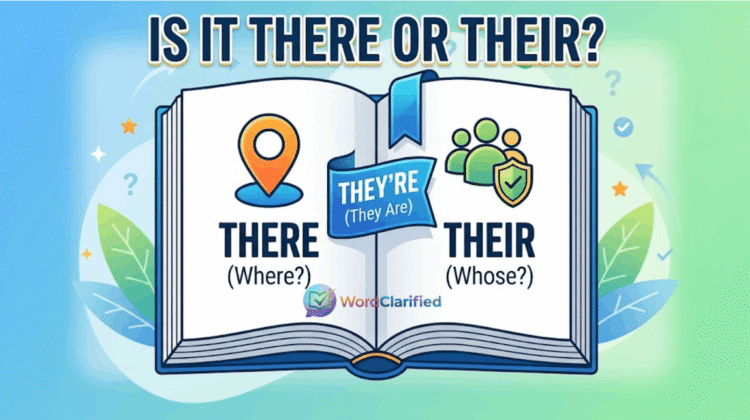
Is it there or their? These words can be confusing because they sound almost identical when spoken. The problem becomes easier once you look at what the sentence is trying to say.
If you are talking about a place, you will usually need there. If something belongs to a person or group, their is the usual choice. You may also come across they’re, which is simply a shorter form of they are.
For example, “Is it there?” asks about the position of something. “Is it their car?” asks who owns the car.
This guide explains when to use each form, shows the difference with everyday examples, and gives you a few quick ways to remember them.
Is It There or Their?
When the question is about where something is, use there.
Imagine that you are looking for your wallet. Someone tells you that it may be on the table. You might ask:
- Is your wallet there?
- Is the mail there?
- Is David there?
- Is my coat still there?
In each case, you are trying to find out where someone or something is.
Their works differently. It connects a person or group with something that belongs to them or is related to them.
For example:
- Is it their car?
- Is that their house?
- Is this their dog?
- Is it their responsibility?
Here, the question is not about a location. It is about ownership or connection.
A useful comparison is:
Is it there? → You want to know where it is.
Is it their car? → You want to know whose car it is.
So, think about the meaning before choosing the spelling.
See Also: Acclimate vs Acclimatize vs Acclimatise: Which One Should You Use?
Can “Their” Refer to One Person?
Yes. Their can be used for one person as well as for more than one person.
This often happens when the person’s gender is unknown or does not need to be mentioned. It is also used when a person uses they as a pronoun.
For example:
- Someone left their umbrella on the bus.
- Ask the customer to check their receipt.
- Every student should bring their ID.
In each example, their refers to one person.
This use is common in everyday English and is often described as singular they.
There, Their, and They’re: What Sets Them Apart?
The spelling may look similar, but the three forms do different jobs.
There is often linked to a place. It can also appear in sentences that introduce something that exists.
Their tells us that something belongs to or is connected with someone.
They’re is the contraction of they are.
Look at how the meaning changes:
The guests are there.
The word points to the guests’ location.
Their guests arrived early.
The word connects the guests with the people being discussed.
They’re waiting outside.
Here, they’re means they are.
Once you pay attention to the meaning, these spellings become much easier to separate.
What Does “They’re” Mean?
They’re is a contraction made from they and are. You will often see it in everyday writing and speech.
When you are not sure about the spelling, try expanding it to they are.
For example:
They’re late.
→ They are late.
They’re watching a movie.
→ They are watching a movie.
They’re ready to leave.
→ They are ready to leave.
Another useful example contains all three forms:
They’re carrying their bags over there.
Each word has its own meaning:
- They’re means they are.
- Their tells us who the bags belong to.
- There points to a location.
Is “Is There” the Same as “Is It There”?
No. These questions are related, but they do not ask for the same information.
“Is It There?”
Use this question when you have a particular person or thing in mind and want to know its location.
For example:
- Is the letter there?
- Is your laptop there?
- Is the manager there?
- Is my jacket there?
The object or person is already known. You are simply checking where it is.
“Is There…?”
This pattern is used to ask whether something exists, is available, or can be found.
For example:
- Is there a problem?
- Is there a seat available?
- Is there a pharmacy nearby?
- Is there a bus to the city?
Consider these two questions:
Is the letter there?
You are looking for one particular letter.
Is there a letter?
You want to know whether a letter is present at all.
That is the main difference. One checks the location of something known, while the other checks for the presence or existence of something.
Common Mistakes With There, Their, and They’re
Because these words sound alike, people sometimes choose the spelling that sounds right instead of checking the meaning.
Here are some examples:
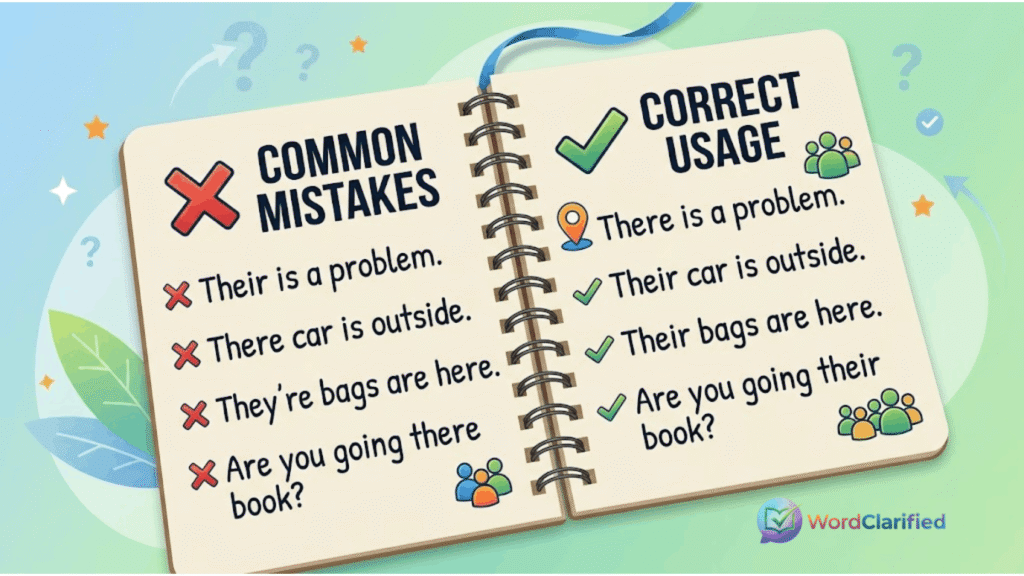
Incorrect: Is it their?
Correct: Is it there?
Incorrect: Their is a problem.
Correct: There is a problem.
Incorrect: Leave it their.
Correct: Leave it there.
Incorrect: There car is outside.
Correct: Their car is outside.
Incorrect: Their coming later.
Correct: They’re coming later.
A good habit is to pause when one of these words appears in your writing. Ask yourself what you are trying to express. Are you pointing to a place, showing ownership, or saying they are?
That quick check can prevent many spelling mistakes.
See Also: Affective or Effective? Learn the Difference Easily
A Simple Way to Remember Them
You do not need to memorize a long grammar rule. Three simple questions can help.
Think About a Place
If you could answer the question “Where?”, there may be the word you need.
Where did you leave the keys?
I left them there.
Think About Ownership
If you can ask “Whose?”, their may be the right choice.
Whose coats are these?
They are their coats.
Try “They Are”
If you are considering they’re, replace it with they are.
They’re ready to go.
They are ready to go.
If the expanded version works naturally, the contraction is appropriate.
Quick Practice
See how well you can tell the three forms apart. Fill in each blank with there, their, or they’re.
- ___ planning a trip next month.
- Your notebook is over ___.
- ___ new apartment is downtown.
- ___ are several people waiting outside.
- The players forgot ___ uniforms.
- Please put the bags over ___.
- ___ already inside the building.
- I think ___ teacher is absent.
Answers
- They’re planning a trip next month.
- Your notebook is over there.
- Their new apartment is downtown.
- There are several people waiting outside.
- The players forgot their uniforms.
- Please put the bags over there.
- They’re already inside the building.
- I think their teacher is absent.
Frequently Asked Questions
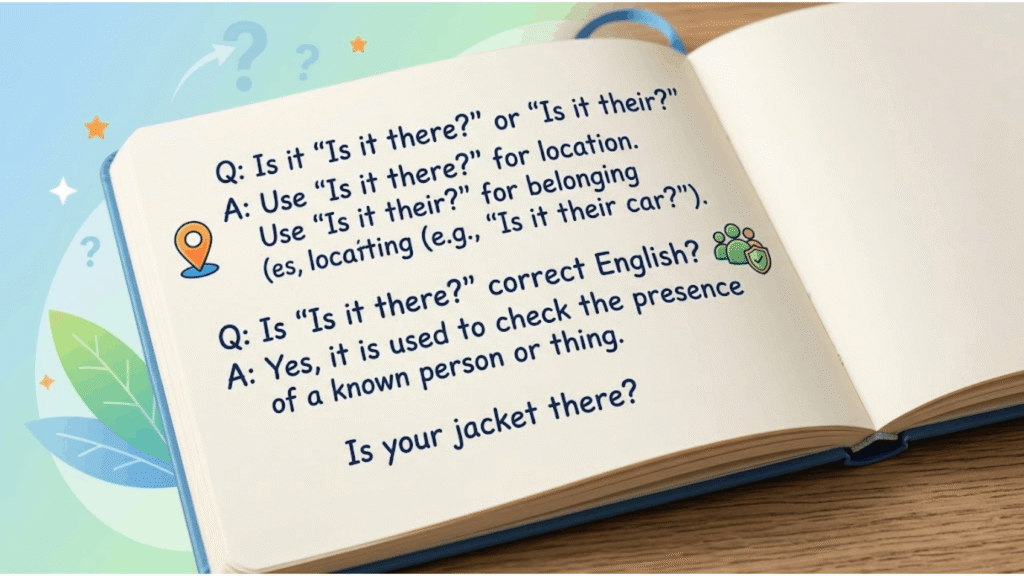
Is it “Is it there?” or “Is it their?”
If you are asking about the location of something, use “Is it there?”
If you are asking whether something belongs to someone, use their, as in “Is it their car?”
Is “Is it there?” correct English?
Yes. “Is it there?” is a correct English question.
It is used when you want to check whether a particular person or thing is in a certain place.
Can “their” stand alone?
In most cases, their comes before a noun:
- their house
- their phone
- their books
If the possessive form needs to stand by itself, theirs is used instead.
That house is theirs.
What does “there” mean?
There can point to a place, as in “Your shoes are there.”
It can also appear in structures such as “There is” and “There are” to introduce something that exists or is present.
What does “their” mean?
Their shows that something belongs to or is connected with a person or group.
For example:
Their car is outside.
The car belongs to the people being discussed.
What does “they’re” mean?
They’re is the short form of they are.
For example:
They’re coming soon.
→ They are coming soon.
What is the difference between “Is there?” and “Is it there?”
“Is it there?” is about the location of something specific.
“Is there…?” asks whether something is present, available, or exists.
For example:
Is your bag there? → You have a particular bag in mind.
Is there a bag? → You are asking whether a bag is present.
How do I remember there, their, and they’re?
Use three quick checks:
Where? → Think there.
Whose? → Think their.
They are? → Think they’re.
These questions can help you make the right choice without stopping to remember a complicated grammar rule.
Final Thought
There, their, and they’re may sound alike, but their meanings are different.
Use there when you are talking about a place or introducing something that exists. Use their when something belongs to or is connected with someone. Use they’re when you mean they are.
When one of these words causes doubt, focus on the meaning first. A quick check for place, ownership, or “they are” will usually give you the answer.

[…] See Also: Is It There or Their? The Correct Spelling Explained […]