
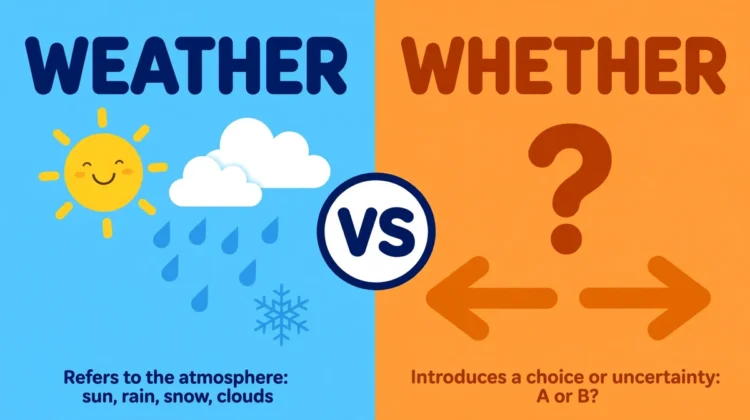
Weather and whether look and sound almost identical, but they do completely different jobs, and spellcheck will not save you, because both are real words. One talks about the sky, the other about a choice, and one quick test tells them apart.
Which Is Correct: Weather or Whether?
Weather is a noun for outside conditions, such as rain, sun, wind, and snow. Whether is a conjunction that introduces a choice or a possibility, and it often means if. If you are talking about
Use weather for conditions outside, like rain, wind, or heat. Use whether when you’re expressing doubt or choosing between options, as in “I don’t know whether it’ll rain.” Suppose you can swap in “if,” it’s whether. Talking about the sky? It’s weather.
There’s a third look-alike, wether, but it shows up only around sheep. More on that below.
What Does Weather Mean?
Weather is what the air is doing: rain, wind, heat, fog, a sky that can’t make up its mind. It’s the noun in “The weather turned halfway through the hike” and “Check the weather app before you wash the car.”
It’s also a close relative of wind. Both trace back to an old root meaning “to blow.”
The word also works as a verb. Things left outside weather, meaning they change from exposure—a cedar deck left unsealed weathers to grey. Nobody’s talking about the forecast there.
What Does “Weather the Storm” Mean?
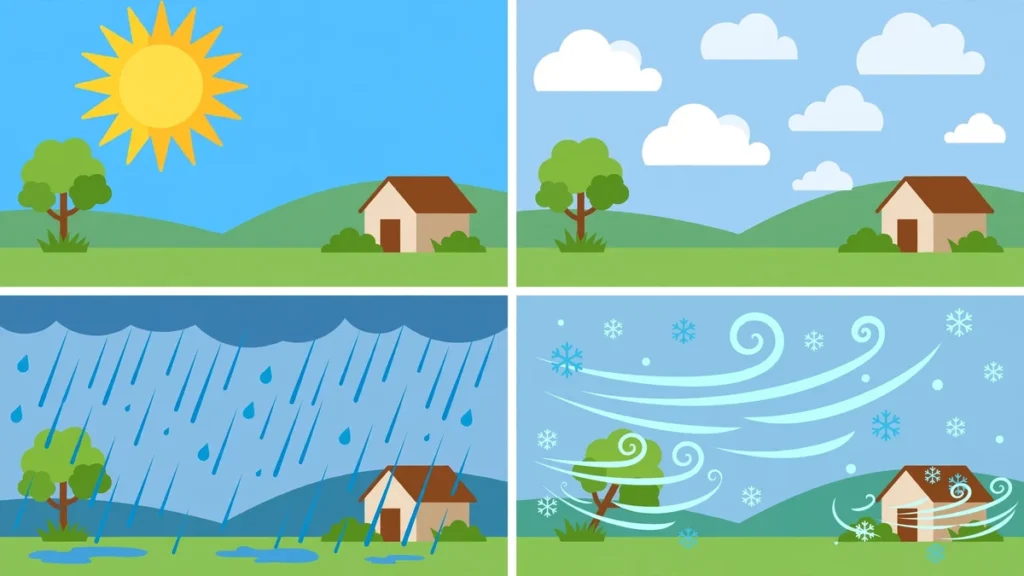
To weather something is to get through it without being broken. A bakery can weather two bad winters. A couple can weather a cross-country move and a bad lease.
The picture behind it comes from sailing: a ship riding out a real storm. “Whether the storm” can’t work, because there’s no choice or doubt in it, only a storm and something surviving it.
“Under the weather” keeps the same spelling. It means feeling ill, so “under the whether” is wrong too.
What Does Whether Mean?
Whether signals a choice or a doubt. You’ll meet it in three spots.
The first is reporting a question someone asked: “She asked whether the gym was still open.” The second is laying out two possibilities: “I can’t tell whether the bus is late or I’m early.” And the third, probably the most useful one to spot, is right before “to” plus a verb: “We haven’t decided whether to rent or buy.” In each, something is still undecided.
See Also: Principle vs Principal: Which One Do You Need? Examples
Whether vs If: When Can You Swap Them?
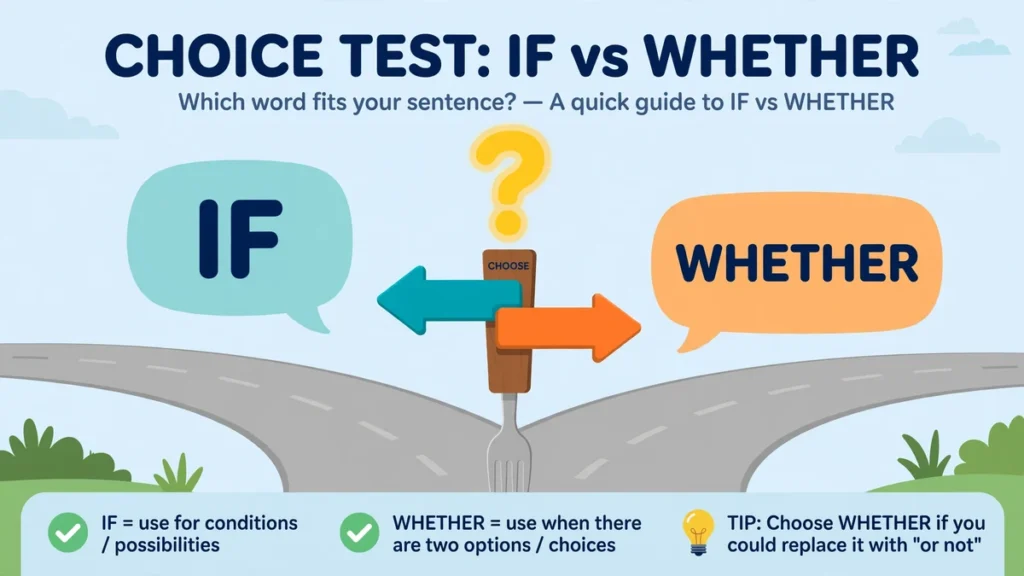
Sometimes you can. “I’m not sure if the pharmacy is open” and “I’m not sure whether the pharmacy is open” mean the same thing, and if is a little more casual.
Three situations don’t allow the swap. Before “to” plus a verb, if is simply wrong: “decide whether to go,” never “decide if to go.” After a preposition, you need whether: “the debate over whether prices will drop.” And for the “regardless” meaning, if turns the sentence into a condition, so “I’m leaving whether you like it or not” can’t become “I’m leaving if you like it or not.”
My pick: when you’re unsure, write whether. It fits every spot where if works in a question, and it fits the spots where if can’t go.
If you want other wording, “regardless of whether” and “no matter whether” cover the “either way” meaning.
Whether or Not: When “or Not” Is Required
Most of the time, “or not” is optional. “I don’t know whether he’ll come” already says everything.
Keep it when the sentence means “regardless.” Try this: delete “or not” and read the sentence again. “Whether or not the refund arrives by Friday, I’m cancelling the order” sounds unfinished without it, because the sentence no longer says the cancellation happens either way.
And the spelling? It’s whether or not, always. “Weather or not” is a misspelling.
What Is a Wether?
A wether is a male sheep that was castrated before maturity. The word also refers to a castrated male goat. Unless you write about farms, you may never need it.
You’ve probably met it indirectly, though. A bellwether was the lead sheep in a flock, the one wearing a bell so the shepherd could find the group. The word later came a mean anything that signals where things are heading. A county whose vote tends to match the national result gets called a bellwether, and nobody is talking about sheep.
Weather vs Whether vs Wether at a Glance
| Item | Meaning | Use it when | Example |
| weather (noun) | Conditions in the air: rain, wind, heat | You’re describing the sky or a forecast | The weather cleared up by noon. |
| weather (verb) | To come through something hard, or to wear from exposure | Something survives a rough stretch or ages outdoors | The shop weathered a slow winter. |
| whether | Introduces doubt or alternatives | You’re reporting a question, offering two options, or deciding “whether to” do something | She isn’t sure whether to apply. |
| wether | A castrated male sheep or goat | You’re writing about livestock | The farm sold three wethers at auction. |
Weather and Whether in Real Sentences
| Sentence | Word | Why |
| Our landlord still hasn’t said whether the lease renews in March. | whether | An open yes-or-no question |
| The weather turned halfway through the hike, so lunch happened under a bridge. | weather | Rain and wind, nothing else |
| Nobody on the team knew whether to laugh or apologize. | whether | Comes right before “to” plus a verb |
| The bakery weathered two years of rising flour prices without closing. | weather (verb) | Came through a long, hard stretch |
| Whether or not the refund arrives by Friday, I’m cancelling the order. | whether or not | Means “regardless” |
| Check the weather app before you wash the car. | weather | A forecast |
| The roofer won’t say whether he can start Monday until he sees Sunday’s weather. | whether and weather | Both words, doing separate jobs |
Do Weather and Whether Sound the Same?
For most speakers, yes. All three words come out as roughly “WEH-thur,” with the soft th you hear in “this,” not the sharp one in “thin.”
That’s a big reason the mix-up is so common. You can’t catch it by ear, and a basic spellcheck won’t flag it, because each one is a real word.
Some accents keep a faint breathy “hw” at the start of whether, and some dictionary entries list that variant. In most everyday speech, you won’t hear a difference.
A Memory Trick With History Behind It
Whether comes from an Old English word meaning “which of two.” That’s the same family as either and neither. Say them together: whether, either, neither. All three are about choosing between options, and all three share that “-ther” ending.
Weather belongs to a different family altogether. It’s a relative of wind, and the link isn’t hard to see: moving air is a big part of weather. So you can sort the two words by family. Choices go with either/neither; air goes with wind.
Five Wrong Sentences, Fixed
These are made-up examples, but each one shows a common mistake.
“Weather or not you agree, the vote stands.” Should be whether or not. The sentence is about two possibilities, not the sky.
“I can’t decide weather to take the train.” Needs whether. The tell is “to take” right after it.
The other three go the opposite way, with whether where weather belongs: “Check the whether forecast before we leave” (a forecast predicts conditions in the air), “The firm managed to whether the storm” (the verb meaning “survive”), and “She’s been under the whether all week” (the “feeling ill” idiom keeps the usual spelling).
See Also: Truly vs. Truely: Which Spelling Is Correct? (Simple Rule)
See Also: Leach vs Leech: Which Is Correct? (Easy Rule + Examples)
Quick Quiz
1. Fill the blank: Nobody knows _____ the ferry will run tomorrow.
Answer: whether. It’s an open question with no answer yet.
2. Which sentence is wrong?
A) The weather turned cold by noon.
B) Nobody could say weather the store opens Sunday.
C) We weathered the delay.
Answer: B. It should be “whether the store opens Sunday.”
3. Pick the right word: The company will (weather / whether) the downturn.
Answer: weather. It’s the verb meaning “to come through.”
Quick Answers
Is it “weather or not” or “whether or not”?
It’s whether or not. “Weather or not” is a misspelling, because the phrase offers two possibilities rather than describing the sky.
Can I use “if” instead of “whether”?
Sometimes, in casual questions like “I don’t know if she called.” You can’t use if before “to” plus a verb, though, and not when you mean “regardless.”
Do weather and whether sound the same?
For most speakers, yes. A few accents keep a breathy “hw” at the start of whether, but most people can’t hear any difference.
What does “weather the storm” mean?
It means to come through a hard stretch without being broken by it. The image comes from a ship riding out a real storm.
Is “wether” a real word?
Yes. It means a castrated male sheep or goat, and it’s the “wether” in “bellwether.”
Final Thoughts: Weather or Whether
Two quick searches clean up most of this pair in a finished draft. Search for “weather to” and “weather or not.” Nearly every hit should be whether. Then search for “whether forecast,” “whether app,” and “whether report,” where the slip runs the other way and nearly every hit should be weather.

Leave a Reply