
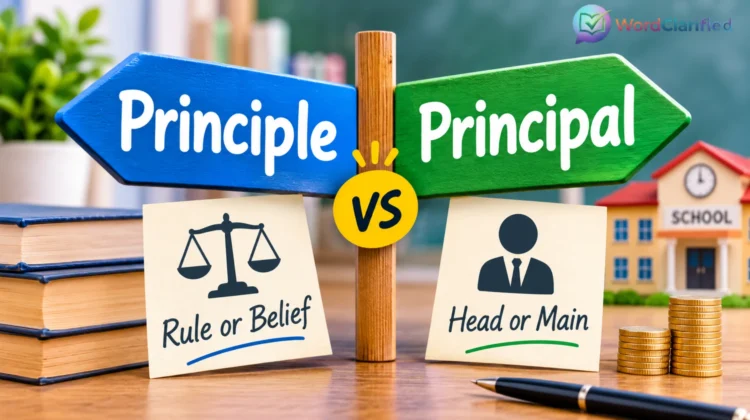
You’re writing a quick note to your daughter’s school and stop on one word — is it “the principal” or “the principle”? The mix-up catches careful writers all the time, and spellcheck stays silent because both are real words.
Is It Principle or Principal?
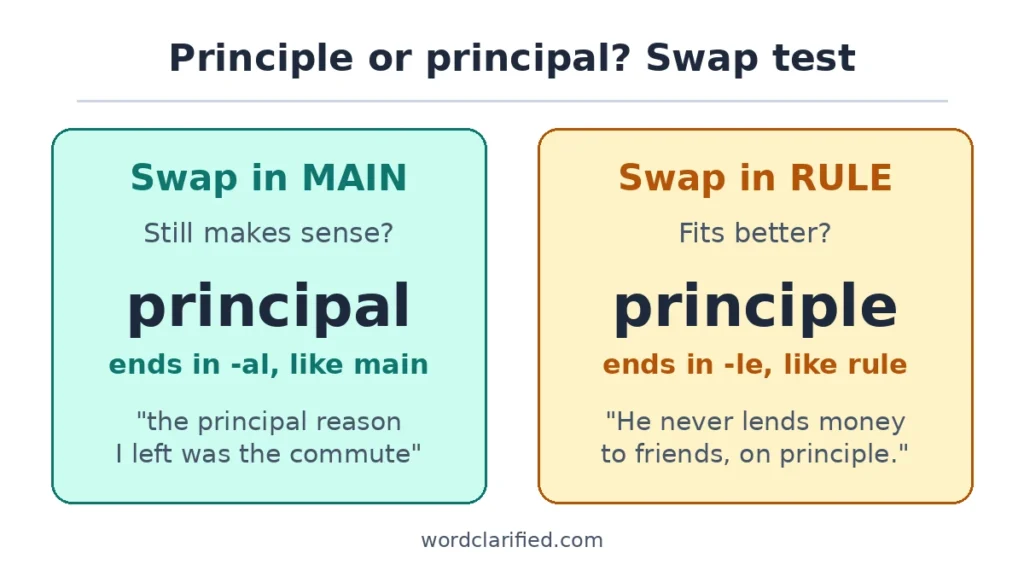
Principle is a rule or belief, and it’s only ever a noun. Principal means the person in charge, the main or most important thing, or the original sum of a loan. If you can swap in “main,” write principal. If “rule” fits, write principle. The idiom “in principle” ends in -le.
The Two-Second Swap Test
Read your sentence and try “main” in the blank. If it still makes sense, you want principal. Try “rule” or “belief” next. If that fits, you want principle.
Take “The ___ reason I left was the commute.” Swap in “main”, and you get “the main reason I left was the commute.” That works, so it’s principal. Now try “Her one ___ at dinner: no phones.” “Main” makes no sense there, but “rule” does. That’s principle.
Two cases skip the test. A school head is a principal, and so is the amount borrowed on a loan.
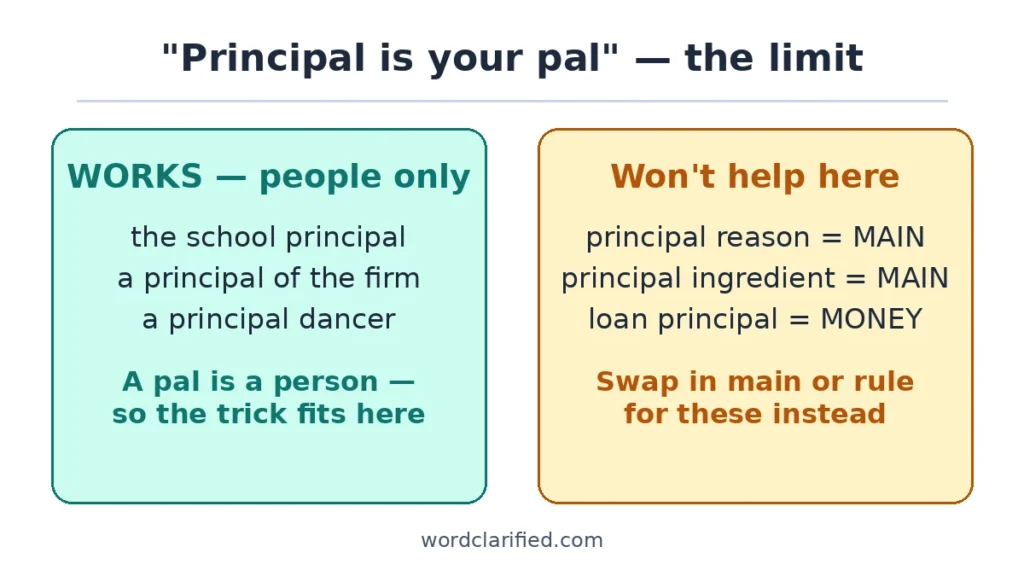
You may have heard the “principal is your pal” trick. It only helps with people, like the school head. It does nothing for “principal ingredient” or a loan, so I’d lean on the swap test instead.
See Also:
What Does Principle Mean?
A principle is a rule or belief that guides how something works or how a person behaves. It’s a noun, and only a noun.
It comes in two flavours. One is a law of how things work, like the principle of supply and demand or Archimedes’ principle, which explains why a boat floats. The other is personal: a line someone won’t cross. Picture a friend who refuses to split a restaurant bill evenly, on principle, because he ordered a salad and the rest of the table ordered steak.
Four phrases show up constantly. Someone who does something on principle does it because of a belief, whatever the cost. A matter of principle is something they won’t bend on, and a person of principle is someone known for that. Then there’s in principle, which means in theory, or in general terms with the details still open: “We’re agreed in principle, but legal hasn’t read the contract.”
Need an adjective? Use principled. Principle can’t stand in for “main”; that job belongs to principal.
What Does Principal Mean?
Principal covers three separate jobs.
Principal as “main”
As an adjective, principal means first in importance. The principal reason, the principal ingredient, the principal cities of a country. The adverb principally means “mostly,” as in “she writes principally for children.”
Principal as a person
A principal runs a school. The word also covers a partner or owner of a firm, and the lead player in an orchestra or ballet company: a principal flautist, a principal dancer. More than one? Principals.
Principal as money
On a loan or an investment, the principal is the original amount, before any interest. Say you borrow $10,000 at 5% a year. The $10,000 is the principal. A year of interest, if you paid nothing down, would be $500. A payment “toward principal” reduces what you owe instead of covering interest.
See Also: Truly vs. Truely: Which Spelling Is Correct? (Simple Rule)
Principle vs Principal Side by Side
| Item | Meaning | Use it when | Example |
| principle (noun) | A rule, belief, or basic truth | You’re talking about how something works or what someone stands for | He turned down the offer on principle. |
| principal (adjective) | Main, most important | “Main” fits in its place | Cost was the principal concern. |
| principal (noun, person) | Head of a school; leader or owner in a firm; lead performer | You mean a person in charge | The principal called an assembly. |
| principal (noun, money) | The original amount borrowed or invested | You mean the sum apart from interest | She paid an extra $200 toward principal. |
Where You’ll See Each One
| Situation | Word | Example |
| The front office | principal | The principal read the announcements at 8:05. |
| A loan statement | principal | Only $40 of this month’s payment went to principal. |
| Orchestra credits | principal | She’s the principal violist this season. |
| A standoff over values | principle | I won’t sign it. It’s a matter of principle. |
| Science class | principle | Archimedes’ principle explains why the boat floats. |
| Explaining a decision | principal | The principal reason I switched banks was the fees. |
| A tentative deal | principle | We’re agreed in principle, pending the contract. |
Five Mistakes People Actually Make
“We agree in principal.” This one slips through easily, because the sentence still reads smoothly. The idiom is in principle.
“The principle reason.” Swap in “main”, and it fits, so write principal reason.
“The school principle.” A school head is a person, so it’s principal. A principle can’t call an assembly.
“Pay down the principle.” Borrowed money is principal. Loan statements use that spelling too.
“The principal of supply and demand.” A law of how markets behave is a principle.
Why These Two Get Mixed Up
They sound identical, so your ear can’t sort them out. Both also trace back to the Latin princeps, meaning “leader” or “initiator.” Principalis, “chief,” gave us principal. Principium, “beginning,” gave us principle. Both have been in English since the 1300s. Principle picked up its -le ending somewhere between Middle French and Middle English, which left two near-twins that differ by only two letters.
Quick Quiz: Fill In the Blank
- The ___ called my mom after I skipped third period.
- I’ll agree to that in ___, but send me the contract before I sign.
- Two years of payments, and she’d barely dented the ___ on the loan.
- He never lends money to friends, on ___.
- The ___ complaint in the reviews was battery life.
Answers: 1. principal (a person in charge). 2. principle (the idiom “in principle”). 3. principal (the amount borrowed). 4. principle (a belief he holds). 5. principal (“main” fits).
Quick Answers
Is it principal or principle for the head of a school?
Principal. The head of a school is the principal.
Is it “in principle” or “in principal”?
The standard spelling is in principle. It means “in theory” or “in general, details to come.”
Is the money on a loan the principal or the principle?
Principal. It’s the original amount borrowed, separate from interest.
What are the plural forms?
Principals for people in charge, and principles for rules and beliefs.
Can “principle” ever be an adjective?
No. It’s a noun only. The adjective is principled, as in “a principled stand.” For “main,” use principal.
One Last Check Before You Send
One last habit worth keeping: before you send a draft, search it for “princip” and check every hit. It takes a few seconds, and it catches the ones your eye slides past.

[…] See Also: Principle vs Principal: Which One Do You Need? Examples […]