
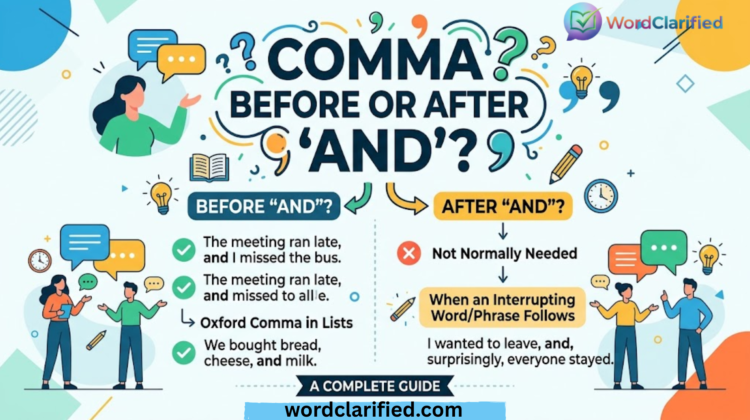
When you write a sentence with “and,” you may wonder where the comma belongs.
Should it go before and, after it, or should you leave it out?
In most cases, when a comma is needed with and, it goes before the word. This is common when and joins two independent clauses.
For example:
The meeting ran late, and I missed the last bus.
However, a comma is not always needed before and. It can connect words, phrases, or two actions performed by the same subject.
The key is to look at what and connects.
Should the Comma Come Before or After “And”?
When and connects two independent clauses, put the comma before and.
The meeting ran late, and I missed the last bus.
Both parts can work as complete sentences:
- The meeting ran late.
- I missed the last bus.
Each clause has its own subject and verb and expresses a complete thought. That is why the comma comes before and.
You normally do not put a comma directly after and.
❌ The meeting ran late, and, I missed the last bus.
✅ The meeting ran late, and I missed the last bus.
A comma can appear after and when an interrupting word or phrase follows it.
When Do You Use a Comma Before “And”?
Place a comma before and when it links two independent clauses.
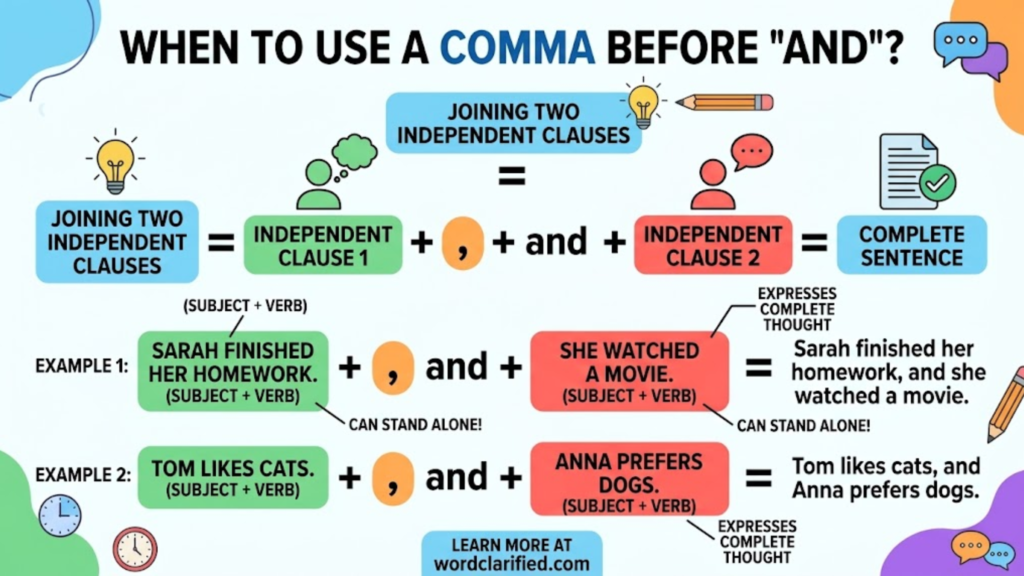
An independent clause can stand on its own as a complete sentence.
For example:
Sarah finished her homework, and she watched a movie.
The two clauses are:
- Sarah finished her homework.
- She watched a movie.
Each one works as a sentence by itself, so the comma comes before and.
More examples:
I called my brother, and he answered immediately.
The students studied hard, and they passed the exam.
We wanted to visit the museum, and we had enough time.
If you are unsure, read each side of and separately. If both sides can work as complete sentences, a comma will usually come before and.
When Should You Not Use a Comma Before “And”?
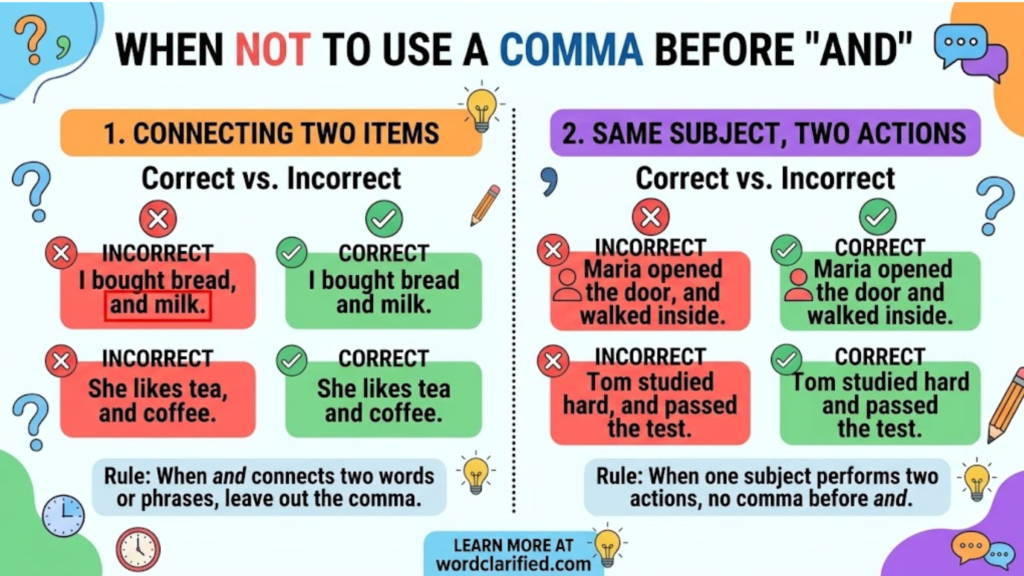
You usually do not need a comma when and connects two words, phrases, or actions with the same subject.
Two Words or Items
When and connects two items, leave out the comma.
I bought bread and milk.
She likes tea and coffee.
John and David are brothers.
These versions are not normally correct:
❌ I bought bread, and milk.
❌ She likes tea, and coffee.
Here, and connects the two items rather than two independent clauses.
See Also: When to Use a Colon or Semicolon: Simple Rules
Two Actions With the Same Subject
A comma is also usually unnecessary when one subject performs two actions.
Maria opened the door and walked inside.
Maria performs both actions:
- opened the door
- walked inside
So there is no comma before and.
❌ Maria opened the door, and walked inside.
✅ Maria opened the door and walked inside.
Now compare that sentence with:
Maria opened the door, and her brother walked inside.
The first clause has Maria as its subject. The second has her brother.
Since each clause can stand on its own, the comma goes before and.
Is a Comma Needed Before “And” in a List?
When a sentence contains three or more items, commas normally separate the items.
We visited London, Paris, and Edinburgh.
The comma before the final and is called the Oxford comma or serial comma.
You may also see:
We visited London, Paris and Edinburgh.
Both forms are used in English. American and British English both use the Oxford comma, although some style guides and publications prefer to leave it out.
If you are writing for a school, university, workplace, or publication, follow its preferred style. Otherwise, choose one approach and use it consistently.
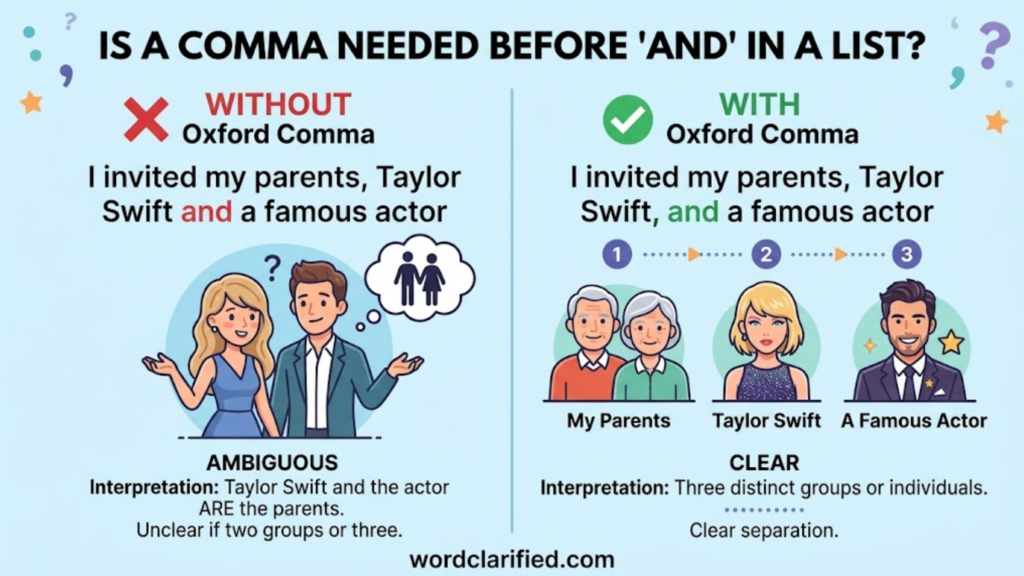
The Oxford comma can sometimes make a list easier to understand.
Compare:
I invited my parents, Taylor Swift and a famous actor.
A reader could briefly wonder whether Taylor Swift and the actor are being identified as the parents.
With the Oxford comma:
I invited my parents, Taylor Swift, and a famous actor.
The grouping is clearer.
The comma in a list has a different job from the comma used between two independent clauses.
Compare:
I visited London, Paris, and Edinburgh.
The commas separate items in a list.
I visited London, and my sister stayed home.
The comma separates two independent clauses.
See Also: Is Verb a Doing Word? The Simple Truth About Verbs
Can a Comma Go After “And”?
A comma normally does not follow and by itself.
However, a comma can appear after and when an interrupting or parenthetical expression follows.
For example:
I wanted to leave, and, surprisingly, everyone stayed.
The word “surprisingly” interrupts the sentence, so it is set off with commas.
Without the interruption:
I wanted to leave, and everyone stayed.
Here are two more examples:
She finished the project, and, to my surprise, she submitted it early.
We went to the restaurant, and, after a long wait, we finally got a table.
The comma after and belongs to the interrupting expression. It does not mean that and normally requires a comma after it.
Can You Start a Sentence With “And”?
Yes. You can start a sentence with and in both American and British English.
For example:
I wanted to call him. And I did.
You would not normally add a comma after and.
❌ And, I did.
✅ And I did.
A comma can appear when an interrupting phrase follows:
And, to be honest, I was nervous.
The phrase “to be honest” is set off with commas because it interrupts the sentence.
What If the Clauses Are Very Short?
Very short clauses can make the rule feel less obvious.
For example:
I came, and I saw.
Both sides are independent clauses:
- I came.
- I saw.
In formal writing, keeping the comma is a safe choice when and joins two independent clauses.
You may occasionally see very short clauses written without a comma, especially in informal or literary writing. However, clause length alone does not determine whether a comma is needed.
For English learners, ask whether each side of and could stand as a complete sentence.
See Also: How Many Verb Tenses Are in English? The 12 Tenses Explained
How Do You Recognize an Independent Clause?
If you are unsure about a comma, look at the words on both sides of and.
Ask yourself:
Could each side work as its own sentence?
For example:
Tom finished his work, and he went home.
The first part works:
Tom finished his work.
The second part works too:
He went home.
So a comma comes before and.
Now look at:
Tom finished his work and went home.
The subject Tom performs both actions.
There is no second independent clause, so a comma is normally unnecessary.
Compare:
Tom finished his work and went home.
Tom finished his work, and his friend went home.
In the first sentence, Tom does both actions. In the second, Tom and his friend are the subjects of separate clauses.
Common Mistakes With “And”
Putting a Comma After “And”
❌ She opened the window and, looked outside.
✅ She opened the window and looked outside.
The same subject performs both actions, so no comma is needed.
Adding a Comma Between Two Items
❌ I need a pen, and a notebook.
✅ I need a pen and a notebook.
Only two items are being connected.
Leaving Out the Comma Between Independent Clauses
❌ The weather was cold and we stayed inside.
✅ The weather was cold, and we stayed inside.
Both parts can stand alone:
The weather was cold.
We stayed inside.
That makes the comma appropriate.
Assuming “And” Always Needs a Comma
It does not.
She smiled and waved.
The same subject performs both actions.
But:
She smiled, and her friend waved.
Here, and connects two independent clauses, so the comma is appropriate.
Does American or British English Change the Rule?
The basic comma rule works the same way in American and British English.
When and joins two independent clauses, a comma can come before it.
The shop was closed, and we went home.
The main difference you may notice concerns the Oxford comma in lists.
American English often uses:
We bought bread, cheese, and fruit.
British English may also use:
We bought bread, cheese and fruit.
Neither form is automatically wrong. The preferred style depends on the publication or style guide.
If you are writing for a particular school, university, company, or publication, check its preferred style. Otherwise, use your chosen style consistently.
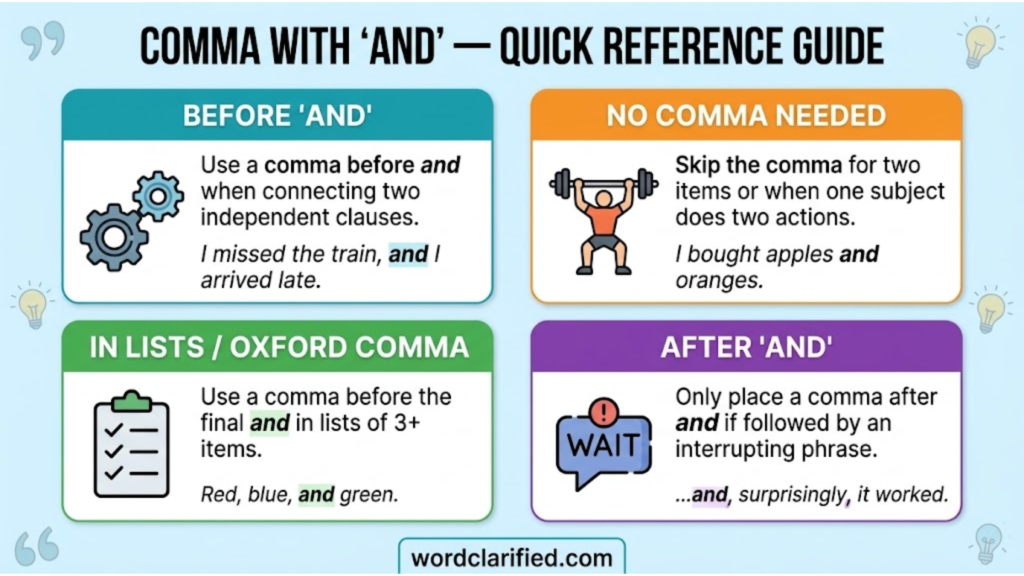
An Easy Test for Commas Before “And”
When you see and, ask what it connects.
Two independent clauses
Use a comma before and.
I missed the train, and I arrived late.
Two words or items
Usually use no comma.
I bought apples and oranges.
Two actions with the same subject
Usually use no comma.
James sat down and opened his laptop.
Three or more items
A comma may appear before the final and.
We bought apples, oranges, and bananas.
This is the Oxford comma.
An interrupting phrase after “and”
A comma can appear after and.
She agreed, and, surprisingly, she kept her promise.
The comma after and belongs to the interrupting phrase.
Practice: Choose the Correct Sentence
Try each pair before checking the answers.
1.
A. I finished my work and I went home.
B. I finished my work, and I went home.
Answer: B.
Both parts can work as complete sentences, so the comma comes before and.
2.
A. She washed the dishes and cleaned the kitchen.
B. She washed the dishes, and cleaned the kitchen.
Answer: A.
The same subject, she, performs both actions.
3.
A. We bought bread, cheese, and fruit.
B. We bought bread and, cheese and fruit.
Answer: A.
The sentence contains three items in a list.
4.
A. He wanted to leave, and she wanted to stay.
B. He wanted to leave and she wanted to stay.
Answer: A.
Both sides are independent clauses.
5.
A. I called him, and, fortunately, he answered.
B. I called him, and fortunately, he answered.
Answer: A.
In A, “fortunately” is treated as an interrupting word and set off with commas. B can also be correct when “fortunately” is not treated as a parenthetical interruption.
The Rule to Remember
When you are unsure about a comma with and, look at what the word connects.
- Two independent clauses: use a comma before and.
- Two words or items: usually no comma.
- Two actions with the same subject: usually no comma.
- Three or more items: a comma may come before the final and.
- An interrupting phrase after and: a comma can appear after and.
The main rule is simple:
I wanted to stay, and my friend wanted to leave.
Not:
❌ I wanted to stay and, my friend wanted to leave.
And not:
❌ I wanted to stay, and, my friend wanted to leave.
The comma normally goes before “and” when it joins two independent clauses.
If you are unsure, use the independent-clause test. Read each side of and separately. If both sides can stand as complete sentences, a comma before and is usually the right choice.

Leave a Reply