
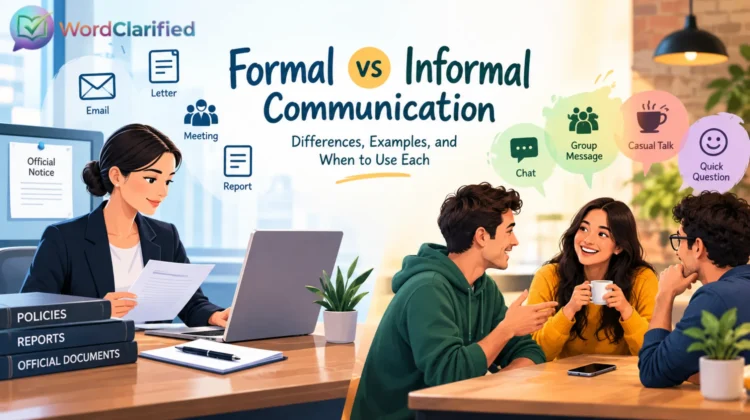
Formal vs informal communication comes down to one question: does the message travel through an official route, or through ordinary conversation? A notice pinned to the staff board is formal. Asking the person beside you whether Friday’s schedule changed is informal. Most people mix the two all day without thinking, and trouble starts when they choose the wrong one for the moment.
Language adds a second layer. An official channel can carry plain words, and a casual chat can be perfectly polite. This guide separates the two and gives you examples you can borrow.
What Is Formal Communication?
Formal communication moves through official channels and follows the organisation’s rules. Schools, clinics, companies, and government offices rely on it because it leaves something to point back to: a letter, a signed form, the minutes of a meeting.
Think of a clinic mailing patients a printed notice about new opening hours, or a department head emailing a revised budget with the approval attached. Both messages need to be exact, traceable, and identical for everyone who receives them.
Formal doesn’t mean stuffy. “Submit the form by Monday” is as formal as a three-paragraph memo if it arrives through the right channel.
Types of Formal Communication
Formal messages are usually sorted by the direction they travel. Some textbooks list only the first three, so you may see “three types” elsewhere. The fourth is common enough to know.
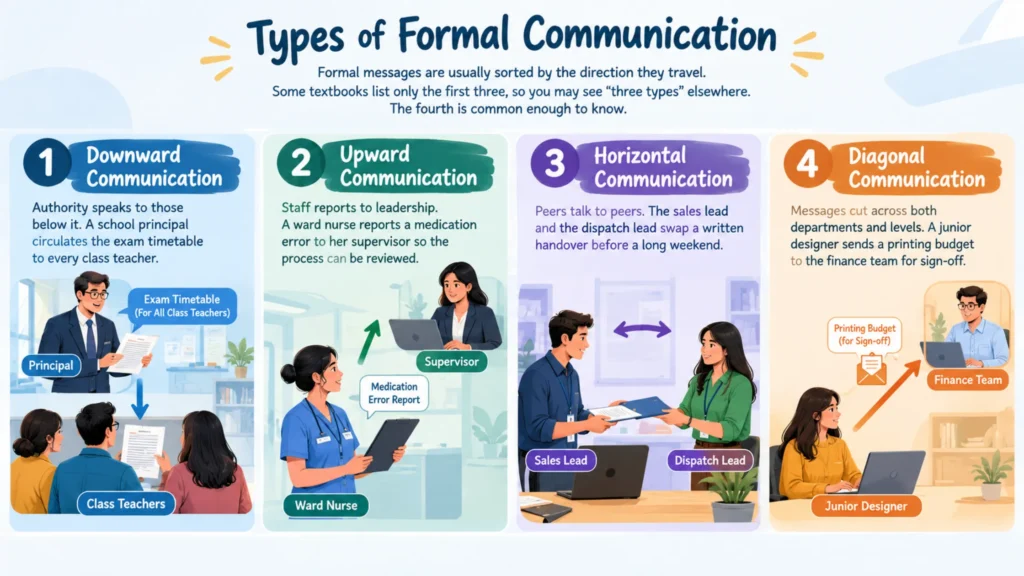
1. Downward Communication
Authority speaks to those below it. A school principal circulates the exam timetable to every class teacher.
2. Upward Communication
Staff reports to leadership. A ward nurse reports a medication error to her supervisor so the process can be reviewed.
3. Horizontal Communication
Peers talk to peers. The sales lead and the dispatch lead swap a written handover before a long weekend.
4. Diagonal Communication
Messages cut across both departments and levels. A junior designer sends a printing budget to the finance team for sign-off.
What Is Informal Communication?
Informal communication happens outside the official structure: the stairwell chat, the group message, the question called across a desk. No one schedules it, and no one approves it.
It does real work. People use it to ask quick questions, test half-formed ideas, and learn how things actually get done in a place, which no handbook explains. It isn’t automatically gossip, either. Much of it is just colleagues being practical.
See Also: Difference Between Columns and Rows: Examples in Tables, Excel, and Matrices
Types of Informal Communication
Management researcher Keith Davis described four patterns for how news moves through the workplace grapevine.
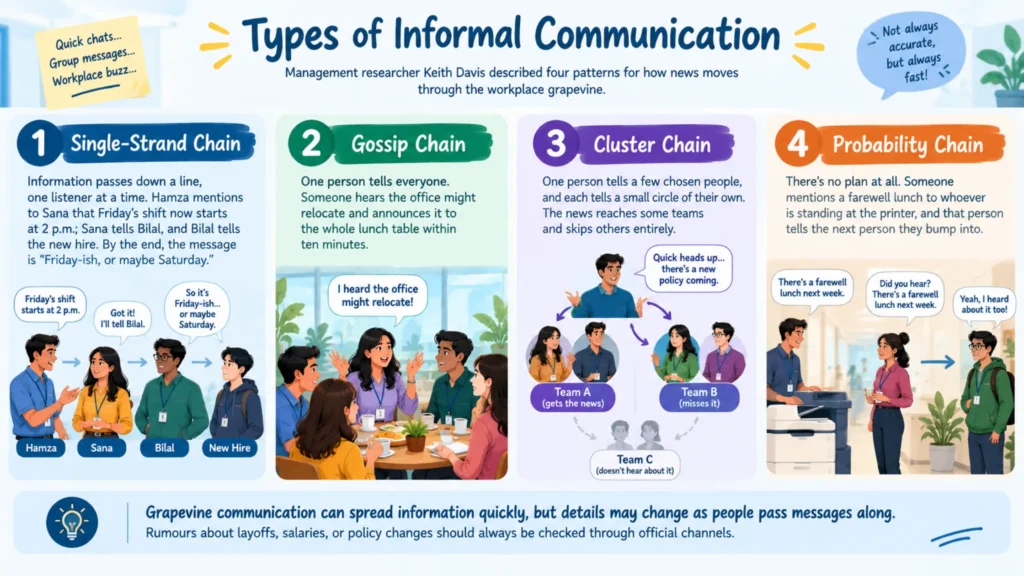
1. Single-Strand Chain
Information passes down a line, one listener at a time. Hamza mentions to Sana that Friday’s shift now starts at 2 p.m.; Sana tells Bilal, and Bilal tells the new hire. Bilal passes it on to the new hire as “Friday-ish, or maybe Saturday.” The 2 p.m. start is gone.
2. Gossip Chain
One person tells everyone. Someone hears the office might relocate and announces it to the whole lunch table within ten minutes.
3. Cluster Chain
One person tells a few chosen people, and each tells a small circle of their own. The news reaches some teams and skips others entirely.
4. Probability Chain
There’s no plan at all. Someone mentions a farewell lunch to whoever is standing at the printer, and that person tells the next person they bump into.
Grapevine communication can spread information quickly, but details may change as people pass messages along. Rumours about layoffs, salaries, or policy changes should always be checked through official channels.
Formal vs Informal Communication: Key Differences
| Feature | Formal | Informal |
| Route | Official channels | Whatever’s handy |
| Tone | Measured, professional | Relaxed, conversational |
| Speed | Slower, may need approval | Often instant |
| Record | Usually kept | Often none, or scattered across chats |
| Checking facts | Compare against the document | Depends on who told whom |
| Best for | Decisions, policies, responsibilities | Quick questions, ideas, rapport |
Treat these as two ends of a slider, not a switch. Plenty of messages sit in the middle, and neither end wins everywhere.
Formal vs Informal Language: How the Wording Changes
Language is about wording. Communication is about the route. The two don’t always line up. A manager chatting over lunch is using informal communication in correct English. A circular written in short, simple sentences is still formal because it came through official channels.
| Situation | Formal | Informal |
| Confirming receipt | “Please confirm that you have received this.” | “Let me know once you get this.” |
| Apologizing | “I apologize for the inconvenience.” | “Sorry about the mix-up.” |
| Declining | “Thanks for thinking of me. I’d like to help, but my workload won’t allow it this time.” | “Can’t make it, sorry.” |
| Asking a favour | “Would you mind Zainab Malik reviewing this?” | “Can you look this over for me?” |
| Buying time | “Could you give me a moment?” | “Hang on a sec.” |
Is Informal English Incorrect?
No. A contraction such as I’m or we’ve is correct English, just a relaxed kind. Slang and fragments are where you need judgment. “Can’t make Thursday, got a dentist appointment” is fine to a teammate and odd in a cover letter. Informal means relaxed, not wrong. The mistake is using it on someone who didn’t invite it.
Formal vs Informal Writing
Writing adds permanence. A spoken remark fades, but a message gets forwarded, screenshotted, and reread on a bad day. The same words carry more risk on the page. Formal writing suits anything that might be checked later: applications, contracts, official notices, assignments. Informal writing suits notes between people who already know each other.
Examples of Formal Writing
- A cover letter
- A complaint to a utility company
- A notice of leave
- A submitted assignment
- Terms and conditions
Dear Mr Rahman,
I am following up on invoice 4471, which was due on 3 October. Could you confirm when payment will be made?
Kind regards,
Zainab Malik
Examples of Informal Writing
- A group chat update
- A text to a friend
- A note on the fridge
- A quick message to a close colleague
Hi Asad, quick nudge on the invoice from the 3rd. Any idea when it’ll go through?
Watch the emoji. A study spanning 29 countries and 549 participants found that a smiley in a work email did nothing for the sender’s warmth and made them seem less capable. In a social message like a party invitation, it did read as friendlier. People in that study were judging strangers, so a colleague who knows you may react differently. When emailing someone for the first time, avoid emojis unless the context clearly allows a casual tone.
See Also: Difference Between I Need and I Want: Meaning and Examples
Advantages and Disadvantages of Formal Communication
The biggest gain is certainty. Everyone gets the same wording, and decisions can be checked later, which settles most “I never said that” arguments. Sensitive information can also go only to those who need it.
The cost is time. Drafts, approvals, and scheduled meetings slow things down. Readers can’t question a notice on the spot, which usually means a second message to clear things up. Stiff wording can also make a simple message harder to understand. A short, clear email that goes through the proper channel avoids most of this.
Advantages and Disadvantages of Informal Communication
Speed is its strength. A two-line message can settle in a minute what a meeting would take a week to schedule. It builds trust, too, and people say things in casual conversation they’d never put in a memo, bringing problems to the surface early.
The costs show up later. Details drift as they’re passed along, people outside the circle miss out, and a spoken agreement leaves everyone with a slightly different memory of it. Chat is a trickier case, because it feels private and isn’t. Depending on local law and workplace policy, work chats and texts may need to be retained or produced during an investigation or legal proceeding. The rules vary by country, so write every casual message as if a stranger might read it someday.
When Should You Use Formal or Informal Communication?
| Situation | Better choice | Why |
| Resigning from a job | Formal | It starts a notice period and needs a dated record |
| Asking a teammate where a file is | Informal | A slower route adds nothing |
| Updating a buyer on a shipment that’s running behind | Semi-formal, in writing | They want clear facts, a polite tone, and proof |
| Reporting a broken fire exit | Formal, plus a phone call | It needs action now and a record |
| Floating a rough idea | Informal | Let it stay messy |
| Confirming a salary change | Formal | Both sides need the number in writing |
What If You’re Not Sure Which Style to Use?
Aim for the middle. Semi-formal means full sentences, plain words, a greeting, a polite close, and no slang or jokes. It’s the safest default with a new colleague, a client you’ve met once, or a teacher you’re emailing for the first time.
After the first reply, copy their tone. If they write “Hi Sam, thanks!”, you can relax a notch. If they sign off with “Regards”, stay put. Whenever money, a job, or safety is involved, go formal and put it in writing, no matter how casual things have been so far.
Can Formal and Informal Communication Be Used Together?
Yes, and the pairing usually works best. Say your landlord agrees on a phone call to fix a leaking tap by Friday. The call settled it fast. Two weeks later, if the tap still drips, nobody can prove what was promised. A short email after the call fixes that in thirty seconds: “Thanks for agreeing to fix the tap by Friday. Please tell me if I’ve misunderstood anything.” Talk first for speed and understanding, then write for the record.
See Also: Violet vs Indigo vs Purple: What Actually Sets Them Apart
Frequently Asked Questions
1. How do formal and informal communication differ at the most basic level?
Formal communication follows official channels and usually leaves a written trail. Informal communication happens in everyday conversation with no fixed process.
2. Which messages count as formal communication? Give five examples.
A resignation letter, a signed purchase order, board meeting minutes, an HR policy update, and a written complaint to a company.
3. What does informal communication look like in daily life?
Asking the person at the next desk for a charger, sending a voice note to a teammate, making a joke in the group chat, chatting in the hallway about a deadline, and texting a classmate about homework.
4. Is one style better than the other?
Neither. Formal suits decisions and records—informal suits quick exchanges and building rapport.
5. How do formal and informal wording differ?
Formal language uses wording suited to official or academic settings. Informal language sounds conversational and uses contractions and familiar phrases. Both can be correct.
6. Where does email fall: formal or informal?
It can be either. The content, the reader, and workplace habits decide.
7. How many types of formal communication are there, and what are they?
Four are commonly taught: downward, upward, horizontal, and diagonal. They describe the direction a message travels.
8. What is grapevine communication?
It’s the informal passing of news through personal connections. It moves fast, so check anything important before you rely on it.
9. Can communication be formal but friendly?
Yes. Polite, warm wording works inside an official process.
Final Thoughts
When a decision comes out of a casual chat, copy it into an email before the day ends. That one habit covers most of what formality is for. Everything else is tone, and you can adjust tone once you know who’s reading.

Leave a Reply