
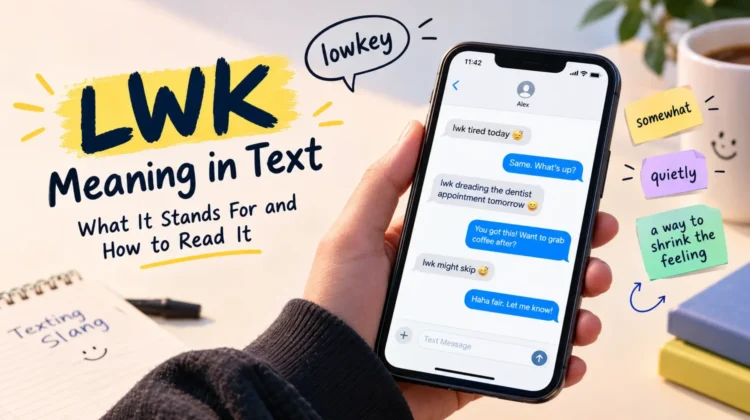
LWK stands for “lowkey,” and the LWK meaning in text comes down to one move: it shrinks whatever comes after it. “lwk dreading the 7:40 dentist appointment” sounds like a shrug. Drop the lwk and the same message sounds like a complaint. People type it lowercase, fast, and mostly without thinking about it.
What LWK Means in a Sentence
Lowkey does two jobs, and a text rarely says which one it’s doing.
The first job is “somewhat.” Someone who types “lwk annoyed that the 14 bus skipped my stop twice this week” is probably mildly annoyed, not drafting a letter to the transit office.
The second job is “quietly,” or sometimes “secretly,” and it’s the more interesting one. “i lwk still have your hoodie from the Eastgate bowling night” isn’t a report about a hoodie. The sender offers a reason to meet up and keeps it small enough to refuse. Opinions work the same way: “lwk the best song on the album” usually means the speaker suspects the room disagrees.
Why People Type LWK Instead of Just Saying It
“I’m stressed” asks for a reply. “Lwk stressed” doesn’t ask for anything, so the other person can decide whether to respond or not. That’s useful in group chats, where anything heartfelt can feel like interrupting the memes. Text also lacks tone of voice, so people borrow a shrug in three letters.
Where “Lowkey” Came From
Long before phones, “low key” described sound. It was recorded in 1837 as a quiet speaking voice, and photographers later used it for prints built mostly from dark tones with little contrast. By the 1940s, it also meant muted or restrained, like a backyard wedding with twenty guests.
The slang adverb is much newer. It was circulating in African American English, especially in hip-hop lyrics, by the early 2010s, and from there it moved into everyday slang. Its opposite, highkey, has appeared in online writing since at least 2008.
LWK is the same word with the o, the e and the y dropped. Like “brb” and “idk,” it saves keystrokes.
See Also: WTM Meaning in Text: Full Form, Uses, and Best Replies
How to Read LWK in Real Messages
Position tells you most of it. Look at the word right after it, because that’s the part being softened: “lwk hate this” softens a verb, “that was lwk rude” an adjective, and “lwk the cafeteria was out of fries again” the whole thought. Sometimes it opens the message, as in “lwk can’t believe it’s October already,” and colors everything after it.
Context does the rest:
- At 11:52 p.m., a friend sends “lwk can’t sleep,” which is less a status update than a nudge to keep talking.
- Your cousin, five minutes before dinner: “lwk might skip.” Trust the “might” more than the lwk.
- In the group chat planning Saturday’s hike, the one person who never wanted to go says “lwk hoping it rains.” A joke with a real preference inside it.
- A Friday text at 6:15 p.m., “lwk don’t feel like going out,” comes from someone who can probably still be talked into an hour at the diner.
- Someone you’ve been seeing sends “i lwk like you.” The word cushions a sentence that took some nerve to type. Read it straight.
A short exchange shows how much the word can hide:
Maya: lwk think I bombed the 8 a.m. chem quiz
Dev: how bad
Maya: rewrite-my-whole-schedule bad
My own rule, take it or leave it: when lwk sits in front of a feeling about a person, read more into it than the sentence admits. A bus that skipped a stop earns a shrug. A hoodie you’ve kept for a month doesn’t.
Frequency matters too. If a friend types lwk in every other message, it’s a tic, and you can mostly skip over it. If someone who never uses slang drops one in, that’s a choice, and the sentence after it deserves a second look.
LWK vs. Lowkey vs. Highkey
LWK and lowkey mean the same thing. LWK is the typed shortcut; lowkey is the spelling for a caption or any message that might get screenshotted.
Highkey sits at the other end. “Lowkey fed up with the group project” admits to a flicker. “Highkey fed up” says it loudly and doesn’t mind who hears.
“Tbh” and “ngl” work differently. They announce honesty (“to be honest,” “not gonna lie”). LWK makes no promise about honesty; it just dials the feeling down and sometimes hints there’s more behind it. “Kinda” and “sorta” only water a feeling down and hint at nothing.
Spelling is flexible. Dictionaries list low-key with a hyphen and give lowkey and low key as variants. In formal writing, use the hyphen. In a text, nobody checks.
When LWK Backfires
Praise is where it goes wrong. “lwk proud of you” can read as lukewarm: proud, but only a little. If a friend just finished their first half marathon, leave the word out. Apologies suffer the same way, since “lwk sorry about Tuesday” sounds like the apology is being kept small, too.
It can also dress up a complaint. “lwk can you stop leaving your mug in the sink” is still a complaint, and the person receiving it usually knows.
Once per message is plenty, placed right before the thing you’re softening. “i’m lwk starving” works. “lwk i’m lwk starving lwk” doesn’t, because by the third one the word has stopped softening anything and become a habit.
And if you’re telling someone they hurt you, say the plain version first: “that stung.” Opening with lwk hands them an excuse to treat it as small. Add a lighter follow-up only if the mood needs one.
See Also: WSP Meaning in Text: What It Says and What to Send Back
How to Reply When Someone Texts LWK
Answer the feeling, not the abbreviation. You don’t have to type lwk back, and most replies don’t need to decode anything.
- “lwk dreading Thursday’s inventory count.” Try “same. Lunch before it starts?”
- “lwk wish we’d stayed longer.” Read it as “let’s do this again,” and “next Saturday?” answers it.
- “i lwk liked her.” Past tense, hedged. Ask: “liked her how?”
- “i lwk miss you.” Answer with “miss you too.” Anything breezier, like “lol same,” sounds like you’re agreeing about the weather.
- lwk mad at you.” Skip the joke and ask plainly: “what did I do?
When you can’t tell whether a message is a throwaway or a confession, ask something small and half-joking: “lwk how much, though?”
Match the setting, too. With a close friend, reply as loosely as they wrote. A coworker who slips one into a Slack message deserves a reply in normal English. Echoing slang back at someone you barely know can make you sound like you’re trying on a costume.
Where LWK Fits, and Where It Doesn’t
Friend chats, comments, stories, group threads: fine. Captions sit in between. I’d type out lowkey there, since lwk reads like a note to self when strangers see it.
An email to a professor at 9 p.m. the night before a deadline is a hard no. “lwk confused about the rubric” tells the professor the confusion is minor, and it may tell them nothing if they’ve never seen the word. “I’m confused about the rubric” does the job. A message to a manager has the same problem: “lwk might miss Friday’s deadline” buries the one thing they need to hear. Texts to a landlord, a customer, or someone’s parent fall on the no side, too.
See Also: What Is a Relative Pronoun? Definition, Examples, and Rules:
Does LWK Mean Anything Else?
Rarely. Other expansions get floated now and then, such as “love with kisses” or “let’s work,” but they’re unconfirmed, and they don’t agree with each other. Inside a normal sentence, lowkey is the safe reading. If a message is just “lwk” with nothing after it, there’s no sentence to read, so ask what they meant.
LWK Meaning FAQs
What does LWK stand for?
Lowkey. You’ll also see it spelled low-key or low key.
Is LWK the same as lowkey?
Yes: same word, three letters instead of six.
Is LWK formal or informal?
Informal. It belongs in chats and comments, not in anything a stranger will read.
What’s the opposite of LWK?
Highkey, which means openly or intensely. “I lwk want the corner seat on the bus” is a whisper; “I highkey want the corner seat” is a claim.
Is LWK the same as the “low-key” in “a low-key party”?
They share a root, but the grammar differs. In “a low-key party,” the word describes the party: small, quiet, no fuss. LWK works as an adverb inside a sentence and softens a feeling or a statement. “lwk excited for the party” has nothing to do with the party’s size.
Does LWK mean someone likes me?
Not by itself. “lwk like you” is a real statement with a cushion on it, but “lwk tired” is just tired. If you can’t tell what someone means, ask about the sentence: “like me how?” keeps the question small.

[…] See Also: LWK Meaning in Text: What It Stands For and How to Read It […]