
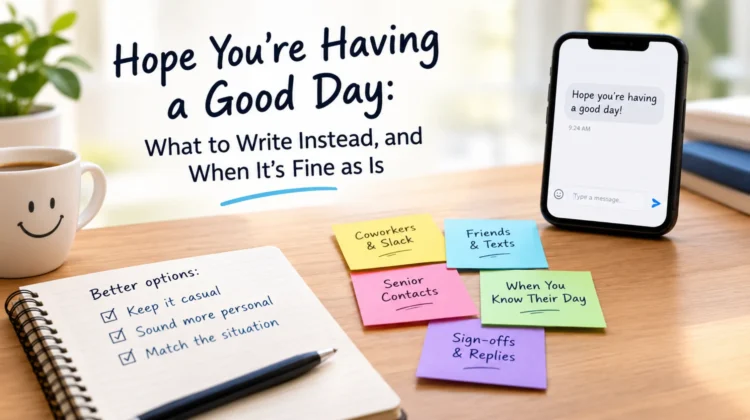
“Hope you’re having a good day.” You’ve typed it so often your fingers probably do it without you. The line is correct, friendly, and harmless, and that’s exactly the problem. Send it to the same vendor four mornings in a row, and it turns into a rubber stamp.
It’s still a fine thing to say to a friend or a coworker you like. This guide covers what the phrase actually means, what to write instead depending on who’s reading, how to write back when it’s sent to you, and when the better move is to leave it out.
What “having” is doing in that sentence
After “hope,” English usually takes a plain present tense, even when the wish points at something still unfolding. “I hope she’s having a good time” is the standard pattern. In your sentence, “are having” pins the wish to right now. The day is underway, and you’re hoping it’s treating them well.
Take out “having”, and the wish points in the opposite direction. “Hope you have a good day” covers the hours still ahead of them. That’s why it works as a goodbye (“Thanks for the call. Hope you have a good day”) and feels a little off as an opener at 4:45 p.m.
A third option is “wish.” “I wish you a pleasant day” sounds stiffer than “I hope you have a pleasant day.” In greetings, “wish” carries a more formal tone, so it suits a letter better than a text.
The practical upshot: “having” is a same-day phrase. If your message might sit unread overnight, or you’re writing across ten time zones, it can miss. Your 9 a.m. can be their 11 p.m. A wish about the week doesn’t depend on the clock, so it holds up better there.
See Also: What Is a Relative Pronoun? Definition, Examples, and Rules:
Pick by who’s reading.
Lists of twenty near-identical phrases don’t help much. What helps is knowing which one fits the person on the other end. Here are four situations and one pick for each.
Coworkers and Slack
You want warmth without a speech. Options that work:
- “Hope the inbox is behaving this morning.”
- “How’s the day treating you?”
- “Any breathing room in your week yet?”
- Hope you’ve squeezed in a coffee between calls today.”
I’d send the first one. It’s the kind of thing a coworker says across a desk, and it quietly admits that email piles up.
Here’s how it reads in a real message: “Hope the inbox is behaving this morning. Could you check the Q3 sheet when you have a minute?”
Someone senior, or a first email
Here, a short, plain line beats a clever one. Choices:
- “I hope you’re well.”
- “I hope you’ve had a steady week.”
- “I hope you’re keeping well.”
Go with “I hope you’re well.” It’s quiet and polite, and it rarely bothers anyone.
For example: “Dear Dr. Okafor, I hope you’re well. I’m writing about the extension request for the Hartley grant.”
You’ll also run into “I hope this message finds you well,” the old business-letter standby. The grammar is fine. The wording is a leftover from paper mail, where “finds” meant “reaches”: the writer hoped you’d be in good shape at the moment the envelope arrived. Some recipients take it as courtesy, and others skim past it. If the person gets two hundred emails a day, choose something shorter.
Friends and texts
Texts reward short and loose. Try:
- “Hope today’s going easy on you.”
- “Hope your Tuesday’s behaving.”
- “Thinking of you. Hope today’s a good one.”
- “Hope the day’s not too bad.”
That’s the one I’d send. It works best when you know they’ve got something annoying coming, like a dentist appointment or a Thursday exam.
“Hope today’s going easy on you. Still on for pizza at 7?”
See Also: Where Do I Put Commas? Simple Rules and Clear Examples
When you know something about their day
A detail only you would know outweighs any well-worded stock line. A real detail shows you were paying attention, and no template can supply one.
- “Hope the dentist wasn’t too bad.”
- “Hope the demo went smoothly.”
- Hope the construction on your route didn’t turn the commute into a crawl.
Here’s one for a friend who just moved: “How’s your back after hauling boxes all weekend? Did the couch fit through the door?”
This last group is the one worth practicing. Pick a single fact you already know about the person’s week and open with it.
The sign-off version
“Hope you have a good day” is mostly a goodbye, so give it some care too. The same default phrase closes thousands of messages, and a closing line that names something real stands out.
- “Good luck with the 3 p.m. presentation.”
- “Enjoy the long weekend.”
- “Have a good one.”
- “Talk Monday.”
Naming the thing that’s coming does the most work. Mentioning the 3 p.m. presentation by name tells them you knew it was coming. A stock phrase can’t know what’s on their calendar. “Have a good one” is fine for a casual exit and slightly vague for anything formal.
Mistakes worth avoiding
Dropping “are.” Cutting the “I” is allowed (“Hope you’re having…”), but cutting the verb isn’t. “I hope you having a good day” has nothing holding the sentence up.
Sending the wrong register. Texting your sister “I trust this message finds you well” will get you a confused emoji. A casual “Hope your day’s okay” to a client you’ve never met can come off as too breezy. Match the room.
Cheerful wishes at a bad moment. If someone just told you their grandmother died, or that they’re out on sick leave, “Hope you’re having a great day!” lands badly. A short “Thinking of you” fits better, or skip the greeting and address the matter at hand.
Stacking. “Hope you’re well! Hope you’re having a great day! Hope the week’s going well!” One wish carries the weight. Three sound like you’re stalling.
Two phrases on repeat. Switching between “Hope you’re well” and “Hope you’re doing well” every other email changes nothing. It’s the same greeting in a different coat.
What to type back when you get one
Keep it short. Nobody expects an essay in response to a pleasantry.
A friendly reply: “Thanks, busy but good. You?”
A formal one: “Thank you, I’m well. I hope the same for you.”
A reply for a rough day: “Hectic, but fine. On your question about the invoice…”
That last one is perfectly polite. You’ve acknowledged the wish and moved on to the real subject. You don’t need to match the sender’s length, and you don’t need to ask a question back unless you actually want to know.
See Also: Past Tense of Tear: Tore, Torn, or Teared Up?
When to skip it entirely
Some messages are better without any opener. If a client call moved to 2 p.m. and you need an answer in ten minutes, put that in the first line: “The client call moved to 2 p.m. Can you join?” If the clock is ticking, go straight to the point. The news goes in the opening line, and the greeting can wait or disappear.
Here’s a test you can use: if deleting your first line changes nothing about the message, and the reader’s on a deadline, delete it.
FAQ
Is it okay to start with “hope” and no “I”?
Yes. Leaving off the “I” is normal in casual messages. The verb has to stay, though, so it’s “Hope you’re having…” and never “Hope you having…”. In a formal letter, write the “I.”
Which is better as a greeting, “having” or “have”?
Use “having” when the day is still in progress, as it’s a natural way to start a message. “Have” points to the hours still to come, so it works as a goodbye.
Can I use it in a business email?
Yes, but watch how often. Using it to open every message to the same person makes the line wear thin. With a senior contact, or in a first email, “I hope you’re well” sits better.
What can I say if it’s already evening?
“Hope you’re having a good evening” works if the day’s still going. If it’s winding down, “I hope you had a good day” is grammatical too, since “hope” can point at something that’s already finished.
Does it need a reply?
With a friend, a quick “Thanks, you too” does the job. At work, the usual move is to answer what was asked. A few warm words in front are fine but not required.
Final thoughts
The opener that works is the one the reader would believe you’d say aloud. Test it: mutter your first line to yourself. A phrase that sounds odd out loud probably reads that way too, and one true detail about the person’s week usually fixes it.

[…] See Also: Hope You’re Having a Good Day: What to Write Instead, and When It’s Fine as Is […]