

Leaped or leapt? If you’ve stalled mid-sentence over it, here’s the relief: both are correct past forms of leap, and both work as the participle too. Neither is a typo, and unless a house style says otherwise, no editor will circle either one. For American writing, though, one is the easier default, and settling on it now saves you from second-guessing every jump, spike, and racing pulse in your draft.
The default is leaped. Here’s why, and where leapt earns its place.
Why leaped is the safe default for US writing
Leaped follows the pattern most English verbs follow. Add -ed, and you’re done, the same way walked comes from walk. American readers see it and keep reading, which is about the best a word choice can do.
Usage records back this up. American writing has favored leaped for a long time. The lead isn’t large, though, and leapt has held its ground throughout, so “safe default” is the right label. It isn’t a rule.
Business email, school essay, product page, newsletter: leaped fits all of them without a second look. “Our support queue leaped from twelve tickets to sixty overnight” reads as ordinary American English.
See Also: Mine as Well or Might as Well: The Real Reason You Mix Them Up
When leapt is the better pick
Leapt is in American dictionaries, and it turns up in American newspapers, novels, and business coverage. Using it won’t make your prose sound British.
What it offers is sound. The vowel is short, and the word stops hard on the t, so it rhymes with swept. Leaped stretches out and rhymes with steeped. Say these two out loud:
- Her stomach leapt when the phone buzzed.
- Her stomach leaped when the phone buzzed.
The first has a flinch in it. The second is fine, just softer.

My own habit is leapt for sudden movement and quick feeling, leaped for changes you can measure. That’s taste, and plenty of good writers do the reverse. Read the sentence aloud and keep whichever one your ear prefers.
The participle: has leaped or has leapt?
Both forms work after have, has, and had, so there’s no second decision waiting.
By the time the bell rang, the cat had leaped onto the counter twice. She has leapt at every offer the company sent. Swap the form in either sentence, and it still stands.
People slip in the slot after did. That position takes the plain verb, so “did leap” is right and “did leapt” is wrong. Only the -ed or -t form belongs after has or had, and “has leap” is wrong for the same reason.
Phrases where you’ll hit this choice
A few expressions come up again and again, and most take either form:
- “He leapt at the chance.” (or leaped)
- “Her heart leapt.” (or leaped)
- “Within an hour of the first report, the team had leapt to a conclusion nobody could back up.” (the idiom works with jumped too)
- “The name leaped to mind.” (or leapt)
Some phrases look like they involve the choice but don’t. In “by leaps and bounds,” leap is a noun, and so is the word in “Sales made a big leap in March.” Neither sentence has a past-tense verb to choose. Commands and plans work the same way: “Don’t leap off the swing at the top of its arc” uses the plain verb. If a sentence has no past action in it, leaped and leapt don’t apply.
Don’t assume the pattern carries over to other verbs
Leap isn’t the only verb with two past forms. Dream and learn do it too: dreamed and dreamt, learned and learnt. It’s tempting to treat them as a set and think that if you choose leapt, you must choose the others to match.
You don’t. Leapt sits comfortably in American prose. Some of the other -t forms, learnt especially, tend to read as distinctly British to US readers. So a sentence like “She leapt from her chair when she learned the score” is perfectly natural for an American audience. Judge each verb separately.
See Also: How-To vs. How-Tos: Hyphen, Apostrophe, or Neither? (3 Jobs)
When a style guide or client has already decided
If a publication, employer, or client hands you a style guide that names one form, follow it and skip the debate. Check the guide itself, though. Assumptions about what a given guide says are often wrong, and I wouldn’t trust a blog post’s claim about them, including this one.
With no guide at all, choose the form that suits your audience and write it down somewhere you’ll find later. A one-line note in a shared doc (“we use leaped”) saves the next editor from re-litigating it. That matters most on team projects, where three writers can each pick differently and, nobody notices until the piece is live.
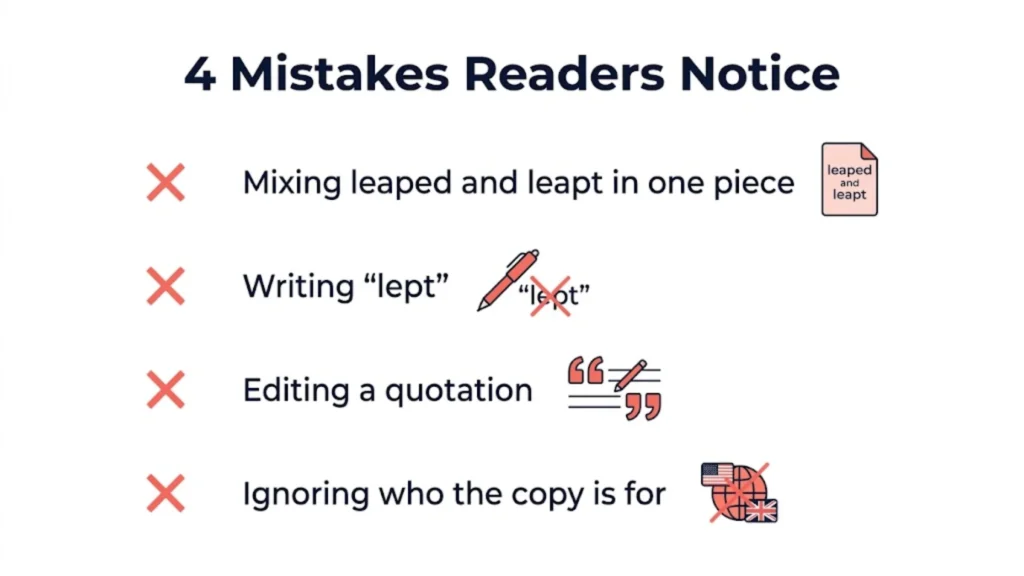
Mistakes readers actually notice: Leaped or Leapt
Using both forms in one piece. This is the one that shows. Say your second paragraph has a runner who leaped a hurdle and your ninth has a goalkeeper who leapt to his left. Neither word is wrong, but the switch makes it look like nobody’s steering. Pick one form and hold it, unless a character’s dialogue or a direct quote calls for the other.
Writing “lept.” It isn’t a word. It’s how leapt sounds, spelled by ear. Correct it to leapt.
Editing a quotation. If the original text says leapt and your article prefers leaped, leave the quote alone. Quotes stay as the author wrote them.
Ignoring who the copy is for. British writers lean toward leapt, and it overtook leaped in British usage around the turn of the 20th century. If you’re editing for a client in London or Sydney, switch to leaped throughout the document. Set your editing tool to the matching English variant before you start, so its suggestions don’t push you back the other way.
Quick answers
Do Americans use leapt?
Yes, especially in stories and news. It’s a little less common than leaped in American text, but it isn’t unusual.
Is leapt wrong in American English?
No. American dictionaries list it as a standard past form of leap. It leans British, but it isn’t limited to Britain.
Do the two forms mean different things?
No. Meaning, tense, and participle use are identical.
Can I use leaped in one article and leapt in another?
Yes. Consistency matters inside a single piece, not across everything you write. A US blog post and a UK client’s brochure can each take their own form.
Before you publish, search your draft for both spellings. If both show up, decide which to keep and change the other.

[…] See Also: Leaped or Leapt for Americans: 1 Default, 4 Mistakes […]