
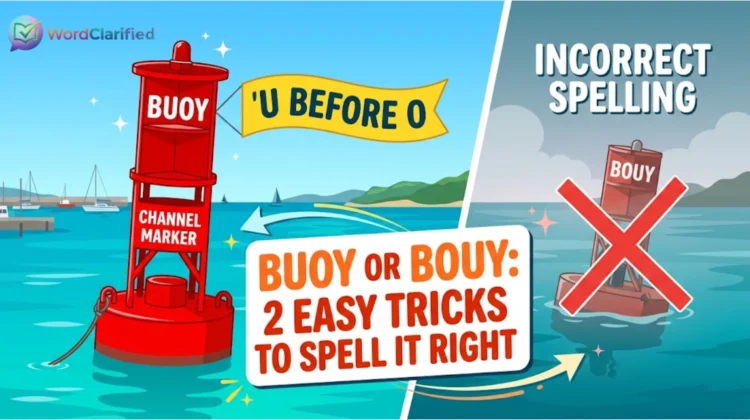
Buoy is the correct spelling. Bouy is a misspelling, and it isn’t accepted in standard English.
If you’re writing about boats, swimming areas, or someone’s lifted mood, buoy is the word you need. The letters run B-U-O-Y, with the U before the O. People often flip them because the word doesn’t look the way it sounds.
Buoy or Bouy: Quick Answer
Here’s the same sentence both ways:
- Correct: The boat passed a red buoy.
- Incorrect: The boat passed a red bouy.
The verb works the same way:
- Correct: The good news buoyed her confidence.
- Incorrect: The good news bouyed her confidence.
There’s no pattern behind the order of those two letters. In every form of the word, the U comes first.
Why Do People Spell Buoy as Bouy?
The likely culprit is habit. The letters “bou” are a familiar chunk, since they show up in about, house, and mouth. Your fingers type the usual pattern before your brain checks it.
Sounding the word out won’t rescue you here, because the spelling doesn’t match the sound. You have to learn it as written. The upside is that buoyant and buoyancy share the same spelling, so fixing one fixes all three.
How Do You Pronounce Buoy?
It depends on where you live. In American English, people usually say BOO-ee, with two syllables, like gooey. In British English, it’s one syllable and sounds exactly like boy. You’ll hear the one-syllable version in some American speech too.
Neither is wrong. Either way, the letters on the page don’t change.
What Does Buoy Mean?
Buoy works as a noun and as a verb, and both meanings come down to the same idea: keeping something up.
Buoy as a Noun
A buoy is a floating object anchored in place on the water. It tells people on boats or in the water something they need to know. A buoy can:
- mark a channel into a harbor
- warn of rocks or shallow water
- show the edge of a swimming area
- give a boat a spot to tie up
- carry weather instruments that report wave height
A few examples:
- A yellow buoy marked the edge of the swimming area.
- The captain watched the buoys as the boat entered the harbor.
- A warning buoy sat near the shallows.
Buoy as a Verb
The physical meaning of the verb is to keep something afloat. Sealed plastic barrels buoyed the little dock all summer is one example.
The figurative meaning is more common in everyday writing: to lift, support, or encourage.
- Her teacher’s praise buoyed her confidence.
- The win buoyed the players’ spirits.
- A strong sales report buoyed investor confidence.
Nothing floats in those sentences. The word just borrows the picture of something holding steady.
See Also: Niece or Neice: 2 Reasons the Wrong Spelling Looks Right
Buoy Up Meaning
Buoy up means to lift someone’s mood or keep something from sinking. This sense often takes “up,” though plenty of sentences drop it.
- His teammates buoyed him up after the loss.
- A call from her sister buoyed her up before the interview.
Without the “up,” the news buoyed her still means the same thing.
Buoy Plural: Buoys, Not Bouys or Buoies
The plural is buoys. Add an S, the same way you would for boy and day. The Y only turns into -ies after a consonant, as in city, so “buoies” is wrong.
- Several buoys marked the channel.
- The crew checked the buoys before leaving the dock.
Buoy, Buoys, Buoyed, and Buoying
Every form keeps the same letter order, and each has a common misspelling:
| Form | Use | Example | Not |
| buoy | noun, base verb | The boat passed a buoy. | bouy |
| buoys | plural noun, present tense | Strong demand buoys the local economy. | bouys |
| buoyed | past tense | The result buoyed the team. | bouyed |
| buoying | present participle | Rising sales are buoying the business. | bouying |
Buoy Synonyms
Which synonym fits depends on whether you’re using the noun or the verb.
For the noun, the closest options are float, marker, and channel marker. Not every one suits every buoy, so let the context decide. “Marker” works for a buoy that shows a route. “Float” is looser and covers almost anything that floats.
For the verb, start with the meaning you’re after:
- To keep afloat: support, sustain, hold up
- To lift spirits: encourage, cheer, hearten, boost
- To strengthen: reinforce, bolster
Pick by the sentence. “The news boosted her mood” and “the news buoyed her mood” are close, but buoyed sounds like a steadying lift, while boosted sounds like a quick jump.
See Also: Apon vs Upon: The Right Spelling, Plus When to Use On
Buoy vs Buoyant vs Buoyancy
These three share a root but do different jobs.
- Buoy is a noun or a verb: The boat moved toward the buoy.
- Buoyant is an adjective. It describes something that floats easily, or a person who stays cheerful: She stayed buoyant despite the setback.
- Buoyancy is a noun for the upward force that keeps things afloat, or for a cheerful outlook: The foam gives the boat extra buoyancy.
Buoy vs Float: What’s the Difference?
A buoy is a kind of float, but not every float is a buoy.
A float is anything that rides on the water’s surface, like a pool noodle or a fishing bobber. A buoy has a job: it marks a route, flags a danger, or holds a position.
- The kids paddled around on a float in the pool.
- The red buoy marked the channel.
Common Types of Buoys

- Navigation buoy: shows boats where the safe route runs.
- Warning buoy: marks a hazard or a restricted area.
- Mooring buoy: gives a boat something to tie up to.
- Safety buoy: marks the limit of a swimming area.
- Life buoy: a floating ring thrown to someone in the water.
Lifebuoy, life buoy, and life-buoy all appear in dictionaries. Choose a single form and use it throughout the piece.
Common Phrases With Buoy
- Buoy someone’s spirits: The message from her family buoyed her spirits.
- Buoy confidence: Early success buoyed her confidence.
- Buoy the economy: Cheaper borrowing could buoy household spending.
- Buoy the market: Strong earnings buoyed the market.
Where Does the Word Buoy Come From?
Buoy has been in English since the 13th century. It entered Middle English from Middle Dutch boeye, meaning a float. Dictionaries suggest that the Dutch word may be linked to another boeye, meaning a shackle or fetter, which would trace back through Old French buie, “chain.” The exact path isn’t settled.
That chain idea suits the object, though. Without an anchor holding it down below, a buoy would just drift away.
Is Buoy Spelled Differently in British and American English?
No. Both varieties spell it buoy. Only the pronunciation differs, and there’s no regional spelling called “bouy.”
Common Spelling Mistakes
Besides the forms in the table above, watch for bouyant and bouyancy. They come from the same swap.
Spell check also won’t flag boy typed in place of buoy. A sentence like “she grabbed the life boy” is spelled correctly, just with the wrong word. Reread any sentence about water before you publish it.
See Also: Is It Congradulations or Congratulations? Get the T Right
Quick Ways to Remember the Spelling
- Boy plus a U. Take the word “boy” and slip a U in right after the B.
- Buoyant. If you can spell buoyant, you can spell buoy. Both start the same way.
FAQs About Buoy or Bouy
Is it buoy or bouy?
Buoy. Bouy is a misspelling.
How do you spell buoy in English?
B-U-O-Y, with the U before the O.
Why is buoy spelled so oddly?
The spelling comes from older forms of the word, and it doesn’t match how the word sounds today. The exact history isn’t fully settled, so there’s no tidy rule to lean on.
How do you pronounce buoy?
Americans usually say BOO-ee. British speakers say it like “boy.”
What is the plural of buoy?
Buoys.
What is the past tense of buoy?
Buoyed.
Can buoy be a verb?
Yes. It means to keep something afloat, or to lift and support someone.
What does buoy up mean?
To raise someone’s mood or give them encouragement.
What’s a synonym for buoy?
For the noun, float or marker. For the verb, support, lift, encourage, or boost.
Is lifebuoy one word?
Both lifebuoy and life buoy are used.
What’s the difference between buoy and buoyant?
Buoy is a noun or verb. Buoyant is an adjective. Use buoyant for an object that rides easily on the water, or for someone with a cheerful, hopeful mood.
Next time a sentence about a harbor or a hard week calls for this word, check the middle of it before you hit send. That’s where the swap happens.

[…] See Also: Buoy or Bouy: 2 Easy Tricks to Spell It Right […]