
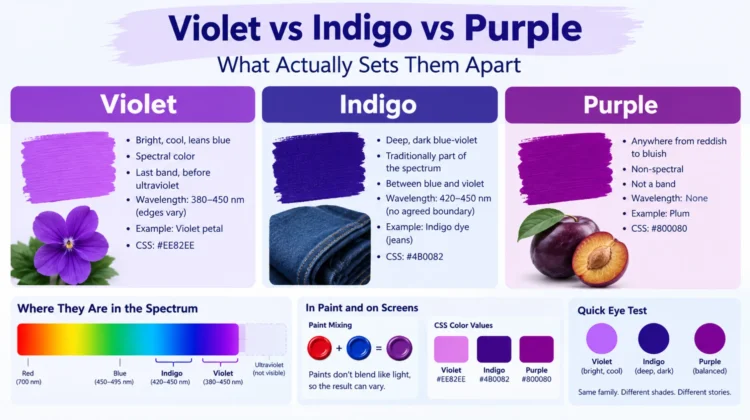
Two of these three are bands of the spectrum: violet at the far end, and indigo just before it, after blue. Purple is the odd one out: light has no purple wavelength, so it never shows up as a band. Most people use the three words loosely, and that rarely causes trouble.
To keep them straight, it helps to know how each one is defined and why a single swatch can pick up three different names.
Violet vs Indigo vs Purple: Quick Comparison
| Feature | Violet | Indigo | Purple |
| Typical look | Bright, cool, leans blue | Deep, dark blue-violet | Anywhere from reddish to bluish |
| Relationship to visible light | Spectral color | Traditionally part of the spectrum | Non-spectral |
| Place in the rainbow | Last band, before ultraviolet | Between blue and violet | Not a band |
| Wavelength | About 380–450 nm; edges vary | About 420–450 nm; no agreed boundary | None |
| Everyday example | A violet petal | Traditional indigo dye | A plum |
| CSS color value | #EE82EE | #4B0082 | #800080 |
The hex codes are CSS named colors. They’re handy for web work, but they don’t define every shade people call violet, indigo, or purple.
What Is Violet?
No color we can see has a shorter wavelength than violet. In the spectrum a prism makes, it’s the last band, right beside ultraviolet, which our eyes can’t pick up.
Unlike purple, violet can be produced by a single wavelength. Exactly where it starts and stops depends on the reference you follow.
Here’s a quirk of human vision. Red sits at the far opposite edge of the spectrum from violet, yet next to pure blue, violet still carries a faint reddish cast. That cast is what nudges it toward purple.
You’ll find violet in flowers, fabric, and paint, but a violet-looking object doesn’t necessarily reflect pure spectral violet. How a violet object looks comes down to two things: the light falling on it and how your eyes read what bounces back.
See Also: Nighttime or Night-Time? Both Are Right, Don’t Mix Them
What Is Indigo?
Indigo is dark blue shaded toward purple. In the traditional rainbow order, it sits between blue and violet.
That spot has a backstory. Newton’s seven-color count owes something to music: it’s widely said he wanted the spectrum to line up with the seven notes of a scale, and indigo helped him reach seven. Many modern descriptions fold it back into blue and violet, since no accepted wavelength cuts it off from either neighbor. In a real rainbow, most people can’t pick it out anyway.
Textile makers have used indigo as a dye for centuries, and the color name grew out of it. Jeans are the everyday example, though finished fabric can run from near-black to light blue.
What Is Purple?
A prism never produces purple. Send red and blue light into the eye together, and the result registers as purple. No single wavelength matches that blend.
On a display, red and blue light shining together give you purple. Paint works differently, since the result depends on how the pigments absorb and reflect light. Equal parts red and blue paint won’t always give the same purple, and two displays won’t show the same one either.
Of the three, purple has the widest range. A reddish purple and a blue-purple look quite different, yet both get the same name. That spread is one reason purple and violet are hard to separate by eye.
Telling Them Apart by Eye
Set three swatches side by side under the same light and see where each one leans.
A deep, blue-heavy swatch is probably indigo. Think dark denim. Pick out the brightest, coolest swatch, the one where blue clearly leads, and you’ve found violet. Anything that hovers between red and blue without committing to either goes by purple. Nobody will argue.
Why Are These Colors So Often Confused?
The spectrum is continuous. There’s no seam where blue stops and violet starts. The shift is gradual, which leaves much of the naming up to habit.
Everyday speech adds to it. Ask two people to name the same sweater, and you may get purple from one and violet from the other. A designer might call a dark blue-purple indigo, while a rainbow chart uses the word for a position in a sequence. Two people can look at the same swatch, name it differently, and both be right.
Lighting changes things too. A fabric under warm indoor bulbs can look different in daylight.
Using These Colors in Paint and on Screens
Mixing Paint
Paint labels aren’t standardized, so one brand’s violet can be another’s purple. Pigments also don’t blend like light, which means a red-plus-blue mix can land somewhere you didn’t expect.
Try it on a scrap of board before you commit to a whole wall.
Choosing Colors for a Screen
Hex codes beat color names on the web, since the named CSS colors often differ from what the word suggests. Of the three CSS keywords, violet is by far the lightest. Its red and blue values are both 238, which tips it toward a pinkish lavender and away from the bluer violet of a rainbow. CSS “indigo” (#4B0082) is a dark blue-violet, and CSS “purple” (#800080) is a deep, balanced red-blue.
There’s a bigger limit underneath. A standard monitor falls short of true spectral violet. It mixes red and blue light to approximate it. Print has a similar problem, and printed violet is usually a bright blue-purple stand-in.
If you’re working with a client or a design team, send the hex code or a swatch. Writing “violet” in the brief invites a guess.
See Also: Niece or Neice: 2 Reasons the Wrong Spelling Looks Right
Frequently Asked Questions
Is violet the same as purple?
Not in color science. Violet corresponds to wavelengths of visible light, and purple doesn’t correspond to any single one. Outside a physics class, people use both words for shades that look nearly the same.
Is indigo blue or purple?
Usually it’s described as deep blue or blue-violet. Dyed cloth and denim lean blue, while on screens some colors labeled indigo drift toward purple.
Is indigo always darker than violet?
Not necessarily. Charts tend to draw it darker, yet neither name pins down a single shade. A light indigo and a dark violet can easily reverse the comparison.
Is purple part of the rainbow?
Not as its own band. The traditional list runs red, orange, yellow, green, blue, indigo, and violet. You can still see purple when different wavelengths combine, but a rainbow only separates light by wavelength.
What’s the difference between violet and indigo in a rainbow?
Indigo sits between blue and violet, and violet is the band nearest ultraviolet. The boundary between them is soft, so where one ends depends on who’s drawing the line.
Which color should I use in a design?
Pick the shade that fits your look, then specify its exact color value. A hex code or a swatch leaves far less room for misreading than the word purple, violet, or indigo.

[…] See Also: Violet vs Indigo vs Purple: What Actually Sets Them Apart […]