
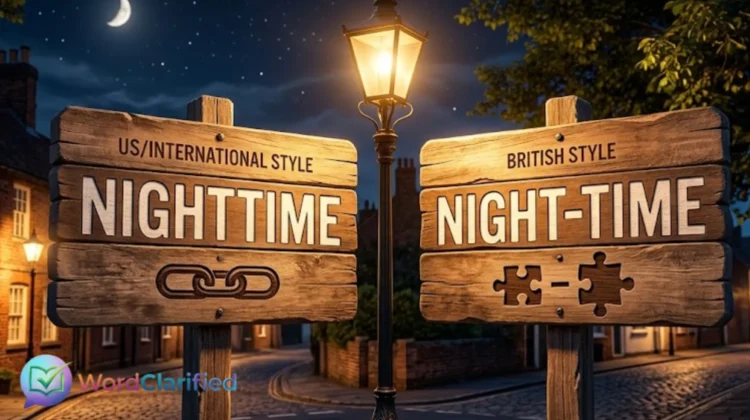
Both are correct. Nighttime and night-time are the same word with two spellings, and both name the hours between the sun going down and coming back up. The only visible difference is the hyphen, and that comes down to habit, audience, and house style.
Pick the one your readers expect and stick with it.
What the word means
Nighttime is the stretch when it’s dark outside. It works as a noun (“The ferry doesn’t run in the nighttime”) and as an adjective before another noun (“a nighttime shift,” “nighttime driving”). Both spellings are pronounced the same way: NITE-tyme.
Adding a hyphen doesn’t turn the word into something else. Hyphen in or hyphen out, the hours you’re describing don’t move.
Nighttime: the one-word spelling
Nighttime is a familiar American spelling. You’ll see it in news reports, product descriptions, health leaflets, and everyday writing. That matches daytime and bedtime, both of which are written as one word.
- The city gets a lot quieter at nighttime.
- Her nighttime routine takes about ten minutes.
- Nighttime parking is free after 6 p.m.
With no style guide and no particular audience in mind, it’s an easy default.
Night-time: the hyphenated spelling
Night-time is an established choice in British writing. A council notice about night-time roadworks, a bus timetable with a night-time service, a hospital letter offering night-time appointments: that’s where many readers meet it.
- Night-time deliveries to the loading dock finish by 5 a.m.
- The night-time bus runs until 1 a.m.
- She likes the quiet of the countryside at night-time.
British writers aren’t locked into the hyphen, though. Nighttime also appears in British publications, so don’t “correct” it when you see it. Regional habit is a tendency here, not a rule.
Nighttime, night-time, or night time?
| Form | What it is | Where you’ll usually see it |
| Nighttime | One word, closed compound | American writing, and plenty of British writing too |
| Night-time | Hyphenated compound | British writing, signs, timetables |
| Night time | Two separate words | Recorded as a variant in some dictionaries and in everyday writing |
The first two are the safe picks. The two-word form isn’t an outright error, but many publications prefer one of the other two, and editors often change it for consistency. For anything you plan to publish, treat it as a form to avoid unless your style guide asks for it.
Night and time can also meet without forming the compound, as in “Every night time slips away a little faster.” Here the two words belong to different parts of the sentence.
Writing for an older British audience
If your readers are mostly older British adults, night-time is probably the spelling they’ve met most often, whether on road signs, in local papers, or in letters from the council. Choosing it makes your writing feel familiar, and that’s a good enough reason on its own.
It doesn’t have to be treated as the only correct British spelling. It’s a house-style decision. And if you’re editing an older British publication that already uses night-time throughout, leave it. Switching every instance to nighttime to look more modern creates work and gives the reader nothing.
For a younger or international audience, the call is looser. Either form will be understood.
See Also: Niece or Neice: 2 Reasons the Wrong Spelling Looks Right
Do you need the word at all?
Often not. “She works at night” sounds more natural than “She works during the nighttime.” Save the longer word for places where it earns its spot, like contrasting with daytime (“daytime and nighttime temperatures”) or naming something specific.
There’s also a small accuracy catch. Nighttime usually refers to the dark part of the day. If you mean the period after work or dinner, even when it’s still light outside, “evening” is more precise. “We arrived at nighttime, around eight” is shaky in July, when the sky is still bright at that hour. Evening describes that arrival accurately.
Mistakes people make with this word
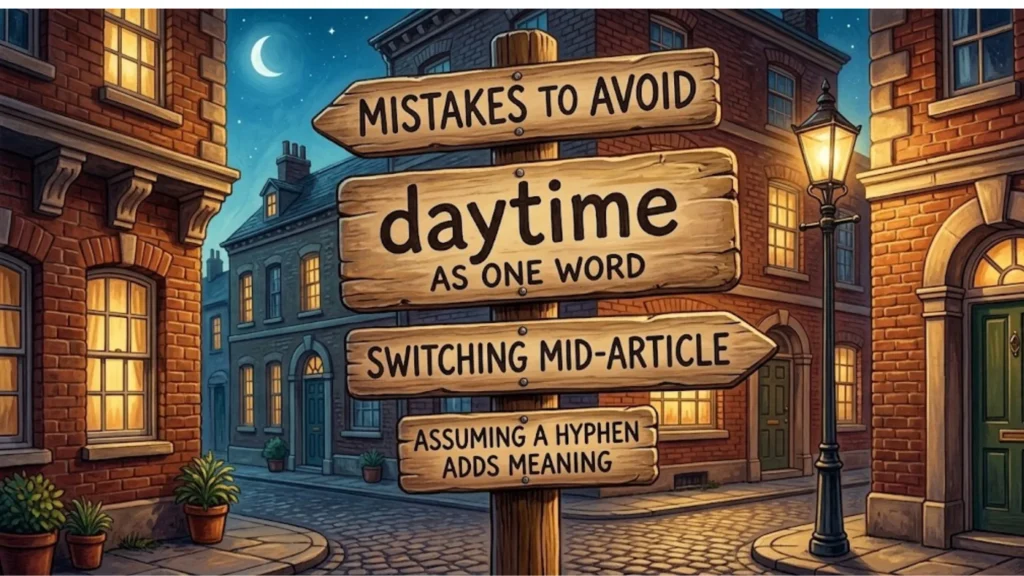
Calling the other spelling wrong. Telling an American writer that night-time is an error, or a British writer that nighttime is one, overstates things.
Switching mid-article. Writing “nighttime” in one paragraph and “night-time” in the next breaks no grammar rule, but it reads like two people edited the page. Readers notice, even when they can’t say why.
Assuming the hyphen adds meaning. It doesn’t. To a reader, the two forms point at the same thing. The hyphen is only a spelling choice and adds no extra sense.
Letting regional spelling decide everything. Keep your spelling consistent with your publication’s chosen style, but remember that using a British or American spelling elsewhere in the text doesn’t settle whether you hyphenate this word.
Applying one rule to every time compound. English doesn’t handle them consistently. Daytime and bedtime are one word, part-time takes a hyphen, and the noun real time stays open. Check each one on its own.
See Also: Apon vs Upon: The Right Spelling, Plus When to Use On
Keeping one spelling across a whole site
If you run a blog, a style guide, or a team of writers, settle it once.
Start with your audience. A mostly older British readership may find night-time more familiar, and a mostly American one will expect nighttime. If your readers are mixed, go with whichever matches your existing house style.
Then write the rule in one line, something like: “Use night-time (hyphenated) everywhere, including headings and image captions.” Once the rule is in place, run a search for the forms you’ve ruled out. The two-word version needs the closest look, because it tends to sneak in during late edits.
Frequently asked questions
Is it nighttime or night-time?
Both are correct. Nighttime is a familiar American spelling, and night-time is an established choice in British writing.
Is nighttime one word?
Yes. It’s a closed compound.
Is night-time outdated?
Not at all. It’s still the spelling many UK writers reach for in everyday copy.
Is “night time” ever correct as two words?
Some dictionaries list it, and plenty of people write it, so calling it an error goes too far. But many publications prefer nighttime or night-time, so pick one of those unless your style guide says otherwise.
Do the two spellings mean different things?
No. The hyphen is the only difference.
Which should I use for a British style guide?
Choose the form your readers know best and apply it everywhere. For an older British audience, night-time is a sensible pick.
Should I write “nighttime routine” or “night-time routine”?
Whichever matches the rest of your writing. Just don’t use both on the same page.

[…] See Also: Nighttime or Night-Time? Both Are Right, Don’t Mix Them […]