
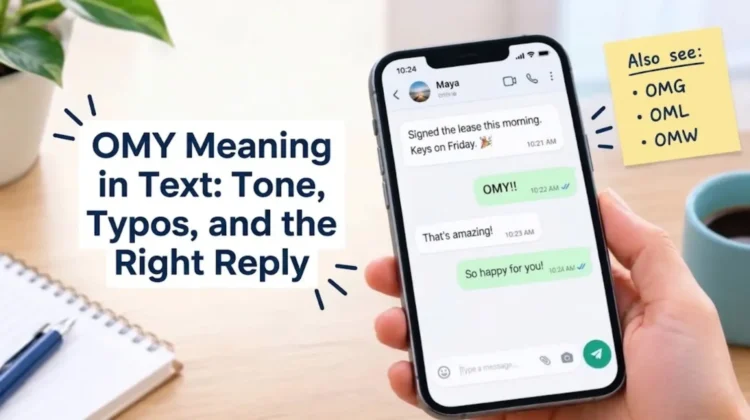
After three weeks of cold showers, you tell a friend the boiler is finally fixed. Their reply: “OMY!!” Don’t worry, there’s no hidden message. Put plainly, the OMY meaning in text comes down to two words, “oh my,” squeezed into three letters. People send it when news catches them off guard, whether the surprise is pleasant or not. Since it’s casual shorthand rather than a dictionary entry, how you read it, and when you send it, takes a little thought.
Where “oh my” comes from
Nothing about OMY is new except the spelling. “Oh” has been an English exclamation since at least the 1200s, and people have said “oh my” aloud for generations. If you’d like a second option: Once the phrase moved from speech to screens, people trimmed it to fit a thumb. OMG is the best-known case, and OMY works the same way with a milder ending.
There’s no documented origin for OMY itself, so any exact start date you see is a guess.
Reading the tone
The letters never change. The feeling does, and punctuation does most of the work.
“OMY!” is excitement, usually over good news. Stretch it to “OMY!!!” and you’re hearing a small celebration. A trail of dots (“OMY…”) suggests the sender is stuck mid-thought, either stunned or uneasy. Add question marks (“OMY??”) and the sender is saying they can’t quite believe it.
Emoji push the tone further. An OMY followed by 😱 is shock. The same OMY followed by 😂 is amusement. Timing counts too. One that lands a second after your message feels like a gasp, while one that shows up an hour later feels like the sender has been thinking it over.
Who sent it matters as well. A close friend’s OMY is playful. One from a coworker you barely know might be hard to read.
See Also: LWK Meaning in Text: What It Stands For and How to Read It
OMY next to OMG, OML, and OMW
These four look alike, and people mix them up.
| Abbreviation | Stands for | Feel |
| OMY | oh my | Mild, a bit soft |
| OMG | Oh my God | Strong, understood everywhere |
| OML | Oh my Lord | Playful or dramatic |
| OMW | on my way | Not a reaction at all |
My read is that OMY sounds gentler than OMG. It’s the texting version of “oh my!” in the voice of someone who’d never raise it above a certain volume. Some people may pick it because it skips “God,” though that’s a guess, not something I can confirm.
OMG is far more widely recognized, so if you need to be understood instantly, it’s the safer choice.
Could OMY mean something else?
Rarely in a chat, but two situations can confuse.
The first is OMW, “on my way.” If someone texts “OMY, be there in ten,” they almost certainly meant OMW, either a thumb slip or a letter mix-up. The rest of the message usually gives it away. A reaction to news means “oh my,” while anything about location or timing points to OMW. Keyboards can cause the reverse slip too. G and Y sit close together on a standard QWERTY layout so that a stray tap can turn an OMG into an OMY.
Two quick checks help. Does the message before it deserve a reaction? A surprise does. “Where are you?” doesn’t. And does this sender usually type OMY, or is it a one-off in a message with other typos? A one-off is probably a slip. If you still can’t tell, ask. “Did you mean OMW?” takes five seconds.
The second situation is outside texting entirely. OMY is the JR East station code for Ōmiya Station in Saitama, and it’s also the ISO code for Old Malay. Neither will show up in your group chat.
You may also run into lists with long expansions like “Oh My Yikes” or “Oh My Youth.” Skip them. They don’t have real backing.
Small spelling choices that change the feel
Spelling is your main tool. “OMY” in caps is the standard form and reads as an upbeat, slightly louder reaction. Lowercase “omy” is quieter and sometimes dry or unimpressed. Stretching it, as in “omyyyy,” adds a teasing, dramatic edge that suits gossip. Writing out “oh my” always feels warmer than the shortened form, regardless of case or punctuation.
Placement matters as well. OMY alone, as its own message, lands like a gasp. Tucked in front of a sentence (“OMY I can’t believe she said that”), it works as a warm-up for what follows. Neither is wrong. Just notice which one you’re sending.
See Also: WTM Meaning in Text: Full Form, Uses, and Best Replies
OMY in real conversations
Here are four scenes that show how much the tone can shift.
Good news
Maya: Signed the lease this morning. Keys on Friday.
Jordan: OMY!! Finally 🎉
Gossip
Priya: Remember Karan from our old office? He brought his ex to Ana’s wedding.
Dev: OMY… go on
Sarcasm
Marcus: I’m training for a marathon and starting tomorrow.
Dee: OMY. Sure you are
A bad fit
Sam: My grandmother’s in the hospital.
Lena: OMY
That last one is the cautionary example. Lena may mean well, but OMY in response to bad news can sound flippant. “Oh no, I’m so sorry. Can I do anything?” would have been much better.
Where you’ll see it
In a one-on-one chat, OMY is personal, a direct reaction to what the other person just told you. In a group chat, it’s more like a murmur around a table. Someone drops it, and others pile on. Under a public post or video, it’s an exclamation aimed at everyone, closer to a reaction than a reply, and nobody expects an answer.
The three letters mean the same thing in all three places. How much weight they carry depends on who’s listening.
When to use it and when to skip it
Casual spaces are OMY’s home turf: chats with friends, group threads, and relaxed comment sections.
Leave it out of emails to your boss, notes to a professor, client messages, and any conversation where someone is hurting. Someone describing a bad day deserves a real sentence.
If you’re not sure, type “oh my” in full. A few extra taps and the message can’t be misread.
See Also: WSP Meaning in Text: What It Says and What to Send Back
How to reply to OMY
Match what they sent. When your own news gets an OMY, give the person what they’re after, which is more story: “I know! The best part is she’d already booked her flights by then.”
If it came out of nowhere, about something they saw or read, ask what happened. “What did you see?” does the job.
And if you can’t tell whether it’s thrilled or shocked or sarcastic, ask. “Good OMY or bad OMY?” works fine between friends and will probably get a laugh.
Quick questions
Is OMY okay to use with parents or grandparents?
Usually, yes. “Oh my” is a mild exclamation, and OMY contains no swearing. The only risk is that an older relative may not recognize it, so expect a “what does that mean?” in reply.
Is it fine in a work chat tool?
That depends on the team. In a relaxed internal channel where people already use emoji and GIFs, an OMY under a colleague’s good news won’t raise eyebrows. In messages to clients, managers you don’t know well, or anything that might get forwarded, write “oh my” or skip the reaction.

[…] See Also: OMY Meaning in Text: Tone, Typos, and the Right Reply […]