
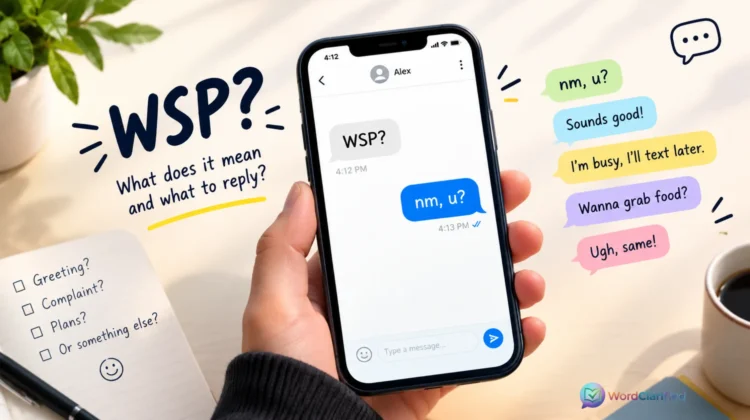
What Does WSP Mean?
WSP means “what’s up.” It’s a text-message greeting, and whoever sends it wants a quick reply, not a life update.
Think of it as the typed version of a nod across a hallway. A “wsp?” from a friend at 4 p.m. needs about three words back, and “nm, u?” does the job.
Most of the time that’s the whole story. A few messages do a different job: a gripe about a late train, a request to switch apps, or a company name in a work email. Each of those gets its own section below, plus a fast check for which kind you’ve got.
Where “wsp” Comes From and Why It Isn’t “wu”
How “what’s up” turns into three letters
Say “what’s up” out loud, fast. You won’t hear two tidy words. You’ll hear something closer to “wassup,” with the T swallowed and the vowel in “up” squashed flat. Plain initials would give “wu,” but that doesn’t echo the sound of the phrase. Wsp does, and that’s the likely reason people adopted it. That’s an educated guess, not documented history.
How long it’s been around
The abbreviation has been in use since at least the early 2000s, so it predates Snapchat and TikTok by years. It isn’t a product of any one app.
Why it feels so casual
Wsp is typed speech, so it reads like a shrug. Nobody sends it hoping for an essay in reply. It mirrors a spoken greeting, so even a late-night send between friends sounds natural, not intrusive.
See Also: CBFW Meaning in Text: How to Tell Which One’s Meant
Two Jobs: A Hello and a Complaint
Wsp as a greeting
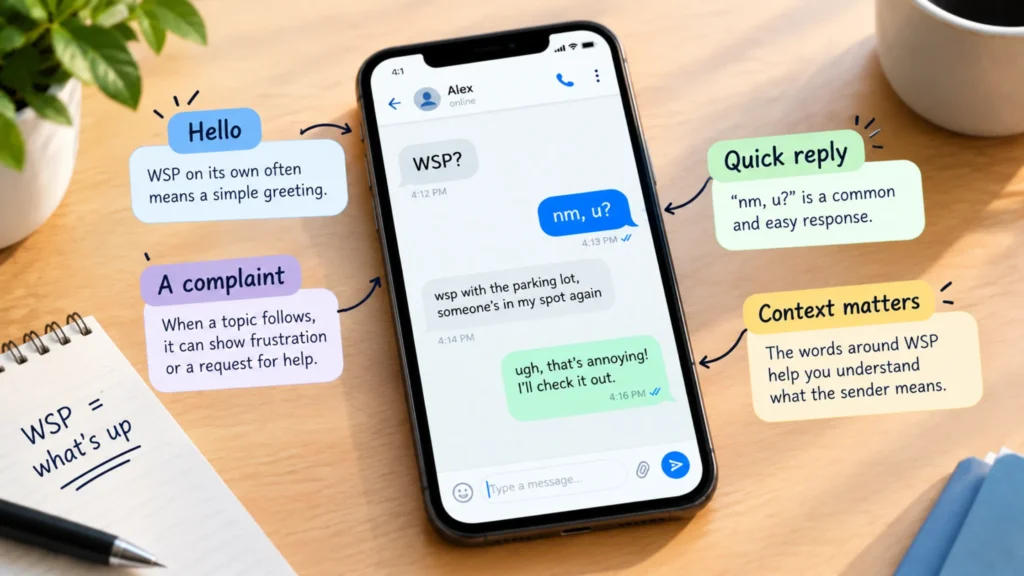
Most of the time wsp is a hello, and it takes a few shapes. It might arrive solo (“wsp?”), aimed at one person (“wsp Dana”), or dropped into a group chat (“wsp all, who’s around for pizza Friday”). Nobody expects a report back. A couple of words and a question mark are plenty in return.
Wsp as “what’s going on with this?”
The second job is easy to miss. Put a subject right behind it, and the greeting turns into a reaction.
Say your neighbor texts, “wsp with the parking lot, someone’s in my spot again.” She isn’t asking how your day is going. She’s irritated and wants a bit of sympathy. Same with “wsp with the wifi, it’s been dropping since lunch.” The message looks casual either way, but the request is completely different.
How to tell which one you got
Look at what comes right after it.
- Nothing, or just a name: a hello.
- “With” plus a thing: a reaction to that thing.
- A time word like “later,” “tonight” or “tmrw”: plans are probably coming, so expect a follow-up question.
Context helps too. If the message lands in the middle of an ongoing complaint, it’s almost certainly the second job.
Does the app change the meaning?
No. Snapchat, Instagram DMs, TikTok comments and plain SMS all read it the same way. What shifts the meaning is the words around it, not the app it arrived in.
How to Reply to WSP
The safe default: “nm, u?”
One reply covers most situations, and this is it. “Nm” means “not much,” and “u” hands the question back. It answers, it’s polite, and it takes about four seconds to type. If the sender wants a real conversation, they’ll steer it from there.
Replies by goal
You want to chat. Drop a small hook into your answer. “Nm, burned the rice and ordering pizza instead. u?”
Gives the sender something to ask about, and a flat “good, u?” tends to end the exchange right there.
You’re busy. Name the reason and the time you’ll be free: “Stuck at the dentist until 4:30, ping you after.” That’s enough.
It was the complaint kind. Answer the gripe, not the greeting. If a coworker texts “wsp with the printer, jammed again,” reply “ugh, third time this week for me too.”
You’re feeling playful or flirty. Keep it short and light. “Nm, bored. Say something interesting” works. A long, loaded paragraph in return for a quick wsp tends to feel like a lot.
Replies by relationship
- A friend: “Nm, walking the dog in the rain. wyd?”
- A relative: “Hi Auntie! Doing well, just cooking dinner. How about you?”
- A classmate or coworker: “Hey, all good. Need something?”
- Someone you like: “Not much, finally cleaned my desk. How’s your night going?”
Notice the relative reply is spelled out. Not everyone reads “nm” at a glance, so match the way the other person writes.
One reply to skip: a flat “nothing”
The answer is true, but it leaves the other person nothing to reply to. The sender asked something small and friendly. Add two words and it changes: “nothing much, you?” works fine.
How fast do you need to answer?
This is an opinion, not a rule: replying the same day is normal. WSP is a hello, not a summons. If it lands while you’re in a meeting, nobody is owed an answer in thirty seconds.
What WSP Means From a Guy, a Girl, or a Stranger
Does gender change the meaning?
No. The abbreviation reads the same no matter who typed it. People who search for the guy or girl version are usually wondering about interest, and a single text can’t settle that. The sender may be killing time in a queue, or softening you up before asking for a favor.
Signals that say more than one wsp
The pattern around the message tells you far more than the message itself does. Watch for these:
- Who texts first. If the same person starts most of your chats, that’s real interest in talking, though not necessarily romance.
- How they respond to your answer. Someone who picks up a detail you gave (“did the bike chain ever work?”) is paying attention. A bare “lol” followed by silence usually isn’t.
- Suggested plans. A jump from “wsp” to “wanna grab food Saturday?” says more about their interest than the abbreviation ever will.
Two or three of these over a week say much more than a single text. If you like the person, wait for the second message before deciding what the first one meant.
When a Stranger Texts You “wsp”
A wsp from someone you haven’t saved, or from a profile you don’t recognize, doesn’t require a friendly answer. “Hey, who’s this?” is a fair reply, and it puts the onus on them to explain. No explanation back? Then you can drop it.
WSP With Capital Letters, WhatsApp and Other Meanings
Rarely, wsp isn’t “what’s up” at all. None of these readings is as common as the greeting, but each one turns up now and then.
Some people type “wsp” as shorthand for the app, usually when they want to move a conversation there. Imagine getting “Can I reach you on wsp?” Here, the three letters stand in for the app’s name, and nobody is greeting you. The mix-up is easy to understand, because the app’s name is itself a play on “what’s up.” The clue is the question: if it asks about an account or a switch of apps, it’s the app.
“What’s popping”
For some people the P stands for “popping,” which makes it “what’s popping.” That’s the same hello in rougher slang, and “nm, u?” answers it just fine.
WSP at work
WSP in capitals is also the name of a large engineering and professional services company. If you spot it in an email signature, a job posting or a project report, it almost certainly refers to the company, not slang. The capitalization and the surrounding words give it away. A line like “WSP will review the site plans” has nothing to do with texting.
The default rule
Unless a message mentions the app, a workplace or switching chats, read it as a plain hello. That covers nearly every case.
See Also: How Do You Do That? Meaning, Tone, and Easy Examples
How to Read the Tone of a WSP Message
A message this short has little tone of its own, so readers lean on the details around it. Take what follows as tendencies, not laws, and weigh each one against how the sender normally types.
Punctuation. A “wsp?” tends to sound open and curious. A bare “wsp” with nothing after it often reads as relaxed. A period (“wsp.”) can feel flatter or more serious, though some people just type that way.
Capitals. Lowercase is the everyday default. “WSP” in all caps can read as loud and excited, or occasionally as pointed, depending on the person.
Emoji. A 😂 or 👋 after it softens the message. No emoji at all from someone who usually sends them is worth noticing.
Here’s the same abbreviation in three moods:
Friendly: wsp!! 😂 Been way too long, what’s new
Flat: wsp.
Annoyed: WSP. You said you’d call at 6
The words are almost identical, but you’d respond differently to each one. The first wants a warm catch-up, the second probably wants a short reply, and the third wants an apology and an explanation.
When the tone is unclear, compare it with how the person normally writes. A single odd text says less than a change from their usual style.
WSP Next to Sup, Wsg, Wyd, Hbu and Nm
These abbreviations show up together in the same chats, and they don’t all do the same job.
- Sup: a shorter cousin of wsp, with the same meaning and an even lazier feel.
- Wsg: “what’s good,” a greeting with the same job as wsp and a slightly more laid-back sound.
- Wyd: “what are you doing,” which asks about your current activity. People send it when they’re checking in on your evening or weekend.
- Hbu: “how about you,” the polite hand-back after you’ve answered.
- Nm: “not much,” the standard reply to a wsp.
Here’s a short chat that uses most of them:
Maya: sup
Jonah: nm hbu
Maya: same lol. wyd after work
Jonah: nothing planned, why
Maya: wanna get dinner then.
Maya opens with a greeting, Jonah answers and hands the question back, and then “wyd” pulls the chat toward plans. Nobody stops to translate anything.
If you only learn two, learn wsp and nm. With those,e you can handle most casual chats without thinking about it.
Common Mix-Ups With WSP
A few misreadings come up often enough to fix quickly.
“It’s asking what I’m doing.” Sometimes, but often it’s just hello. Answer lightly and see where it goes.
Treating your reply as a test. Nobody is grading it. A short, friendly answer is exactly what the sender hoped for.
Taking silence as rejection. One unanswered WSP usually means the person is busy, not annoyed.
Where WSP Fits and Where It Doesn’t
WSP works in DMs, group chats and texts to friends, anywhere the people already talk the way they’d talk in person. A message to your roommate or cousin can be as short as you like.
It’s too casual for a boss, a teacher, a client, or a first message to someone who isn’t expecting you. Swap in something plain:
- To a manager: “Hi Priya, could we go over Friday’s schedule?”
- To a teacher: “Hello Mr. Okafor, I had a question about the assignment.”
- To someone new: “Hello Sam, I’m Jordan; we met at the book club.”
Tone does more work than the abbreviation. A bare wsp to someone who barely knows you leaves them to start the conversation, and that can read as lazy even when you didn’t mean it that way.
Final Thought
“Three letters don’t deserve a long deliberation. Read the words after them, and if there aren’t any, send “nm, u?” and see what comes back. Their next text will make the intent obvious.”
Frequently Asked Questions
What does wsp mean in text?
It’s short for “what’s up,” and it does two jobs. Alone it’s a hello, and with a topic attached (“wsp with this traffic”) it’s a reaction.
What does wsp mean on Snapchat and Instagram?
It works as a low-effort opener, mostly in DMs. Reply the way you would in a normal text, because nothing about the meaning changes inside the app.
Does the sender’s gender change what wsp means?
No. The meaning stays “what’s up”, whoever types it. Tone shifts with how well you know the person, since the same text from an old friend and someone you met last week lands very differently.
How do I reply to wsp?
Match their size. A short message deserves a few words back, and “nm, u?” fits.
Does wsp mean “what’s popping”?
For some people, yes. You don’t need to know which one a sender has in mind, because the reply is identical either way.
Does wsp mean WhatsApp?
Sometimes. When the surrounding message doesn’t make it clear, a quick “wsp as in WhatsApp?” gets you a straight answer.
What’s the difference between wsp, sup and wyd?
Wsp and sup are interchangeable greetings. Wyd goes further and asks what you’re up to right now, so a one-word reply feels thin, and “nothing, why?” gives it what it’s after.
Is wsp rude?
No. It feels abrupt because of the timing, like a wsp at 11 p.m. when you haven’t talked in months.
Do I have to reply right away?
No. A same-day reply is normal, and if someone is clearly waiting, “in a meeting, text you later” covers you in a few seconds.
Can I use wsp with my boss or teacher?
Skip it. Open with their name and a reason for writing, and save wsp for friends.

[…] WSP means “what’s up.” […]