

Where should I put commas when writing a sentence? Commas do more than show a pause. They separate parts of a sentence and help clarify meaning.
You do not have to learn every comma rule at the same time. Start by looking at what each part of the sentence is doing.
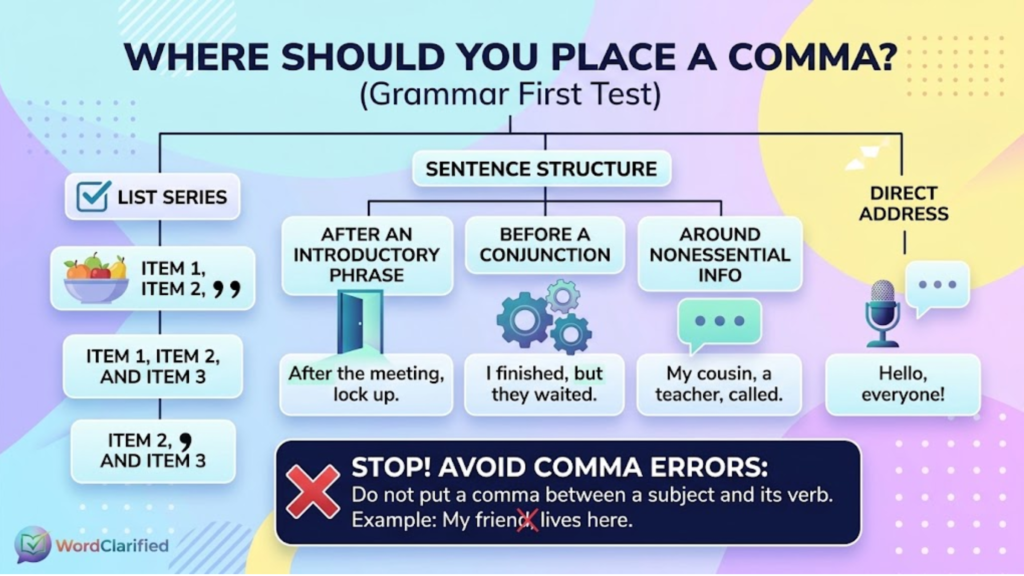
Commas can separate items in a list, set off an opening phrase, join two independent clauses with a coordinating conjunction, or mark extra information. They can also separate a person’s name when you speak directly to them.
Here are the most common cases.
Where Should You Place a Comma in a Sentence?
Commas commonly appear:
- Between items in a list
- After an introductory phrase or clause
- Before a coordinating conjunction that connects two independent clauses
- Around nonessential information
- Around a person’s name in direct address
- Between coordinate adjectives
- Around certain interrupting words or phrases
For example:
We bought bread, fruit, and cheese.
After lunch, we went for a walk.
I wanted to call you, but I lost your number.
My cousin, who lives nearby, visits us often.
The main thing to remember: don’t add a comma just because you hear a pause. Look at the grammar first.
Use Commas to Separate Items in a Series
Use commas to separate three or more items in a series.
I packed a shirt, a jacket, two books, and my charger.
We need flour, sugar, butter, and eggs.
The course covers grammar, spelling, pronunciation, and writing.
The commas show where one item ends and the next begins.
With only two items, you normally do not need a comma:
I bought bread and milk.
What About the Comma Before “And”?
The comma before the final and in a list is called the Oxford comma or serial comma.
We invited James, Maria, and Daniel.
Some writing styles leave out the final comma:
We invited James, Maria and Daniel.
Both styles are used in English. Follow the style required for your writing and stay consistent.
The final comma can also make a list easier to understand:
We thanked the teachers, the principal, and the parents.
Without the final comma, a reader may briefly wonder whether the principal and the parents form one group.
Put a Comma Before “And,” “But,” “So,” and Other Coordinating Conjunctions
The coordinating conjunctions are:
for, and, nor, but, or, yet, so
When a coordinating conjunction joins two independent clauses, put a comma before the conjunction.
I finished the report and sent it to my manager.
Both parts can stand as sentences:
I finished the report.
I sent it to my manager.
Here is another example:
The store had closed, so we went somewhere else.
Do not put a comma before and every time you see it.
I completed the report and emailed it to my manager.
One subject does two related actions, so you don’t need a comma.
Sarah opened the window and turned on the fan.
Avoid the shortcut “put a comma before every and.” Check whether the words on both sides form two independent clauses.
When Should You Use a Comma After an Introductory Phrase or Clause?
A sentence can begin with information that sets up the main idea. A comma often separates that opening material from the main clause.
After the meeting, we went home.
Before you leave, lock the door.
Since the road was closed, we took another route.
To save money, we cooked at home.
The same pattern works with longer introductory phrases:
After spending several hours at the library, I finally found the book I needed.
With very short opening phrases, punctuation can sometimes vary by sentence and writing style. Do not assume that every short opening requires a comma.
Use Commas Around Extra Information
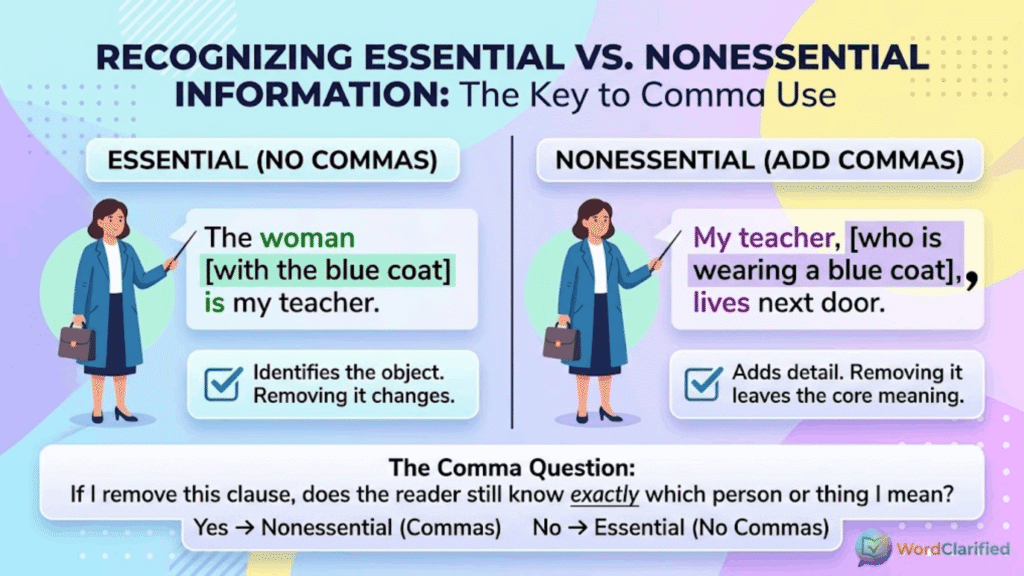
Some information adds detail without identifying the person or thing being discussed. When that information is nonessential, commas set it apart.
My uncle, who lives in Canada, is coming to visit next month.
The sentence still works without the middle part:
My uncle is visiting next month.
Now compare:
The uncle who lives in Canada is coming to visit next month.
Here, who lives in Canada may identify which uncle the speaker means.
This distinction matters with who, which, and where. Do not automatically put commas around every clause that begins with one of these words.
Ask:
Does this information identify the person or thing, or does it simply add extra detail?
When Do I Put a Comma Before “Where”?
The word where can take a comma in some sentences but not in others. It depends on the job the following clause does.
Use a comma when where begins a nonessential relative clause:
We visited Paris, where my sister studied for two years.
The main idea is:
We visited Paris.
The information about your sister adds extra detail.
But no comma belongs here:
I know where my sister studied.
The words where my sister studied complete the meaning of I know.
Another example:
This is the house where I grew up..
Here, where I grew up helps identify the house. It is part of the information that tells the reader which house you mean.
Don’t follow the rule “always put a comma before where.” Check how the clause functions in the sentence.
Use a Comma When Speaking Directly to Someone
When you speak directly to someone, separate their name from the rest of the sentence with a comma.
David, could you open the window?
Could you open the window, David?
Thank you, everyone.
Compare these:
Emma, please call me.
Emma called me.
In the first sentence, you are speaking to Emma. In the second, Emma is the subject.
See Also: Past Tense of Tear: Tore, Torn, or Teared Up?
Use Commas Between Coordinate Adjectives
Sometimes two adjectives describe the same noun independently.
It was a cold, rainy morning.
You can place and between the adjectives:
It was a cold and rainy morning.
That is a useful test for coordinate adjectives.
But some adjectives work together as a unit:
She bought a small wooden box.
You would not normally say:
a small and wooden box
So no comma belongs between small and wooden.
Compare:
a bright, sunny afternoon
with:
three large wooden chairs
The relationship between the adjectives matters. Do not add a comma simply because two adjectives appear next to each other.
How Do I Punctuate “However”?
However can be confusing because it does not work like but.
At the beginning of a sentence:
However, we decided to stay.
In the middle of a sentence:
The plan, however, was too expensive.
When however links two independent clauses, you need more than a comma between them.
Incorrect:
I wanted to leave, however, it was raining.
Better:
I wanted to leave; however, it was raining.
You could also write:
I wanted to leave. However, it was raining.
Do I Put a Comma Before “Because”?
Usually, you do not need a comma before because when the clause gives the reason for the main idea.
I stayed home because I felt sick.
When the because clause comes first, a comma normally follows it:
Because I felt sick, I stayed home.
So do not use the shortcut “put a comma before because.” Look at how the clause works in the sentence.
Do Commas Go Wherever You Pause?
No.
A spoken pause can sometimes help you notice where punctuation might belong, but it is not a reliable rule.
For example:
The woman wearing the red coat is my teacher.
You might pause after coat when speaking, but there is no reason to put a comma there.
Incorrect:
The woman wearing the red coat, is my teacher.
Correct:
The woman wearing the red coat is my teacher.
Instead of asking, “Would I pause here?”, ask:
What role does this part of the sentence play?
That makes it easier to decide where the comma belongs.
Where Should I Not Put a Comma?
Knowing where commas do not belong can prevent many common errors.
Don’t Separate the Subject From the Verb
Incorrect:
My brother, works in a bank.
Correct:
My brother works in a bank.
A comma should not normally split the subject from its verb.
Don’t Separate a Verb From Its Object
Incorrect:
She ordered, a cup of coffee.
Correct:
She ordered a cup of coffee.
The verb ordered connects directly to its object, a cup of coffee.
Don’t Join Two Complete Sentences With a Comma Alone
This mistake is called a comma splice.
Incorrect:
I missed the bus, I arrived late.
You can fix it in several ways:
I missed the bus, so I got to work late.
I missed the bus. I arrived late.
I missed the bus; I arrived late.
The choice depends on how the two ideas relate.
What About Commas With Relative Clauses?
Relative clauses often cause problems because some need commas and others do not.
Compare:
My car, which is ten years old, still runs well.
The clause which is ten years old adds information about the car.
Now look at:
The car that has a broken window belongs to Sam.
Here, that has a broken window helps identify which car you mean.
A useful question is:
If I remove the clause, does the reader still know exactly which person or thing I mean?
If the clause adds extra information, you may need commas. If it identifies the noun, do not automatically use commas.
Common Comma Mistakes
Watch for these errors when checking your writing.
Comma before every “and”
I opened the door and walked outside.
No comma is needed.
Comma between the subject and verb
My sister, lives in Chicago.
Remove the comma.
Comma between a verb and its object
We watched, the movie.
Remove the comma.
Comma splice
The weather was bad, we stayed home.
Use a conjunction, period, or semicolon.
Commas around information that identifies a noun
The students who arrived early found seats.
Do not add commas if who arrived early identifies which students you mean.
Commas based only on pauses
The man near the entrance is my uncle.
The comma does not belong there.
A Quick Test for Comma Placement
When you are unsure, ask these questions:
- Am I separating three or more items in a list?
- Does a coordinating conjunction join two independent clauses?
- Does the sentence start with an introductory phrase or clause?
- Is some information extra rather than needed to identify the noun?
- Am I speaking directly to someone?
- Are two adjectives independently describing the same noun?
- Am I using however between two complete thoughts?
- Did I accidentally split the subject from its verb?
- Did I place a comma between the verb and its object?
- Did I join two complete sentences with just a comma?
If you can identify the job of the comma, the decision becomes much easier.
The Easiest Way to Remember Comma Rules
Do not think of a comma as a mark that simply tells the reader to pause.
Think of it as a separator.
It can separate items in a list, an opening part of a sentence, extra information, or two independent clauses joined by a suitable conjunction.
If you are unsure, check the words around the comma. Then ask what grammatical job that section performs.
For example:
After work, I went shopping.
The comma separates the opening phrase from the rest of the sentence.
I wanted to go, but I was busy.
The comma separates two independent clauses joined by but.
My friend, who lives nearby, called me.
The commas set off extra information.
Once you focus on sentence structure instead of pauses, comma placement becomes much easier.

Leave a Reply