
When to Use a Colon or Semicolon
Choosing between a colon and semicolon is much simpler when you know the job each mark performs.
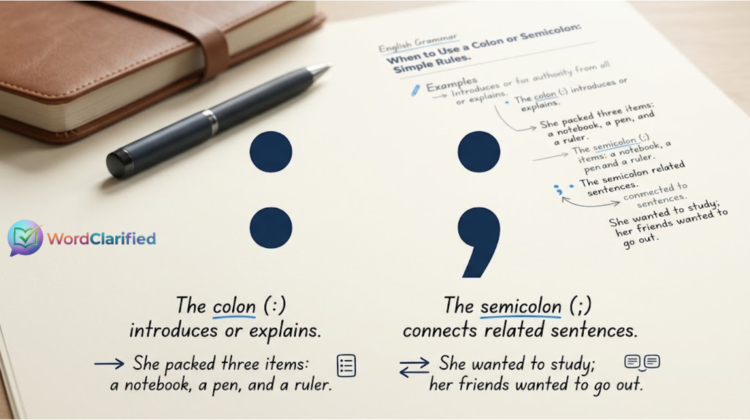
A colon (:) directs attention to what comes next, including a list, explanation, example, or quotation.
A semicolon (;) connects two complete, related thoughts. It can also divide list items when those items already contain commas.
For example:
Colon: She packed three items: a notebook, a pen, and a charger.
Semicolon: She wanted to study; her friends wanted to go out.
The simple rule is:
A colon introduces. A semicolon connects.
Colon vs. Semicolon: The Basic Difference
A colon signals that the sentence is about to provide something more specific, such as an explanation, detail, or identification.
A semicolon links two related independent clauses, with each side able to function as a complete sentence.
| Punctuation | Main job | Example |
| Colon (:) | Introduces or explains information | I need three items: a pen, paper, and a notebook. |
| Semicolon (;) | Connects related independent clauses | I need to study; my exam is tomorrow. |
Compare these examples:
Colon: She had one goal: passing the exam.
The words after the colon identify her goal.
Semicolon: She stayed up studying; passing the exam mattered to her.
Both sides can stand alone, and the semicolon keeps the related ideas together.
When to Use a Colon
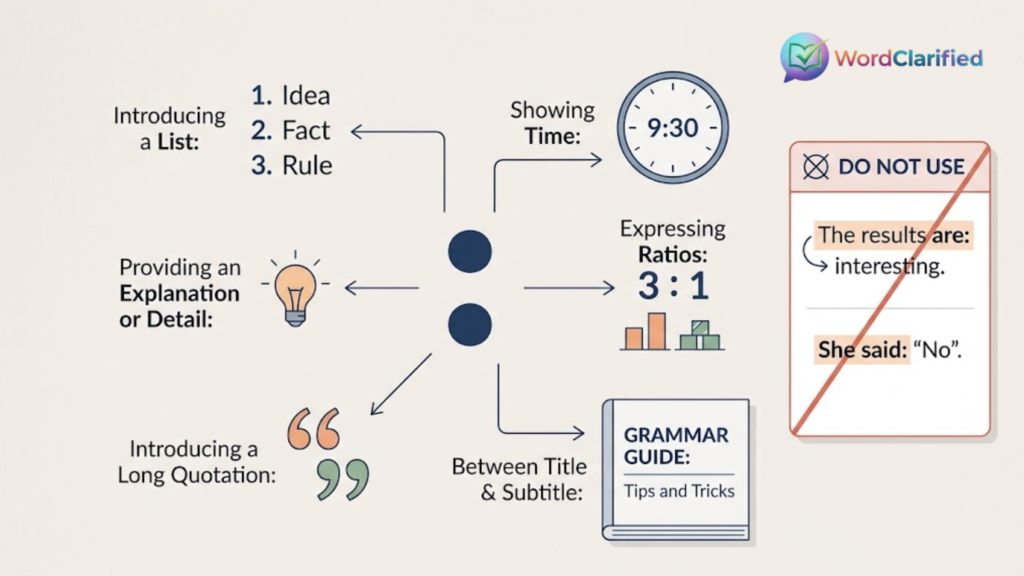
Choose a colon when the material that follows explains, identifies, or introduces something mentioned before it.
Before a List
Place a colon before a list when the words introducing it can already stand as a complete sentence.
Correct: I need three items: a notebook, a pen, and a ruler.
The lead-in, “I need three things,” is complete.
Do not use a colon when the sentence flows directly into the list and the introductory words are not a complete thought.
No colon: My favorite subjects are math, science, and history.
Incorrect: I need a notebook, a pen, and a ruler.
“I need” does not provide a complete lead-in for the list. A colon would interrupt the sentence.
Before an Explanation or Specific Detail
A colon may introduce a detail that explains or adds information to the statement before it.
Examples:
She knew one thing: she had to study harder.
The reason is simple: practice improves your writing.
He had one rule for his students: always ask questions.
In these examples, the words after the colon give the reader more information about the preceding idea.
Before a Quotation
You may place a colon before a quotation when the preceding words provide a complete introduction to it.
Example: The teacher gave her students this advice: “Read every day.”
A comma can also introduce a quotation when the quoted words fit directly into the sentence:
The teacher said, “Read every day.”
The punctuation depends on how the quotation fits into the sentence.
Other Common Uses of a Colon
Colons also appear in several standard formats:
- Time: 9:30
- Ratios: 3:1
- Titles and subtitles: Grammar Basics: A Guide for Students
These uses follow conventions that differ from using a colon between parts of a sentence.
See Also: Past Tense of Panic: What Is the Correct Form
When Not to Use a Colon
Use a colon for a grammatical reason, not just because the sentence seems to call for a pause.
After an Incomplete Lead-In
Incorrect: My favorite fruits include: apples, oranges, and bananas.
Correct: My favorite fruits include apples, oranges, and bananas.
You can also rewrite the sentence so the lead-in is complete:
Correct: Three fruits are my favorites: apples, oranges, and bananas.
Between a Subject and Its Verb
Do not place a colon between a subject and its verb.
Incorrect: The best parts of the trip were: the food and the beaches.
Correct: The best parts of the trip were the food and the beaches.
The colon breaks the normal connection between the subject and verb.
Just to Create a Pause
A colon does more than mark a longer pause.
Incorrect: She opened the door: and walked inside.
Correct: She opened the door and walked inside.
Use a colon only when the material that follows has a clear grammatical relationship with what comes before it.
When to Use a Semicolon
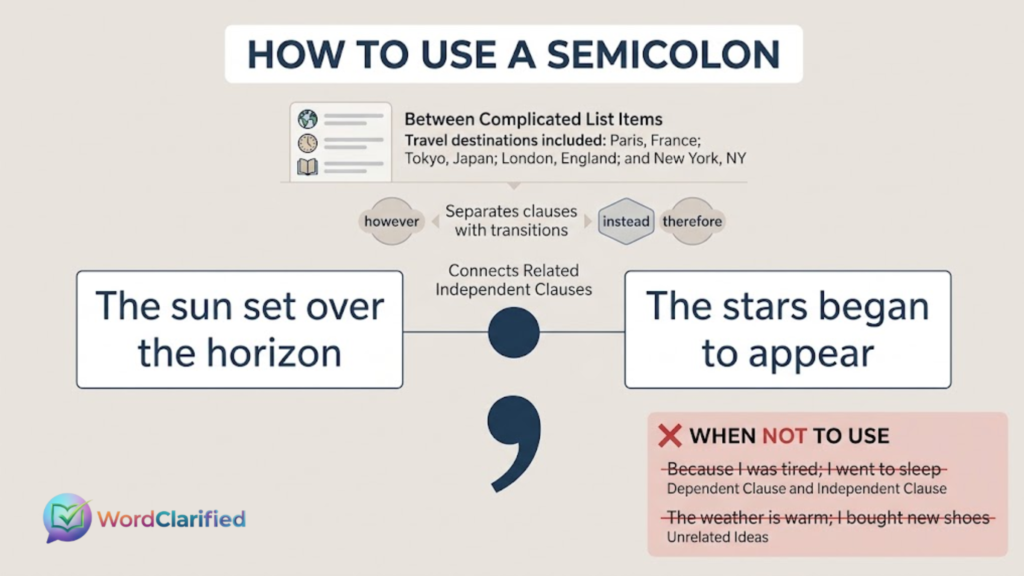
In everyday writing, semicolons have two common uses:
- To connect related independent clauses.
- To separate list items that contain commas.
Between Two Related Independent Clauses
An independent clause expresses a complete thought and can stand alone as a sentence.
For example:
The rain stopped.
We went outside.
You can join them with a semicolon:
The rain stopped; we went outside.
A semicolon keeps two closely related ideas in the same sentence while separating them clearly.
You could also use a period:
The rain stopped. We went outside.
Both are correct. It lets the related thoughts remain together within a single sentence.
Before “However,” “Therefore,” and Similar Words
Words such as however, therefore, instead, meanwhile, and as a result can follow a semicolon when they link two independent clauses.
The basic pattern is:
Independent clause; transition word, independent clause.
Examples:
- I wanted to go; however, I was too tired.
- She studied hard; therefore, she passed the exam.
- We could take the bus; instead, we walked.
- Tom finished his work; meanwhile, Sarah started hers.
- The road was closed; as a result, we took another route.
The semicolon separates the two independent clauses. The transition word shows the relationship between them.
Between Complicated List Items
When list items already contain commas, semicolons can be used to divide the larger items.
Example:
The conference attracted people from Austin, Texas; Miami, Florida; Denver, Colorado; and Portland, Oregon.
This makes it clear where one list item ends and the next one begins.
When Not to Use a Semicolon
A semicolon cannot replace every comma or period. Check the structure of the sentence first.
After a Dependent Clause
A semicolon does not follow a dependent clause because that clause cannot function as a complete sentence by itself.
Words such as because, although, and when often introduce dependent clauses.
Incorrect: Because I was feeling tired, so I went to bed early.
Correct: Since I was tired, I went to bed early.
A semicolon works when both parts are independent clauses:
I was feeling tired; so I went to bed early.
Where a Comma Belongs
A semicolon does not serve as a stronger version of a comma.
Incorrect: After dinner; we watched a movie.
Correct: After dinner, we watched a movie.
“After dinner” cannot stand alone as a sentence, so a semicolon does not work there.
Between Unrelated Ideas
A semicolon is most useful when the two independent clauses are closely connected in meaning.
Awkward: I finished my homework; the store sells fresh bread.
The two clauses are complete, but their ideas are unrelated.
Use separate sentences instead:
I finished my homework. The store sells fresh bread.
See Also: Writing or Writting: Which Spelling Is Correct?
Colon or Semicolon? How Do You Choose?
The quickest way to choose is to look at the relationship between the two parts.
Use a Colon When the Second Part Explains or Introduces the First
Ask:
Does the second part explain, identify, or introduce something from the first part?
If yes, a colon may be appropriate.
Example: She had one main goal: passing the exam.
The second part identifies her goal.
Use a Semicolon When Both Parts Are Independent Clauses
Ask:
Could each side work on its own as a complete sentence?
If they can, and the ideas are closely related, a semicolon may work.
Example: She studied every night; she wanted to pass the exam.
Both parts can stand alone:
She studied every night.
She wanted to pass the exam.
A Quick Decision Rule
When choosing between the two:
- Check what comes before the punctuation.
- Check whether both parts can stand alone.
- Ask whether the second part explains or introduces the first.
- Choose the punctuation that fits.
Explanation or introduction → colon
Two related independent clauses → semicolon
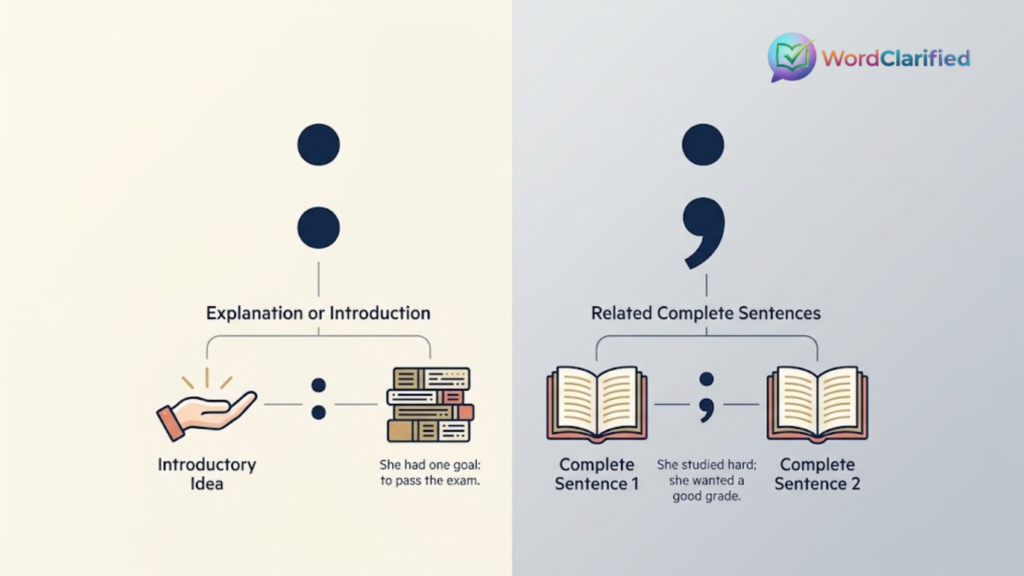
Colon vs. Semicolon: Side-by-Side Examples
List vs. Related Sentence
Colon: I bought three fruits: apples, oranges, and bananas.
Semicolon: I bought some fruit; my sister bought vegetables.
The colon introduces a list. The semicolon connects two independent clauses.
Explanation vs. Connection
Colon: There was one problem: we had no tickets.
Semicolon: We had no tickets; we could not enter.
The colon introduces an explanation. The semicolon joins two complete thoughts.
Simple List vs. Complicated List
Colon: The class needs three supplies: paper, pencils, and folders.
Semicolons: The students came from Austin, Texas; Miami, Florida; and Denver, Colorado.
The colon introduces the list. The semicolons separate list items that already contain commas.
Common Colon and Semicolon Mistakes
| Mistake | Better Choice |
| Colon after an incomplete lead-in | Remove the colon |
| Colon between a subject and its verb | Remove the colon |
| Semicolon after a dependent clause | Use a comma or rewrite the sentence |
| Semicolon between unrelated thoughts | Use a period |
| Semicolon used like a comma | Check whether both sides are independent clauses |
The important point is to look at sentence structure, not just the pause you hear while reading.
Can You Replace a Semicolon With a Period?
Yes, when both sides are independent clauses.
Semicolon: The weather turned cold; we stayed indoors.
Period: The weather was cold. We stayed inside.
Both versions are correct. The semicolon keeps the related thoughts together, while the period separates them into two sentences.
See Also: Up to Date or Up-to-Date Examples: Easy Rules to Get It Right
Can You Replace a Colon With a Semicolon?
Usually, no. They perform different jobs.
A colon introduces information:
She needed one thing: sleep.
A semicolon connects two independent clauses:
She was exhausted; she needed sleep.
In the first sentence, “sleep” identifies the thing she needed. In the second, both sides can stand alone.
Capitalization After a Colon
Capitalization after a colon depends on what follows and, in some cases, the style guide being used.
Before a List or Phrase
Use lowercase when the colon introduces an ordinary list or phrase.
Example: I bought three items: bread, milk, and eggs.
Before a Complete Sentence
Capitalization can vary when a complete sentence follows a colon.
Example: She knew the truth: she had made a mistake.
Some style guides use lowercase in this situation, while others allow or prefer an uppercase first word. If you are following a specific style guide, follow its rule consistently.
Can You Use a Colon Before a Question?
Yes. A colon can introduce a question when the question follows naturally from the preceding statement.
Example: There is one question we need to answer: Why did the plan fail?
Another example:
She asked herself the same thing: Was she ready?
The question should have a clear connection to the statement before the colon.
Can You Use a Colon Before “Because”?
A colon can sometimes appear before because, but the result may sound awkward.
Awkward: There was one reason: because the weather was bad.
A clearer version is:
There was one reason: the weather was bad.
Or:
The bad weather led to the event being canceled.
Choose the sentence structure that makes the relationship between the ideas clear.
Easy Way to Remember Colon vs. Semicolon
Remember these two rules:
Colon = introduces or explains.
Semicolon = connects related independent clauses.
For example:
Colon: I need one thing: your help.
Semicolon: I needed help; my friend was available.
Colon or Semicolon Practice Quiz
Test yourself before checking the answers.
1. Choose the correct punctuation
I bought three things ___ bread, milk, and eggs.
Answer: Colon (:)
Correct: I bought three things: bread, milk, and eggs.
The colon introduces the list.
2. Choose the correct punctuation
The exam was difficult ___ I still passed.
Answer: Semicolon (;)
Correct: The exam was difficult; I still passed.
Both sides are independent clauses.
3. Choose the correct punctuation
My favorite subjects are ___ math, science, and history.
Answer: No colon
Correct: My favorite school subjects are math, science, and history.
The sentence flows directly into the list.
4. Choose the correct punctuation
She knew one thing ___ she needed more practice.
Answer: Colon (:)
Correct: She knew one thing: she needed more practice.
The second part explains the first.
5. Choose the correct punctuation
Although it was raining ___ we went outside.
Answer: Comma (,)
Correct: We went outside even though it was raining.
“Although it was raining” is a dependent clause.
6. Choose the correct punctuation
I wanted to call her ___ however, I lost her number.
Answer: Semicolon (;)
Correct: I wanted to call her; however, I lost her number.
Both sides are independent clauses.
7. Choose the correct punctuation
The guests came from Dallas, Texas ___ Phoenix, Arizona ___ and Miami, Florida.
Answer: Semicolons (;)
Correct: The guests came from Dallas, Texas; Phoenix, Arizona; and Miami, Florida.
The locations already contain commas, so semicolons separate the larger list items.
8. Choose the correct punctuation
He had one goal ___ to finish the project today.
Answer: Colon (:)
Correct: He had one goal: to finish the project today.
The phrase after the colon identifies his goal.
9. Choose the correct punctuation
I finished my homework ___ then I watched a movie.
Answer: Semicolon (;)
Correct: I finished my homework; then I watched a movie.
Both parts can stand alone as complete sentences.
10. Choose the correct punctuation
The store was closed ___ we went home.
Answer: Semicolon (;)
Correct: The store was closed; we went home.
The two independent clauses are closely related.
Frequently Asked Questions
What is the difference between a colon and a semicolon?
A colon introduces or explains information. A semicolon connects two related independent clauses.
When should I use a colon before a list?
Use a colon when the words before the list form a complete thought and introduce the items.
Example: I need three things: paper, a pen, and a folder.
Can a semicolon join two complete sentences?
Yes. A semicolon can join two independent clauses that have a close connection.
Example: The store was closed; we went home.
Can a colon introduce an explanation?
Yes. A colon can introduce information that explains or expands on the statement before it.
Example: She had one concern: the deadline was too close.
Can I use a semicolon in place of a period?
Yes, when both sides are independent clauses and the ideas are closely related.
Semicolon: The rain stopped; we went outside.
Period: The rain stopped. We went outside.
Can I use a colon before a question?
Yes. A colon can introduce a question when it follows naturally from the preceding statement.
Example: She had one question: What should she do next?
Should I capitalize after a colon?
Not always. A list or phrase usually begins with lowercase. Capitalization may vary when a complete sentence follows, depending on the style guide.
Is a semicolon stronger than a comma?
No. They have different jobs. A semicolon can join two independent clauses, while a comma cannot normally join two complete sentences by itself.
Final Rule
Use a colon when the second part introduces, explains, or identifies information from the first part.
Use a semicolon when two related independent clauses belong together.
Colon: She had one goal: passing the exam.
She studied hard; passing the exam was important to her.

[…] See Also: When to Use a Colon or Semicolon: Simple Rules […]