

Requestor or requester? Both are correct, and both mean the same thing: a person or organization that makes a request. Write either one and no dictionary will call you wrong. Still, one is the everyday spelling, and the other mostly lives inside forms, systems, and contracts where somebody already made the call.
Here’s the whole decision in a sentence. Use requester unless the form, software, or contract you’re working with already says requestor, in which case match it. That one rule handles almost every situation you’ll actually run into.
The rest of this article is for the moments when that sentence isn’t enough. Maybe you’re wondering why two spellings exist at all. Maybe someone told you requestor is “the legal one.” Or maybe you’re stuck editing a document that uses both.
Who counts as a requester?
A requester is whoever asks. The asker can just as easily be a group. A homeowner who emails the city for a copy of a building permit is a requester. So is a billing office asking a clinic to send over a patient’s records, and so is a manager who files a ticket on Friday afternoon asking for a laptop to be ready by Monday.
The word comes straight from the verb. You request something, so you’re the one requesting. The thing you ask for is the request. Whoever receives it goes by other names depending on the setting: the clerk, the approver, the help desk, the ticket owner. Only the asking side ends up with two spellings.
Organizations count too. In a ticket queue, the requester might be a customer who never typed a word into the system, because their email got turned into a ticket. In a purchasing process, it might be a whole department.
Why English has two spellings
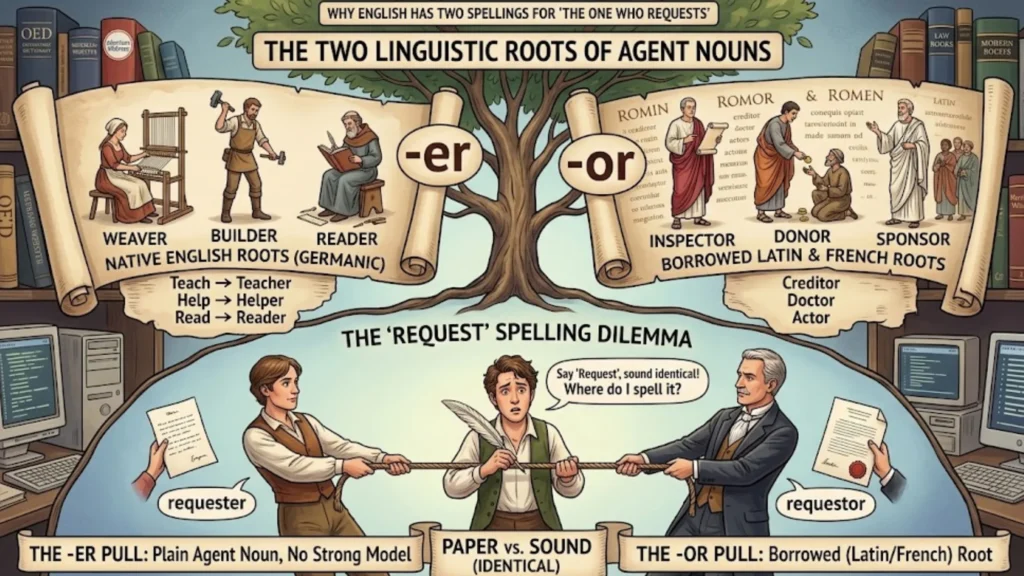
English has two common endings for “the one who does the verb”: -er and -or. Teach becomes teacher, help becomes helper, read becomes reader. Then there’s sponsor, donor, creditor, inspector. Many of the -or words arrived in English already wearing that ending, borrowed from Latin or French, while -er is what English attaches to its own native verbs. Nobody writes askor or helpor.
Request sits on the fence. It’s a borrowed word: Merriam-Webster traces it to Middle English requeste, from Anglo-French, from Vulgar Latin, and ultimately from the Latin verb requaerere. A Latin root pulls some writers toward the Latin-style ending, which is a plausible source of requestor. But -er is also what English reaches for when it needs a plain agent noun and has no strong model to follow, and that’s the pull behind requester. Neither camp has a clear claim, so both spellings survived.
English doesn’t referee this. Adviser and advisor are both accepted. Spellings drift because of habit, because a widely copied document used one form, or because someone named a database field one afternoon and everyone after them copied it. Requestor is that kind of story: an -or spelling that took hold in certain places without ever pushing out the -er form.
The two words sound identical, by the way. Say either one in a meeting and nobody can tell which you meant. The problem only exists on paper.
See Also: Simile vs Metaphor: Tell Them Apart in 10 Seconds
What the dictionary says
Merriam-Webster lists requester as the main entry and gives requestor beside it as a variant, with one pronunciation covering both. A variant is an accepted alternative form, which is a different category from “misspelling” or “nonstandard.”
Plenty of advice online makes requestor sound risky. It isn’t. Use it in an email, and an editor with a dictionary can’t mark it wrong. All they can say is that it’s less usual.
What a dictionary can’t tell you is which spelling your reader, publisher, or employer prefers. A style guide may pick one form just to keep a long document consistent, and that has nothing to do with right or wrong. If you write for a publication with its own style sheet, check it first.
Which one readers expect
Requester is the form you’ll see far more often in ordinary writing, and readers glide right over it. A spelling nobody notices costs them nothing. One that’s slightly off from what they expect makes them stop for half a second, and a few will assume a typo.
My call: unless you have a reason, requestor isn’t worth the friction. You gain nothing by using it, and sooner or later somebody will ask in a comment whether you meant requester. To see the gap for yourself, run both spellings through Google’s Ngram Viewer. It takes about ten seconds.
Where requestor turns up anyway
When requestor appears, it usually follows a pattern: someone built a form, a tool, or a contract once, picked a spelling, and everything afterward copied it.
Picture a purchase approval form with a field labeled “Requestor name.” Or an internal tool where every order has a requestor, an approver, and a buyer. Or a contract that defines “Requestor” as a capitalized term in the first paragraph and then uses it throughout. In each of those, the spelling is a label, and labels have a way of spreading. People search for them, build reports around them, and teach them to new hires.
That’s the practical reason to match an existing label. If the screen says Requestor and your help article says requester, a new employee might wonder whether those are two different roles. It looks small until somebody files a support ticket about it.
Claims you can ignore
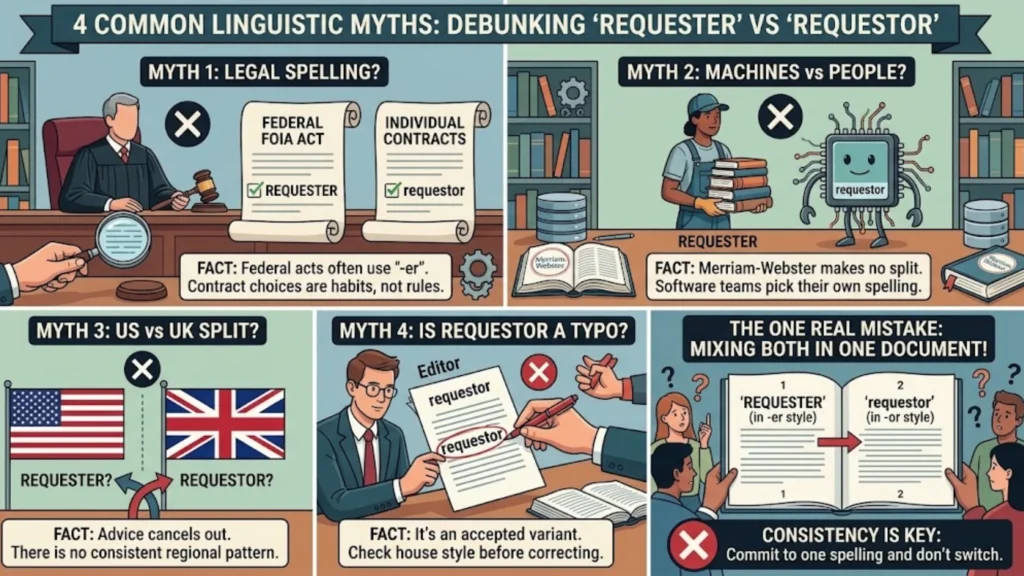
A few ideas about these two words get repeated so often that they’ve started to sound like rules.
You’ll hear that requestor is the legal spelling, but that doesn’t hold as a general rule. The federal Freedom of Information Act, as amended, uses requester. So does the Justice Department’s FOIA guidance on fees, and so does at least one federal agency regulation on FOIA fees (5 CFR § 1204.12). Individual forms and contracts vary, and some do use requestor, but that’s a drafting habit, not a legal requirement.
A common rule of thumb says requestor is for machines and requester is for people, and it often gets passed along as settled fact. It isn’t. Merriam-Webster doesn’t split the two words by meaning. Software teams pick one spelling or the other for their own reasons, and that choice tells you about that team, not about the word.
Advice about a US-versus-UK split points in opposite directions: one camp says Americans favor one spelling and Britons the other, while another swears it’s the reverse. Claims that cancel each other out don’t add up to a pattern, so choose by document and audience, not by country.
Then there’s the worry that requestor is a typo. It’s an accepted variant, so before you “correct” it in somebody else’s draft, find out whether it’s their house style.
And one real mistake, as opposed to a myth: mixing both spellings in a single piece. If paragraph two says requester and paragraph nine says requestor, readers may reasonably wonder whether you mean two different people. Commit to one spelling when you start, and don’t switch before the final sentence.
See Also: Carmel or Caramel: 7 Real Cases, 1 Simple Rule
Choosing between them
Start by looking for a spelling that’s already fixed. That might be a field name on a form, a label in software, or a defined term in a contract. If you find one, copy it exactly. No other consideration beats this one.
If nothing’s fixed, look for house rules instead: a company style guide, documents a client sent you earlier, or a note from an editor. Any of those settles it.
If you’re still free to choose, go with requester. It’s what most readers expect, and it keeps you out of arguments. Then stay with it.
Find-and-replace is a trap here. A global swap from requestor to requester can rewrite a quoted form field, a section of someone else’s contract, or a label that matches a screenshot. In code, it can rename a variable and break something. Check each hit before accepting it, and leave quoted material alone.
Settling it for a team
If you manage documents for a group, put the answer in your style sheet so nobody has to decide it again. One line is enough: “Requester, except where a system label or contract term says requestor.”
Before you write that line, search your shared drive and your tools for both spellings. The one that shows up in labels people actually click on is the one that’ll be hardest to change, and your rule should account for it.
How it plays out in real documents
Emailing a university registrar for a transcript? There’s no form to match, so ordinary English wins. Most people would skip the noun entirely and write “I’d like to request a transcript.”
An internal help page for a company’s ticketing tool is different. If the interface says “Requestor,” your page should too, so the words people read match the words they see. Don’t correct the interface in your documentation.
A contract draft with requester on page one and requestor on page eleven is the easiest case. Pick one, change the other, and check the defined-terms section for the same slip.
And a blog post about public records requests, written for a general audience, has no system to match and no client style sheet. Requester, every time.
See Also: Leaped or Leapt for Americans: 1 Default, 4 Mistakes
Sentences, plurals, and possessives
Both spellings follow the same grammar. The plural adds s, and the possessive follows the usual apostrophe rules.
- The requester’s phone number was missing from the ticket.
- Two requesters asked for the same file on the same morning.
- All requesters’ names were removed before the report went out.
- Please list the requestor’s department in the box below.
- Requestors must attach a quote before approval.
The top three examples use requester, while the bottom two show requestor. A real document would stick with one.
Quick answers
Is requestor a real word?
Yes. Merriam-Webster lists it as a variant of requester, so it isn’t a misspelling.
Do the two sound different?
No. Only the writing gives them away.
Which should I use in a work email?
Requester, unless your company’s own system or forms say requestor. In that case, match them.
I’m designing a form. What should the field say?
Either works, as long as you use it everywhere: the form, the help text, the reports, and the training material. For a general audience, requester is the safer pick.
What if my boss insists on requestor?
Then it’s requestor. It’s correct, and it’s their call.

[…] See Also: Requestor or Requester? 4 Myths to Stop Believing […]