
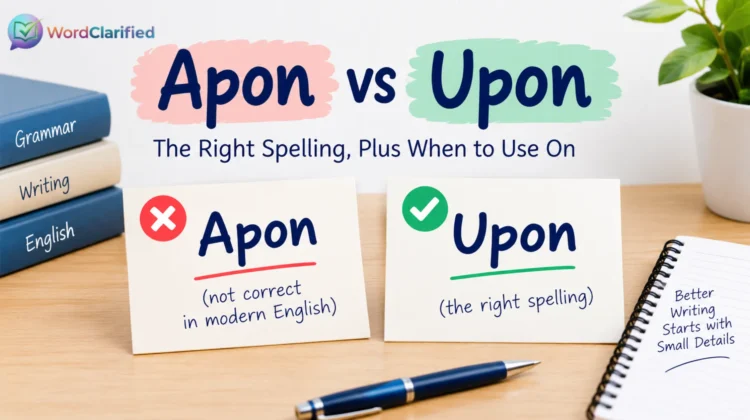
The apon vs. upon question has a short answer: it’s “upon” every time. If “apon” slipped into a cover letter, an invoice, or a note to your landlord, count it as a typo and fix it. No modern reader will take it as a style choice.
The fuller story is short, and it’s more interesting than the verdict suggests. “Apon” isn’t random noise. People wrote it on purpose several hundred years ago. In Bengali, it’s an everyday word and a name. And it still gets typed today for a reason that has little to do with fat fingers.
Below you’ll find what “apon” actually is, why people keep writing it, what “upon” means in each of its jobs, and when plain “on” is the better pick. Later sections cover “upon arrival,” “upon us,” “upon me,” the two-word “up on,” and a few formal relatives like “whereupon,” with practice questions at the end. If you only needed the spelling, you have it. If you’ve ever winced at a stiff “upon” in a workplace email, keep going. You were right to wince, at least some of the time.
Apon vs upon at a glance
| Upon | Apon | |
| Accepted in modern English? | Yes | No |
| What it is | A preposition | An old spelling of that same preposition; also a Bengali word and name |
| Where you’ll meet it | Contracts, stories, signs, formal letters | Medieval texts, typos, Bengali names and film titles |
| What to do | Use it, or switch to “on” for a lighter tone | Change it to “upon” |
| Example | Fees are charged upon cancellation. | Fees are charged apon cancellation. |
That table holds the whole practical rule. “Apon” never developed a meaning of its own in English, so the apon/upon difference is one of status: one is the standard spelling, and the other is a leftover. The rest of this article is mostly about “upon” itself, because that’s where the harder decisions sit. Spelling it correctly takes five seconds. Deciding whether to use it takes judgment.
What “apon” means in English
It means exactly what “upon” means. That’s the full English meaning, but the backstory explains why the mistake survives.
An old spelling of the same word
Medieval English had no fixed spelling, and scribes often wrote what they heard, which varied from region to region. The preposition we now write “upon” appears in old texts as upon, uppon, uppen, apon, appon, and in places as opon or oppon.
One Coventry civic record from the late medieval period says that on a third offense a person must “stond apon the pillary.” In today’s spelling, that’s “stand upon the pillory.” Nobody reading it at the time saw a mistake or a different word.
So if you meet “apon” in a manuscript, a facsimile, or a historical novel imitating old spelling, read it as “upon” and carry on. Every sense of “upon” applies.
Apon as a Bengali word and name
In Bengali, আপন (apon) means one’s own, close, dear. It’s the word you’d reach for when talking about family, or about someone who counts as one of your own. It’s also a given name, typically a boy’s name, in Bangladesh and West Bengal. A 2017 Bangladeshi film called Apon Manush uses the word in its title.
None of this ties to the English preposition. It’s a separate word from another language that happens to share the letters. If you’re writing about a person named Apon, keep the spelling as is, and don’t let autocorrect “fix” it.
Apon in capital letters
In all capitals, APON can be an abbreviation for an organization or a technical term, depending on the field. It has nothing to do with the preposition, and the capitals are usually the giveaway.
Word games and spell-checkers
The standard Scrabble word list doesn’t accept “apon,” and most spell-checkers will underline it. In modern writing, treat it as an error.
See Also: Is It Congradulations or Congratulations? Get the T Right
Why people keep typing “apon”
A and U sit far apart on a standard keyboard, so a slipped finger rarely explains it. More likely, it’s a spelling-by-ear mistake.
Say the word out loud: “uh-PON.” Nearly all the stress falls on the second half, and the first syllable is so faint it barely registers. A weak “uh” could be written with an a or a u, and your ear can’t say which, so you probably go with whichever looks more familiar. Plenty of common words open with that same soft sound and spell it with an a: about, above, along, around, again. After a lifetime of those, “apon” looks plausible.
The find-and-replace trap
There’s one more trap, and it catches careful editors too. Say you’re cleaning up a long document and want to fix every “apon.” Don’t run a blanket find-and-replace of “apon” with “upon.” Plenty of ordinary words contain those four letters in a row, and you’d end up with weapon → weupon, capon → cupon, and weaponize → weuponize.
Turn on your editor’s whole-word option so it matches only standalone “apon,” and ignore case, since the word may start a sentence. Then read each hit before you change it. That also protects a Bengali name if one is sitting in the text.
How the spelling settled on “upon”
Take the word apart, and you can see how it was built: “up” plus “on.” Old English already had a close ancestor doing the same job, written uppan or upon. When Middle English writers set it down, however it sounded to them, the spellings multiplied.
That loose period left a mark you still deal with. In some medieval lines, even careful modern readers can’t tell whether the writer meant the one-word “upon” or the two-word “up on.” Spelling hadn’t been decided, and English ended up keeping both, which is why you still have to choose between them (a full section on that comes below).
Over time, one form of the single word became standard, and “upon” won. “Apon” and the rest dropped out of ordinary writing. Was “apon” ever correct, then? In its own era, it was one ordinary spelling among several. Once standard spelling closed around “upon,” it became a mistake. It’s a good example of how “correct” in spelling often just means “the form everyone agreed on.”
What “upon” means, one job at a time
“Upon” does about six jobs. They overlap a little, but each is easy to recognize in context. This section doubles as a set of “upon in a sentence” examples, since that’s the best way to see how it works.
Resting on a surface
The oldest and plainest use. One thing sits on another.
The lantern sat upon the fence post, unlit.
Swap in “on” and the meaning stays the same. Only the tone changes: “upon” gives the line a slight storybook feel.
Moving up onto something
The goat scrambled upon the shed roof before anyone could stop it.
Here the preposition carries the climbing action as well as the position. Swap in “onto” or “up on” and the sentence still does its job.
Being very close in time
Exam week was upon them.
This is the idiom for something that has stopped being “coming” and is practically here. Replace it with “on them”, and the sentence goes odd, as if exam week were an object dropped on someone’s shoulders.
Happening right after a trigger
Upon hearing the whistle, the swimmers climbed out.
Deposits are repaid upon return of the room key.
The first sentence links one action to the one before it. The second ties a result to a condition being met. In both, “upon” means roughly “once” or “as soon as.”
Piling one thing on another
Box upon box of old cables lined the garage wall.
Mile upon mile of wheat ran to the horizon.
The pattern puts the same noun on both sides with “upon” in the middle, to show a heap or a long stretch. “On” can’t do this job. “Box on box” sounds wrong.
Plain “on,” in formal dress
She swore upon her grandmother’s watch.
There’s no height here and no contact, just a serious-sounding “on.” Oaths and solemn statements often take this form, and writers choose it for rhythm too.
Look back over the six uses, and most lean formal or ceremonial. That’s the thread connecting them. “Upon” is a more formal “on,” and it picks up a few duties that “on” can’t handle.
When to use apon vs upon (and when to use neither)
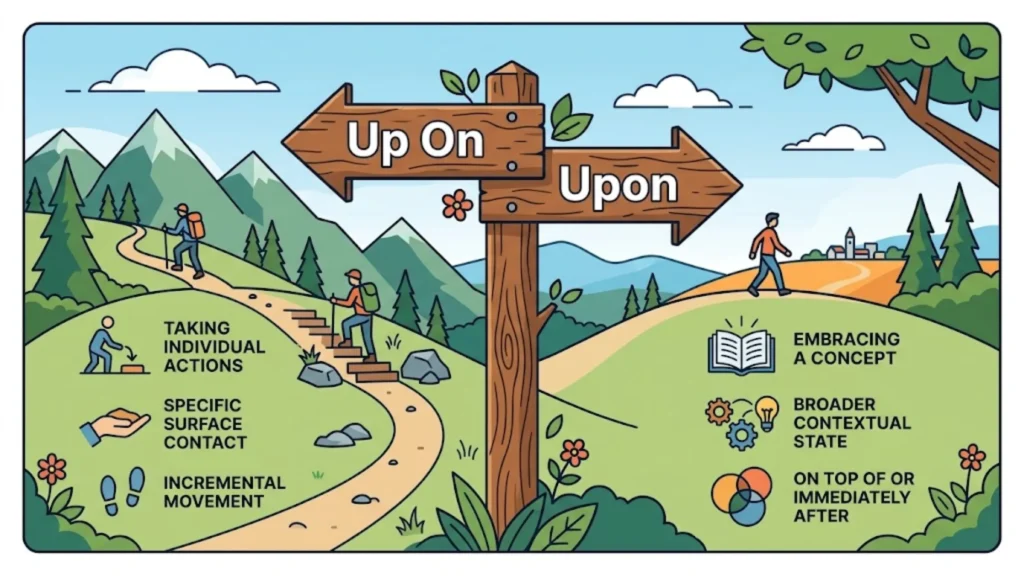
The first half of that question is settled: it’s “upon.” The harder half is deciding whether “upon” is right in the first place, or whether plain “on” would serve better.
The swap test
Replace “upon” with “on.” If the sentence reads the same and means the same, either word works, and you pick by tone. If it reads wrong or changes meaning, “upon” is doing real work.
- She laid the key upon the counter. “On” works fine.
- The deadline was upon us. “On us” shifts the meaning.
- Once upon a time. “Once on a time” doesn’t exist.
- Page upon page of notes. “Page on page” sounds wrong.
Where “upon” is the natural choice
The storybook opener (“once upon a time”) has no substitute, and neither do the pile-up pattern (“mile upon mile”), the about-to-happen idiom, or the old-fashioned exclamation “upon my word.” In each of these, “on” either sounds wrong or means something else.
Where only “on” works
In modern English, days and dates take “on”: on Friday, on the third of May. So do topics: a lecture on soil health. So do states and devices: turn on the oven, on time, on foot. “Upon” doesn’t fit any of these now, and forcing it in makes the sentence sound like a parody of formal English.
Verbs that take either
A number of verbs work with both: depend, rely, insist, decide, reflect, comment. The “upon” version is a notch more formal each time. The picnic depends on the weather is how most people say it. The picnic depends upon the weather is how a notice might phrase it.
What “upon” signals to a reader
“Upon” tells readers the writing is formal, official, or a bit old-fashioned. That’s helpful when you want it and a nuisance when you don’t. Picture a text message that reads: Upon reaching the pub, I will message you. It lands as a joke, and it works because it’s obviously a joke.
A working rule
In emails to coworkers, chat messages, web pages, and most everyday writing, write “on,” or rephrase around the preposition altogether. Save “upon” for fixed phrases, formal notices, contracts, and voices where ceremony is the point. Compare:
Upon receipt of your message, I contacted the supplier.
When I got your message, I called the supplier.
The second is what most people would say, and most readers prefer it. The first isn’t wrong. It belongs on letterhead.
See Also: How-To vs. How-Tos: Hyphen, Apostrophe, or Neither? (3 Jobs)
“Up on” vs “upon”: one word or two?
“Upon” is one word with one set of jobs. “Up on” is two words that happen to sit side by side: “up,” which gives direction or position, and “on.”
The quickest check is to delete “up.” If the sentence survives with its meaning intact, “upon” is probably allowed. If the sentence stops making sense, write “up on” as two words.
Direction plus place. She hung the poster up on the wall. Here “up” tells you where on the wall, and it’s doing real work. Hung the poster upon the wall is grammatical, but it drops the “up” idea and sounds odd in ordinary speech.
Phrasal verbs ending in “up.” These are verbs where “up” belongs to the verb itself: brush up on, catch up on, follow up on, read up on. I need to read up on tax rules. Delete “up”, and you get “read on tax rules,” which means something different. Write “catch upon sleep” and the sentence breaks, because “up” belongs to “catch,” not to the preposition.
Being informed. She’s up on every local rumor. “Up on” means well-informed about here. “Upon” won’t work.
Where both are fine, the cat jumped upon the sofa. The cat jumped up on the sofa. Both are grammatical. The two-word version feels more casual and puts a little more weight on the upward leap.
A quick comparison:
- ✗ I’ll follow upon your message tomorrow. → ✓ I’ll follow up on your message tomorrow.
- ✗ She needs to catch upon her reading. → ✓ She needs to catch up on her reading.
Apon vs upon in a sentence: wrong and right, side by side
These are the mistakes grouped by where they tend to show up, each with its fix.
Place and position
| Wrong | Right |
| The wasps built a nest apon the porch beam. | The wasps built a nest upon the porch beam. |
| Someone left a casserole dish apon my doorstep. | Someone left a casserole dish upon my doorstep. |
“On” would work in both fixed versions. The only difference is how formal you want to sound.
Time and trigger
| Wrong | Right |
| Apon opening the fridge, I found the missing keys. | Upon opening the fridge, I found the missing keys. |
| Apon hearing my name, I looked up. | Upon hearing my name, I looked up. |
Abstract ideas
| Wrong | Right |
| The festival’s success rests apon its volunteers. | The festival’s success rests upon its volunteers. |
| Whether the ferry runs depends apon the tide. | Whether the ferry runs depends upon the tide. |
Workplace and formal writing
| Wrong | Right |
| The warranty starts apon activation of the device. | The warranty starts upon activation of the device. |
| Access is granted apon approval. | Access is granted upon approval. |
Everyday phrases
| Wrong | Right |
| I stumbled apon an old receipt in my coat. | I stumbled upon an old receipt in my coat. |
| The price we agreed apon was fair. | The price we agreed upon was fair. |
In every row, the fix is a single letter. That’s why the mistake is so easy to make and so easy to repair.
“Upon arrival” meaning, and how it compares with “on arrival”
“Apon arrival” is a common way the misspelling turns up, probably because “upon arrival” appears on so many hotel confirmations, event invitations, and delivery notes. The correct form is “upon arrival.”
What “upon arrival” means
At the moment of arrival, or right after. Something happens when you get there.
Ring the bell twice upon arrival.
The courier needs a signature upon arrival.
“Upon arrival” vs “on arrival”
Both are correct, and in practice they mean the same thing. “Upon” sounds a bit more formal, so it’s common in official letters and policy writing. “On arrival” is more at home in travel instructions and day-to-day notices.
Luggage is tagged on arrival.
The depot manager logs each delivery upon arrival.
For a sign or a quick instruction, “on arrival” is lighter. For a formal notice or a policy, “upon arrival” fits the tone. Either will pass.
A small trap: how soon is “upon”?
“Upon arrival” sounds precise, but it’s vague. Texting the host upon arrival could mean within a minute of parking or sometime that evening. If timing matters (when a payment is due, when a deadline starts), spell it out: Text the host within ten minutes of parking. A formal phrase doesn’t make a deadline clearer. What it adds is the appearance of precision.
The dangling opener
Watch out for “upon” paired with an -ing verb at the start of a sentence.
Upon reaching the summit, the clouds closed in.
Read it literally, and the clouds did the climbing. The opening phrase needs a person as its subject, and the sentence doesn’t supply one. The fix is to name who reached the summit:
Upon reaching the summit, we watched the clouds close in.
The noun version (“upon arrival”) has less of this problem, since there’s no verb waiting for a subject. It can still leave readers wondering whose arrival you mean, so name them when it isn’t obvious.
Neighbors: upon request, upon receipt, upon completion
These follow the same logic.
- A paper copy is available upon request. (When you ask for it.)
- Your refund will be processed upon receipt of the item. (Once the item reaches us.)
- Keys are released upon completion of the inspection. (When the inspection is finished.)
Most can become “on request,” “when we receive it,” or “when it’s finished” with no loss of meaning. The “upon” versions are standard in official wording. The plainer ones read warmer.
“Upon us” and “upon me”: what they mean
“Upon us” meaning
The most common use of “upon us” is the idiom for something about to happen or just arrived. A date, a season, a deadline, an event: it was coming, and now it’s here.
The first frost was upon us before we’d stacked the firewood.
The ferry strike was upon us before we’d booked another way across.
You wouldn’t say “the first frost was on us,” because that sounds as though frost fell on you physically. The idiom needs “upon.”
There’s also a literal use. The rain came down upon us just means the rain fell on us. The same pattern works with other pronouns: upon you, upon them, upon me.
“Upon me” meaning
In everyday English, “upon me” works like “on me” with a more formal or literary tone. Some common uses:
A strange calm came upon me. A feeling arrives and settles.
It dawned upon me that I’d left the stove on. A realization lands.
The job fell upon me. It became my responsibility by default.
I took it upon myself to relabel the spice jars. I decided to do it without being asked.
The Bible verse behind “upon me”
If you landed here from a Bible verse, this is likely the one: “The Spirit of the Lord is upon me,” from Luke 4:18, which quotes Isaiah 61:1. Here “, upon me” has nothing to do with time. It’s a picture of God’s Spirit resting on a person.
In the Hebrew Scriptures, that picture tends to mark someone who has been given a job and the strength to do it. The Spirit may be said to settle on a person, wrap around them like a garment, or surge toward them. Saul and David both get the “rushing” treatment in the book of Samuel.
Luke shows Jesus reading the Isaiah lines in a synagogue and saying they describe him: the person on whom God’s Spirit rests, sent to bring good news to the poor and freedom to captives. “Upon” gives the line its weight. Something has descended, settled, and been assigned a task.
In the verse itself, then, “upon me” points to a Spirit that has landed on the speaker and made them ready for the work ahead.
Fixed phrases built around “upon”
Some phrases hold “upon” so firmly that swapping it out changes the meaning or sounds off. The ones covered earlier (once upon a time, row upon row, upon my word) aren’t repeated here.
Agreed upon. The agreed-upon deadline was Friday. It’s often hyphenated before a noun. “Agreed on” is equally standard, so choose by tone.
Come upon. To find something by chance. We came upon a farmers’ market on the way home. Don’t swap this for “come on,” which is a different expression, a nudge as in “come on, hurry up.”
Look upon. To regard someone or something a certain way. They looked upon the newcomers with suspicion. It’s more formal than “look at,” and it’s about attitude, not eyesight.
Upon closer inspection. Upon closer inspection, the painting turned out to be a print. “On closer inspection” is also standard, so either works.
Take it upon yourself. To volunteer for a job nobody handed you. She took it upon herself to rewrite the sign-up sheet.
Whereupon, thereupon, and “upon whom”
“Upon” also lives inside a few formal relatives.
Whereupon means “after which” or “at which point.” He apologized, whereupon the crowd cheered. It’s old-fashioned and mostly found in stories and formal prose.
Thereupon means “immediately after that.” She opened the letter and thereupon burst into tears. Same register, and one you can safely skip in everyday writing.
Upon whom is the formal version of “on whom.” The person upon whom she relied most was her sister. In plain speech, most people would rephrase: The person she relied on most was her sister.
See Also: Treck or Trek: 5 Forms, 1 Right Spelling
Matching “upon” to the kind of writing you’re doing
How “upon” lands depends on what you’re writing.
Contracts and formal notices. “Upon” is at home here. The balance is payable upon signing. The tenant shall vacate upon expiry of the lease. The formality is expected, and readers don’t blink.
Emails and web copy. Plain wording almost always reads better. Compare:
| Stiff | Plain |
| Upon completion of the survey, collect your voucher from the desk. | When you’ve finished the survey, pick up your voucher at the desk. |
| The plan succeeds only upon the committee’s approval. | The plan needs the committee’s approval. |
| Upon notification, the account is closed. | Once we’re told, we close the account. |
Product screens and help text. Short interface messages work harder when they sound like speech. Upon login, you will see your dashboard becomes After you log in, you’ll see your dashboard. The second is shorter, friendlier, and harder to misread.
Academic writing. “Upon” turns up here and does no harm, but a page full of it starts to sound like a parody of a scholarly voice. Use it where it fits and cut the rest.
Fiction. It depends entirely on the voice. In a fantasy novel or a period piece, “upon” can set the tone. In a contemporary thriller with a gritty narrator, it would stick out. Ask whether your narrator would actually say it.
Common mistakes and a memory hook
The spelling slips themselves, such as apon arrival, apon request, agreed apon, and stumbled apon, are all “upon” with the wrong first vowel. The mistakes below are the ones around it.
Merging “up on” into “upon” where it doesn’t belong. Catch upon sleep, follow upon an email, read upon the rules. These need the two-word form, since “up” belongs to the verb.
Splitting “upon” into “up on” when it should be one word. Once up on a time. Rarer, but it appears.
Overusing “upon.” Three or four in a paragraph and the writing starts to sound like a legal notice. If you’ve used it twice already, switch to “on” or rephrase.
Leaving the doer out after “upon + -ing.” The summit example earlier shows how this goes wrong. Whoever performs the -ing action has to be the subject of the sentence.
A quick proofreading routine
Run a whole-word search for “apon” and fix each hit by hand. Then search for “upon” and look at each one: could it be “on,” or could the whole phrase be simpler? Finally, read every sentence that starts with “Upon” and check that the person doing the action is clear.
A memory hook
“Upon” is built from two smaller words, “up” and “on,” and both are visible inside the spelling: u-p-o-n. If you can see “up” in it, you can’t write “ap.” That’s the same fact the word’s history gives you, and it works as a fast spot-check.
Practice check
Pick the right form for each blank. Answers follow.
- Fees are charged ___ cancellation. (apon / upon)
- I need to catch ___ my reading. (upon / up on)
- The first day of school was ___ us before we’d bought notebooks. (apon / upon)
- We stumbled ___ a hidden beach. (apon / upon)
- Once ___ a time, a baker lived beside a river. (apon / upon)
- She read ___ the rules before the match. (upon / up on)
- The ___ price was fair. (agreed apon / agreed-upon)
- ___ hearing the alarm, everyone left. (Apon / Upon)
- Box ___ box filled the attic. (apon / upon)
- He apologized, ___ the crowd cheered. (whereapon / whereupon)
- True or false: “apon” is a correct spelling in modern English.
Answers: 1. upon. 2. up on. 3. upon. 4. upon. 5. upon. 6. up on. 7. agreed-upon. 8. Upon. 9. upon. 10. whereupon. 11. False.
Frequently asked questions
Is “apon” a real word?
In Bengali, yes. It means “one’s own” or “dear,” and it’s a common given name. In English, it’s an old spelling of “upon,” and today it counts as a mistake.
Is “apon” ever correct in English?
Only when you’re quoting a medieval text or naming a person or title; in everyday modern writing, it’s always “upon.”
Can I use “apon” for an old-fashioned effect?
You can, if the archaic spelling is obvious from the rest of the page, such as a full imitation of medieval writing. Otherwise, readers will assume you made a typo.
Does “upon” have different spellings in the UK and the US?
No. It’s “upon” in both.
Can “upon” start a sentence?
Yes. Upon opening the box, she found the missing earring is correct. Just make sure the person doing the opening is the subject of the main clause.
Is “upon” outdated or too formal?
It isn’t outdated. It’s still standard English, and it leans formal, so you’ll see it more in official writing, set phrases, and storytelling than in casual speech. People mostly say “on,” “when,” or “as soon as.” You’ll still hear “upon” in a few set phrases and the occasional joke, as in “upon further review.”

[…] See Also: Apon vs Upon: The Right Spelling, Plus When to Use On […]