

Type “how to” into a sentence and you hit a small fork: hyphen or no hyphen, and if you mean more than one, an s or an apostrophe. The how-to vs. how-tos question looks like a coin toss, but it isn’t. Each spelling serves a different job, and once you know which job you’ve given it, the spelling settles itself.
Here’s the whole system in one sentence: This how-to shows how to write the how-tos your readers keep asking for. Same words, three roles, three spellings. The table below sorts the forms at a glance, and the rest of the article explains why they work this way and where the edge cases hide.
| Form | Job it does | Example |
| how to | Opens an infinitive; a verb comes next | She knows how to proof dough. |
| how-to (noun) | Names one guide, card, or video | He keeps a how-to for sourdough on the fridge. |
| how-to (modifier) | Describes the noun after it | Watch the how-to video first. |
| how-tos | Plural noun; you mean several | The library shelves twelve baking how-tos. |
| how-to’s | Possessive of one how-to | The how-to’s third step is missing. |
| how tos / how to’s | Not standard as a plural | Avoid. |
Three jobs, three spellings
Start with a sentence where nobody is handing over a document: “Show me how to jump-start a car.” The word how is an adverb, to opens an infinitive, and jump-start is the verb. It’s two ordinary words doing ordinary work, so there’s no hyphen.
Try a different scene: “Her glovebox has a one-page how-to for jump-starting a car.” Nobody in that sentence is being told how to do anything. The phrase labels something you could pick up, like a card, a printout, or a page. That makes it a noun, and nouns of this kind take the hyphen.
A third job shows up when the phrase leans on another noun: “the how-to card in the glovebox.” Here, how-to describes card. It’s an adjective, and the hyphen tells the reader that both words are one descriptor rather than two strangers standing side by side. Oxford’s and Cambridge’s learner dictionaries both record this adjective as something that sits before a noun, which matters later in this article.
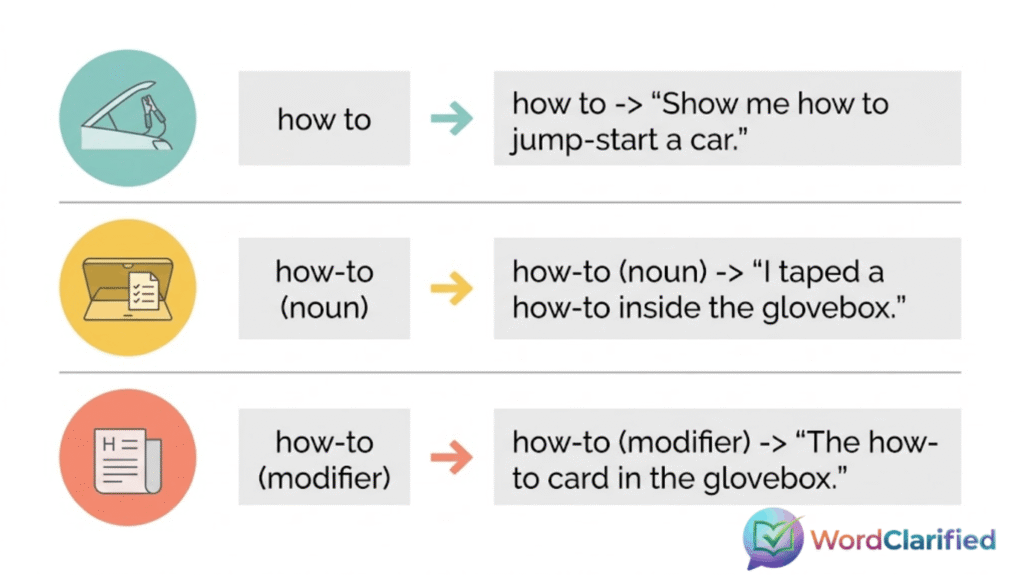
Sorting a sentence takes one look at what comes after the phrase. A verb (weld, reset, fold) means two words, no hyphen. A noun (guide, video, card) means the phrase is describing it, so hyphenate. If nothing follows, put a number in front: “three how-tos” works; “three how to fix it” doesn’t. When the count works, you’ve got the hyphenated noun, and the plural goes on the very end.
One trap catches careful writers. In “Explain how to guide a new hire through the first week,” the word guide looks like it belongs to a how-to guide, but it’s a verb. Hyphenate and the sentence collapses: “a new hire” is left with nothing to attach to.
Why the plural is how-tos
Merriam-Webster, Cambridge, Oxford Learner’s, and Britannica all list how-tos as the plural of the noun. That settles the spelling. The reasoning behind it is worth a minute, though, because it keeps you from doubting yourself later.
Some compounds pluralize in the middle. You write mothers-in-law, not mother-in-laws, because the phrase has a real noun at its center and the rest hangs off it. How-to has no such centre. Neither how nor to is what the phrase is about; together they form one lump of meaning. With no head noun to carry the plural, the s lands at the end, as it does in to-dos and go-tos.
The apostrophe version is tempting for a simple reason: “tos” looks wrong. Readers rarely see that letter pair, so an apostrophe feels like a way to soften it, and plenty of careful people give in. One page of Django’s documentation talks about “guides and how-to’s,” while another page on the same site says “how-to guides.” So you’ll find the apostrophe in respectable places.
I’d still avoid it, and the reason is practical, not pedantic. How-to’s already has a job: it’s the possessive of a single how-to. Compare “The how-to’s last step is missing” (one guide, one missing step) with “The how-tos’ last steps are missing” (several guides, each short a step). If your plural wears the possessive’s clothes, some readers will stop and work out which one you meant. Even a half-second stall costs more than an unfamiliar-looking tos.
Dropping the hyphen doesn’t help either. How tos and how to’s both invite the eye to read “how to” as the start of an instruction, then wait for a verb that never arrives.
If how-tos still looks clumsy in your sentence, don’t fight it. Put a noun right after it instead, as in “how-to guides” or “how-to videos.” The plural moves to the noun that follows, the adjective stays put, and nobody has to think about it.
Where writers slip
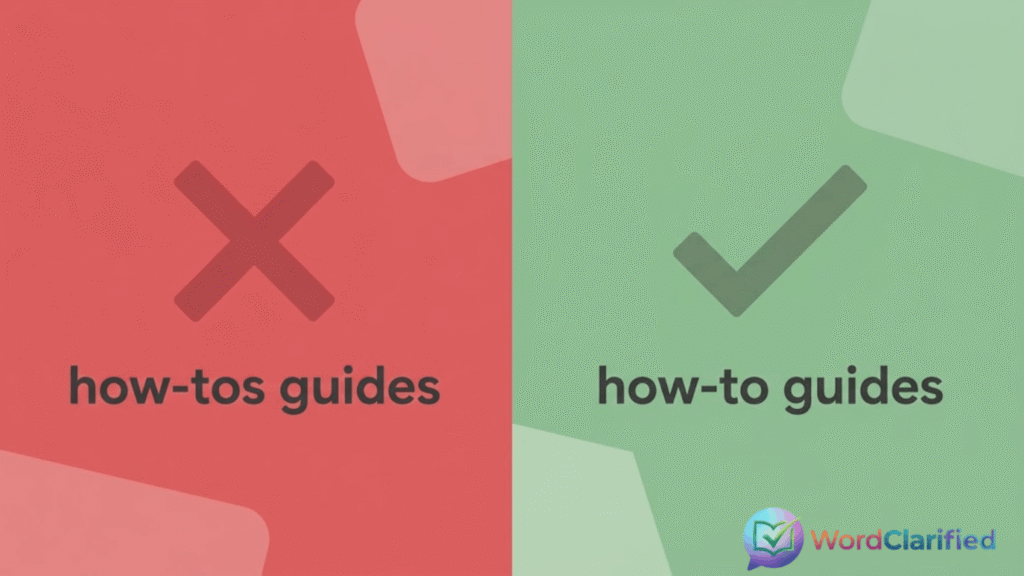
The most common mistake comes right after people learn the plural rule. Having discovered how-tos, they start using it everywhere, including “how-tos guides.” Adjectives don’t take plural endings in English; you’d never write “a blues guitarists” for a group of blues guitarists. The plural belongs to whatever is being counted: how-to guides, how-to videos.
A second slip is using the adjective as a predicate. “This video is how-to” reads oddly to most ears, and the dictionaries mentioned above don’t record the adjective in that position. Give the word a clear role instead: “This video is a how-to” treats it as a noun, while “This is a how-to video” treats it as a modifier. Both are easier to read.
Then there’s the pile-up. Someone wants a modifier that says what the guide covers and writes “a how-to-choose-a-mattress guide.” Every hyphen is defensible, and the result is still tiring to read. Rewrite it as “a guide to choosing a mattress.” When a modifier needs more than three or four words to do its job, the sentence usually wants a different shape.
Finally, some writers hyphenate every “how to” they meet, including titles like “How-to Fix a Dripping Faucet.” That takes the hyphen out of its lane. The title introduces a verb, so it’s “How to Fix a Dripping Faucet,” full stop.
See Also: Mine as Well or Might as Well: The Real Reason You Mix Them Up
Headings, menus, and labels
Titles add a wrinkle, because capitalization depends on which style you follow. Microsoft’s style guide asks for sentence-style capitalization in most titles and headings, which gives you “How to patch drywall” and “A beginner’s how-to guide.” Chicago-style title case capitalizes both halves of the compound: “A Beginner’s How-To Guide.” The verb-phrase version plays by other rules: “How to Patch Drywall” keeps a lowercase to and no hyphen between the two words.
Pick one system and apply it everywhere. A site that shows “How-To Guides” in one menu and “How-to guides” in another looks careless, even if every article underneath is excellent.
Navigation labels deserve their own decision. If a menu section holds guides, walkthroughs, and video lessons, “How-Tos” is friendly but a bit vague. “Guides” covers more ground and sidesteps the plural altogether. My recommendation: use “How-Tos” only when the section is really a pile of task-based pages, and your voice is casual. Otherwise choose “Guides” and stop worrying.
Is it a how-to at all?
Writers often treat how-to, tutorial, and guide as interchangeable. People who write software and product documentation don’t. Under the Diátaxis model, a tutorial is learning-oriented: someone is studying, and the writer steers them toward a result. A how-to guide is task-oriented: the reader already has a job to do and wants the shortest safe route through it.
You can feel the difference in ordinary topics. “Learn to play the ukulele” is a tutorial, a sequence built to teach, with practice pieces and a gentle order. “How to restring a ukulele” is a how-to. The reader already owns the instrument and just wants the strings changed by tonight. If your page assumes a beginner who needs coaching, “tutorial” is the more honest label. If it assumes competence and hands over the steps, “how-to” fits.
One more spelling you’ll bump into: HOWTO, all caps and closed up. A well-known collection of Linux documentation was built around that label, and technical communities still use it in filenames, URLs, and forum categories. In regular prose, stay with how-to and how-tos.
Quick answers
Is it “go-tos” or “go-to’s”?
Go-tos, for the same reason as how-tos: the whole compound takes the s.
What about the plural possessive?
How-tos’ is correct (“the how-tos’ formatting is inconsistent”), and it’s awkward. An “of” phrase reads more easily: “the formatting of the how-tos.”
Is “how-to guide” hyphenated?
Yes, and it stays hyphenated in the plural: how-to guides.Mine
Can I write “howto”?
In a filename or a URL slug, sure. In sentences, no.
If your team needs a paste-ready line for a style sheet, here’s one: Use “how-to” as a noun and as a modifier before a noun; the plural noun is “how-tos”; keep “how to” as two separate words whenever a verb follows.
See Also: City vs Town vs Village: 3 Real Differences That Matter

[…] See Also: How-To vs. How-Tos: Hyphen, Apostrophe, or Neither? (3 Jobs) […]