
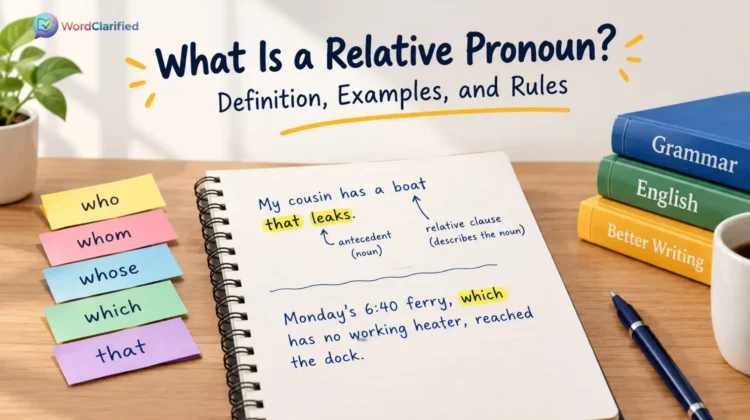
What is a relative pronoun? It’s a word like who, which, or that that stands in for a noun you’ve already mentioned and opens a clause to describe it. Take two clipped sentences: “My cousin has a boat. The boat leaks.” Swap the second the boat for that and you get “My cousin has a boat that leaks.” One sentence, no stutter.
The noun being described, boat here, is the antecedent. The clause that follows the pronoun, that leaks, is the relative clause. Both terms come back below.
How a Relative Pronoun Joins Two Sentences
Picture two sentences about the same ferry. “Eleven minutes after its scheduled time, the 6:40 ferry tied up on Monday. The 6:40 ferry has no working heater.” Saying the noun twice makes the reader trip. Leave out the second 6:40 ferry and open the clause with which, placed straight after the noun it describes: “Monday’s 6:40 ferry, which has no working heater, reached the dock eleven minutes behind schedule.”
The pronoun has a job inside its own clause. In which has no working heater, the word which is the subject of has. Delete it, and nobody is left doing the having. That’s what sets a relative pronoun apart from a plain linking word like and: it connects the clause, and it also takes the place of a noun.
Ownership folds in the same way. “The tenant has a dog. The tenant’s dog howls at 3 a.m.” becomes “The tenant whose dog howls at 3 a.m. has already had two warning letters.”
A relative clause is also called an adjective clause because it describes a noun like an adjective. It can’t stand alone, which gives you an easy check: say which has no working heater by itself and the sentence is plainly unfinished.
See Also: Where Do I Put Commas? Simple Rules and Clear Examples
The Five Main Relative Pronouns
Most lists give five: who, whom, whose, which, and that. They divide up by what they point to and by the role they play in the clause.
Who and Whom
Who points to people, and it fits when that person does the acting: “The vendor who haggled me down to $40 wrapped the oven door in newspaper.” Flip the roles, so the person receives the action, and you get whom: “The vendor whom I paid in coins wrapped the oven door in newspaper.” If the slot could take them, formal grammar wants whom.
Use who almost everywhere. Whom earns a place in two spots: directly after a preposition (“the pharmacist from whom I bought the cough syrup”) and in stiff, formal prose. Elsewhere, who is standard even as an object, and whom can sound stilted. Read “the guy whom I sat next to” aloud and see how it lands.
Whose
Whose shows ownership, and it isn’t limited to people: a violinist whose bow snapped halfway through the second movement, a spreadsheet whose formulas broke on row 212. Don’t mix it up with who’s, which is who is or who has squeezed into one word. Some grammarians file whose separately, as a possessive that modifies a noun rather than a true pronoun. Most word lists include it anyway, and this guide does too.
Which and That
Which points to things. That covers things, animals, and people, but only in clauses that pin down which one you mean. Commas decide when to reach for each, and the section on defining clauses below sorts that out.
Subject or Object: What the Pronoun Does Inside Its Clause
The pronoun’s job inside its clause decides two things: which form fits, and whether you can delete the word.
Subjects come first. Take “The plumber who fixed our sink on Tuesday charged only $60.” The plumber is the one doing the fixing. Without it, “The plumber fixed our sink on Tuesday charged only $60” has two verbs and nothing to join them.
Objects work differently. In “The tutor whom Ines found online lives in Leeds,” Ines does the finding and the tutor gets found. Formal English puts whom in exactly that spot. In casual speech it’s who. Or the word vanishes: “The tutor Ines found online lives in Leeds.” All three mean the same thing. Dropping only works when the clause is the defining kind, the type that tells you which tutor.
To find a pronoun’s job, rebuild the clause as a plain sentence. “Ines found the tutor” has Ines as the subject, so the tutor, and the pronoun standing in for the tutor, is the object.
Prepositions add a wrinkle. Formal English fronts them: “the neighbor from whom I borrowed the ladder.” Everyday speech leaves the preposition at the end and often drops the pronoun: “the neighbor I borrowed the ladder from.” With that, the choice disappears: the preposition goes last, so “the tape that I sealed the box with” works and “the tape with that I sealed the box” doesn’t.
See Also: Past Tense of Tear: Tore, Torn, or Teared Up?
That or Which: Defining and Non-Defining Clauses
A defining clause pins down which one you mean. A non-defining clause adds a side comment about something already identified. Commas mark the second kind, and they change what the sentence claims.
Compare “The bakeries that open at 5 a.m. sell out by 7” with “The bakeries, which open at 5 a.m., sell out by 7.” In the first, only some bakeries sell out: the early ones. In the second, every bakery in the story opens at 5, and the hour is a bonus detail.
American style guides, Chicago among them, want that in defining clauses and which in non-defining ones. Chicago allows one exception: which can open a defining clause when a preposition sits directly in front of it, as in “the drawer in which I keep the stamps.” British writers often use which in defining clauses too.
On one point, American and British usage agree: a non-defining clause can’t start with that. “The lasagna, that Dara baked on Sunday, was gone by noon” needs which instead.
Not sure whether commas belong? Delete the clause and read what’s left.” Does the sentence still point at one clear thing? Commas go in. Does it now fit several things? Leave them out.
If you’re writing for a US audience, I’d follow the split. Some editors argue the strict version overstates what real usage supports, but it’s the line Chicago takes.
Can “That” Refer to a Person?
Grammatically, yes. “The kid that fixed my bike” sounds natural in conversation. Style guides disagree about it in print, though, and I’d go with who in anything you publish. Compare two ways of describing the same repair: “the mechanic who found the leak” and “the mechanic that found the leak.” Aloud, the who version sounds like it’s about a person, and the that version a shade more like a job title.
Less Common Cases: What, Whoever, and Whichever
A few words carry their own antecedent. “She packed what she could carry” means she packed what she could carry, so what swallows both the noun and the pronoun. “Whoever parks in the loading bay before 8 a.m. gets a ticket” works the same way, and so does “Take whichever bus comes first.”
Grammars don’t agree on whether these count. Some call them free or nominal relative pronouns, and others leave them off the list entirely. If you’re studying for an exam, check which list your textbook uses before you bet on it.
Relative Pronoun or Something Else?
Where, when, and why also open relative clauses, but they’re relative adverbs. Instead of standing in for a noun, they point to a place, a time, or a reason. “The café where we met” can be rebuilt as “the café at which we met,” and that rebuild is the tell: if a preposition plus which fits, you’re looking at an adverb.
Who turns up in questions as well. “Who locked the gate?” has no antecedent and no noun to describe. “The man who locked the gate” has both, and that’s what makes it relative. Same word, different job. Look for a noun in front of it that the clause describes.
Singular, Plural, and the Verb That Follows
Number doesn’t touch the pronoun: who serves one cyclist or forty. The verb changes to match the antecedent: “the neighbor who lives upstairs,” but “the neighbors who live upstairs.”
People slip when a singular noun sits closer to the verb than the real antecedent does. In “the tenants of the flat who ___ upstairs,” the blank takes live. The clause describes tenants, and a flat can’t be a who.
Picking the Right Word in Three Questions
When you’re stuck mid-sentence, ask three things in order.
- What is it pointing at? A person points toward who, a thing toward which or that, an owner toward whose.
- What’s its job in the clause? An object in a defining clause can probably be deleted.
- Would the sentence still point at the same thing without the clause? If so, use commas and which (or who). If not, no commas.
Try it on “I emailed the supplier ___ invoice was wrong.” The invoice belongs to the supplier, so the blank is possessive: whose. The clause tells you which supplier, so no commas.
See Also: Does the Comma Go Before or After And? The Complete Guide
Common Mistakes with Relative Pronouns
Five slips worth hunting for when you proof a draft:
- Who’s in place of whose. “Expand the contraction in “the driver who’s van blocked the fire lane” and you get “the driver who is van blocked the fire lane,” which makes no sense.” Whose is the fix.
- “The woman who she lives upstairs” gives one verb two subjects. Cut she.
- A missing subject pronoun leaves a run-on like “The tenant lives upstairs works nights.” Put who back between tenant and lives.
- A comma followed by that. Use which, or who for people.
- A pronoun stranded far from its noun. “I bought a lamp from a shop on Calder Road, which was cracked.” Was it the lamp, the shop, or the road? Move the clause next to what it describes: “I bought a cracked lamp from a shop on Calder Road.”
Quick Check
Fill each gap. Some have more than one right answer.
- The glassblower ___ studio burned down in March now sells at the Saturday market in Frome.
- We stayed in a cabin ___ had no heating.
- My cousin Tariq, ___ coaches the under-12 swim team on Saturdays, is moving in June.
- The auditor with ___ I spent Thursday afternoon wants the 2022 receipts again.
- The key ___ I left on the counter is gone.
Answers: (1) whose. (2) that, or which in British usage. (3) who. (4) whom, though “The auditor I spent Thursday afternoon with” skips it. (5) that, which, or nothing at all.
Number 5 has three right answers, and I’d pick the one with no pronoun at all.

[…] See Also: What Is a Relative Pronoun? Definition, Examples, and Rules: […]