

Introduction
Both long term and long-term are correct — the right choice depends on how the phrase is functioning in your sentence. The hyphen isn’t optional decoration; it signals grammatical role. When the phrase describes a noun, it becomes long-term (a compound adjective). When it refers to a stretch of time on its own, it stays long term (a noun phrase).
You may also see longterm written as a single word, particularly online. That form isn’t standard in formal English and is best avoided.
By the end of this guide, you’ll know exactly when to hyphenate the phrase, when to leave it open, how to spot and fix the most common mistakes, and how the rule holds up across business, finance, education, and everyday writing.
Long Term or Long-Term: Which Is Correct?
Here’s the answer up front:
- Long-term → compound adjective, hyphenated, sits before a noun
- Long term → noun phrase, no hyphen, refers to a period of time
- Longterm → not the standard form in either case
Quick examples:
- She has a long-term plan for her business. (describes “plan”)
- These changes may help in the long term. (refers to a future period)
- ❌ She has a longterm plan for her business.
Understanding Long Term vs. Long-Term
The difference comes down to what job the phrase is doing in the sentence — describing something, or naming a period of time.
Long-Term as an Adjective
Long-term describes something that continues, develops, or produces results over an extended period. It works as a compound adjective, meaning the two words function as a single descriptive unit placed directly before a noun. The hyphen is what glues them together — without it, a reader has to work harder to see that “long” and “term” are modifying the noun as one idea rather than two separate words.
Examples:
- Long-term goals can help you stay focused.
- The company needs a long-term strategy.
- She is making a long-term investment.
- The treatment may have long-term effects.
- They are developing a lasting relationship with their customers.
Long Term as a Noun Phrase
Long term refers to an extended period of time, especially when discussing future results or consequences. It doesn’t describe a noun directly, so it doesn’t need a hyphen. You’ll most often see it following a preposition.
Common patterns:
- in the long term — This decision should save money in the long term.
- over the long term — Small improvements can make a difference over the long term.
- for the long term — They are planning for the long term.
- think about the long term — Good decisions should consider the long term.
What Does “Long-Term” Mean?
Long-term means lasting, continuing, or having an effect over an extended period. It’s typically used as an adjective directly before a noun, describing plans, decisions, relationships, investments, or results expected to continue for years or influence the future well beyond the present.
In everyday English, it describes something that isn’t temporary — a long-term career goal, a long-term relationship, a long-term plan for improving finances.
In business and finance, long-term commonly describes commitments that extend over several years: long-term investments, long-term loans, long-term business plans, long-term financial goals.
It also describes effects or plans that reach beyond the present moment — a decision may have long-term effects, while a company may build a long-term strategy to guide future growth.
Examples:
- She has a long-term goal of buying a home.
- The company needs a long-term strategy.
- Regular exercise can provide long-term benefits.
- He made a long-term investment in the business.
- The decision could have long-term effects.
What Does “Long Term” Mean?
Long term refers to an extended period of time or a distant point in the future. Unlike long-term, it functions as a noun phrase rather than an adjective, so it’s written without a hyphen.
The phrase often points to what happens once enough time has passed for the results of a decision to become clear. Someone might “consider the long term” when weighing whether a choice will deliver lasting benefit.
Common expressions include in the long term, over the long term, and for the long term — all frequent in everyday writing, business discussions, and financial advice.
Examples:
- This decision should save money in the long term.
- Small improvements can lead to meaningful results long term.
- They build businesses for the long term.
- You should think about the long term before making a decision.
- The plan may be difficult now but helpful in the long term.
When to Use “Long-Term”
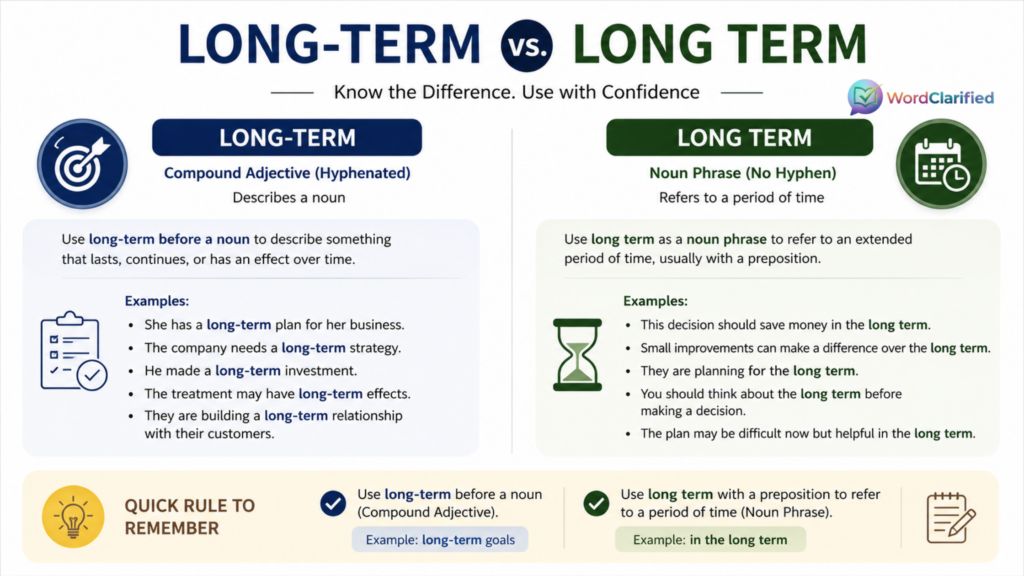
Use the hyphen whenever long-term works as a compound adjective directly before a noun — it tells the reader that something lasts, develops, or produces an effect over time.
Long-Term Before a Noun
- Long-term plan: We need a long-term plan for the project.
- Long-term solution: The company is looking for a long-term solution.
- Long-term success: Consistency is important for long-term success.
- Long-term growth: The business is focused on long-term growth.
Long-Term in Common Expressions
These pairings show up constantly across business, healthcare, finance, and education writing:
- Long-term goals: She has clear long-term goals for her career.
- Long-term care: Some patients may need long-term care.
- Long-term debt: The company reported an increase in long-term debt.
- Long-term planning: Good long-term planning can reduce future problems.
- Long-term effects: Researchers are studying the long-term effects of the treatment.
The rule stays constant regardless of topic: if long-term is describing the noun right after it, keep the hyphen.
See Also: Of Course or Ofcourse: The Correct Way to Write It
When to Use “Long Term”
Drop the hyphen whenever the phrase functions as a noun phrase — referring to a period of time rather than modifying a noun.
“In the Long Term”
Refers to what may happen after an extended period, often used for future results, benefits, costs, or consequences.
- This investment may deliver returns over the long term.
- The changes may save the company money in the long term.
- Eating well can improve your health in the long term.
“Over the Long Term”
Means throughout an extended period — emphasizing gradual change rather than a single future point.
- Small improvements can produce better results over the long term.
- The company expects steady growth over the long term.
- Regular saving can build wealth over the long term.
“For the Long Term”
Means intended to continue or remain useful for an extended stretch — common when discussing plans, commitments, or decisions.
- They invest in businesses with a long-term view.
- We need to choose a solution that works for the long term.
- She plans to stay with the company for the long term.
“Think About the Long Term”
Means considering future results rather than just immediate outcomes. There’s no hyphen because the phrase stands on its own as a noun phrase — unlike long-term planning, where it directly modifies “planning” and therefore does need one.
- Think about the long term before making a major decision.
- Good investors often think about the long term.
- You should consider the long term when planning your career.
Long-Term Goals vs. Long Term Goals: Which Is Correct?
Long-term goals is the correct and preferred form whenever the phrase sits directly before “goals.” Here, long-term works as a compound adjective describing the type of goals in question, and the hyphen shows that “long” and “term” function together as one modifier.
- She has several long-term goals for her career.
- Having long-term goals can help you stay focused.
- The company has created long-term goals for future growth.
- His long-term goals include buying a home.
- Good financial planning starts with clear long-term goals.
Long term goals (without the hyphen) sometimes appear in informal writing, but it’s not the standard choice when the phrase directly modifies a noun. The same logic applies elsewhere: long-term plan ✅, long-term strategy ✅, long-term investment ✅, long-term benefits ✅, long-term effects ✅.
“In the Long Term” or “In the Long-Term”: Which One Is Right?
The correct form is in the long term — no hyphen, because the phrase stands alone as a noun phrase rather than describing a noun.
- This decision should save money in the long term.
- The change may improve the company’s results in the long term.
- Regular exercise can benefit your health in the long term.
- Spending more now could reduce costs in the long term.
By contrast, long-term does need a hyphen when it directly precedes a noun: long-term savings ✅, long-term benefits ✅, long-term results ✅.
Compare:
- The change will help in the long term. (refers to a period)
- The change offers long-term benefits. (describes “benefits”)
That grammatical difference — whether a noun immediately follows — is what determines the hyphen.
Why Is “Longterm” Usually Incorrect?
Longterm written as a single word isn’t standard English. The accepted forms remain long-term (adjective) and long term (noun phrase). Using the one-word spelling can read as a mistake, especially in formal, academic, or professional contexts.
Is “Longterm” One Word?
No. If you’re describing a noun, use long-term (as in long-term planning). If you’re referring to a period of time, use long term (as in in the long term). You may still spot longterm in online content, but its presence there doesn’t make it the preferred spelling — search engines surface plenty of unedited pages.
Why You May See “Longterm” Online
A few common reasons this spelling slips through:
- Informal writing — people take shortcuts when writing quickly.
- User-generated content — comments, forums, and social posts aren’t always edited.
- Poorly edited pages — some sites publish without careful proofreading.
- Typographical errors — writers sometimes combine the words by accident.
- Branding or unusual naming — a business or product may intentionally use longterm as a name.
Online frequency doesn’t establish standard spelling. For formal or professional writing, stick with long-term or long term depending on grammatical function.
The Simple Rule for Long Term vs. Long-Term
The easiest way to remember the difference is to check what comes right after the phrase.
Before a noun → long-term; referring to a period of time → long term
Compare:
- a long-term investment
- invest for the long term
- a long-term strategy
- think about the long term
This single rule covers the vast majority of real-world cases.
Long Term vs. Long-Term: Side-by-Side Comparison
| Feature | Long-term | Long term |
| Function | Compound adjective | Noun phrase |
| Hyphen | Yes | No |
| Main use | Describes a noun | Refers to an extended period |
| Typical position | Usually before a noun | Often follows a preposition |
| Example | long-term plan | in the long term |
| Another example | long-term growth | over the long term |
Common Mistakes With Long Term and Long-Term
Writers often make mistakes by using or leaving out the hyphen where it does not belong. Once you identify the phrase’s grammatical role, the fix is usually simple.
1. “Longterm Strategy” ❌ longterm strategy → ✅ long-term strategy Long-term describes “strategy,” so it needs the hyphen — and longterm as one word is never standard.
2. “Long Term Strategy” ❌ long term strategy → ✅ long-term strategy Because it comes directly before “strategy” and acts as one description, it needs the hyphen.
3. “In the Long-Term” ❌ in the long-term → ✅ in the long term Here, long term refers to a period on its own — no noun follows it to justify a hyphen.
4. “For the Long-Term” ❌ for the long-term → ✅ for the long term The phrase follows “for” and functions as a noun phrase, so it stays open.
Quick Correction Guide
Incorrect Correct
longterm strategy long-term strategy
long term strategy long-term strategy
in the long-term in the long term
for the long-term for the long term
A reliable habit: check the word that follows. If it directly describes a noun, hyphenate. If it refers to a period by itself, don’t.
See Also: Writing or Writting: Which Spelling Is Correct?
Long Term and Long-Term Examples
Business Examples
- The company created a long-term strategy for entering new markets.
- Building long-term relationships can help a business retain customers.
- The team focuses on long-term growth instead, rather than quick results.
- The new policy could have long-term effects on the company.
- They want to develop a long-term partnership with the supplier.
- The investment may deliver significant benefits to the company long term.
- The business needs to think about the long term before expanding.
Finance Examples
- She invested in the stock market with a long-term perspective.
- The bank offers several long-term loan options.
- Paying down long-term debt can strengthen a company’s finances.
- He is saving for his long-term financial goals.
- The fund is designed for long-term growth.
- Investors often focus on returns over the long term.
- This approach may produce better results in the long term.
Education Examples
- Students should set long-term learning goals.
- Reading regularly can provide long-term benefits.
- The school created a long-term improvement plan.
- Teachers can help students develop long-term study habits.
- Good education can have long-term effects on a student’s career.
- Students should think about the long term when choosing a career.
- skills can provide lasting value long term.
Everyday English Examples
- We need a long-term solution to this problem.
- They are in a long-term relationship.
- She has a long-term plan for her career.
- Exercise can support long-term health.
- This choice will probably work better in the long term.
- We need to consider the long term.
- It may cost more now but save money over the long term.
Long-Term vs. Short-Term
Long-term and short-term follow the same rule. Both hyphenate as compound adjectives before a noun, and both drop the hyphen as noun phrases referring to a period.
- long-term strategy / short-term strategy
- long-term benefits / short-term benefits
- long-term goals / short-term goals
- in the long term / over short term
- over the long term / throughout the short term
- for the long term / for short term
Compare:
- The company needs a long-term strategy for growth.
- The company needs a short-term strategy to solve the immediate problem.
- The changes may help in the long term.
- The changes may also reduce costs in the short term.
Does American English Use “Long-Term” Differently?
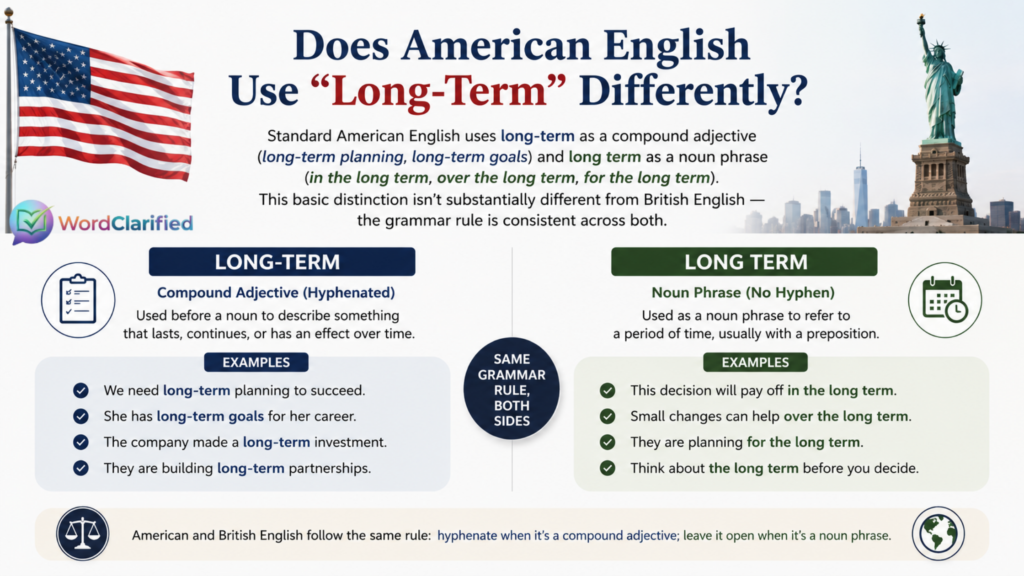
Standard American English uses long-term as a compound adjective (long-term planning, long-term goals) and long term as a noun phrase (in the long term, over the long term, for the long term). This basic distinction isn’t substantially different from British English — while minor style-guide preferences can vary, the underlying grammar rule is consistent across both.
Long Term or Long-Term: Quick Reference
A compact cheat sheet for when you’re unsure:
Use long-term when:
- It directly describes a noun.
- Example: long-term planning, long-term investment
Use long term when:
- It refers to an extended period.
- Example: planning for the long term, results in the long term
Avoid longterm when:
- Writing in standard English.
- Example: ❌ longterm planning → ✅ long-term planning
Frequently Asked Questions
Is “longterm” one word?
No. Longterm isn’t the standard spelling. Use long-term when the phrase describes a noun (long-term planning) and long term when it refers to an extended period (in the long term).
Is it long term or long-term?
Both forms are valid — the difference lies in their grammatical function. Use long-term before a noun as a compound adjective; use long term as a noun phrase, such as over the long term.
Is “long-term” always hyphenated?
No — only when it works as a compound adjective (long-term goals). As a noun phrase, it’s written open: in the long term.
Is “in the long term” correct?
Yes. It’s the standard form, referring to what happens after an extended period. Example: This decision could save money in the long term.
Is “long-term goals” correct?
Yes. Long-term describes “goals,” so the hyphen is required to show the two words work together as one modifier.
Should I write “long term goals” or “long-term goals”?
Use long-term goals. Since the phrase directly describes “goals,” it functions as a compound adjective and takes the hyphen.
Is “for the long term” correct?
Yes, when you mean “for an extended period.” Example: They are investing in the business for the long term. No hyphen, since it’s a noun phrase.
Is long-term formal English?
Yes. It’s standard and widely used in formal, professional, academic, and everyday writing — long-term planning, long-term research, long-term financial goals.
Is there a difference between American and British English?
The basic rule is the same in both. Some minor style-guide preferences may vary, but the adjective/noun-phrase distinction is consistent.
What’s the simplest way to keep the two straight?
Before a noun, use long-term; when referring to a period of time, use long term. For example: long-term strategy (describes “strategy”) vs. in the long term (refers to a period).
Final Takeaway
- Long-term = compound adjective, hyphenated, describes a noun
- Long term = noun phrase, no hyphen, refers to an extended period
- Longterm = avoid in standard English

[…] See Also Long Term or Long-Term: A Complete Guide to Getting the Hyphen Right […]