

Simile vs. metaphor is one of those topics where the school rule is almost right, which is what makes it annoying. Simile gets “like.” Metaphor gets “is.” “The train was like a sauna” versus “The train was a sauna.” Done, right? Mostly. A few sentences slip through that rule, though, and teachers love putting them on tests.
The ten-second test
Find the two things being compared. They should feel mismatched: a train and a sauna, an inbox and a landfill. Then check whether a connecting word ties them together.
Her inbox was like a landfill. There’s a bridge word. Simile.
Her inbox was a landfill. No bridge. The inbox isn’t being compared anymore; it’s become one. Metaphor.
It works backward too. Cut “like” from a simile, and you land on a metaphor. Slip “like” into a metaphor, and if it still reads fine, you’ve confirmed it.
Quick word on pronunciation, since people trip on it: simile is SIM-uh-lee, three syllables, not “smile.” It traces back to a Latin word for “like.” Metaphor comes from the Greek for “to transfer,” and that’s literally the job: a quality moves off one thing and onto another.
See Also: Carmel or Caramel: 7 Real Cases, 1 Simple Rule
When “like” and “as” lie to you
Hunt for those two words and you’ll be right most of the time—the rest of the time you’ll get caught.
Take “I like my coffee black.” There’s no comparison here, because “like” just means enjoy.
“Their apartment looks like their parents’ place” does compare, but both apartments are similar, so it stays literal. A simile needs a stretch, say, a bakery and a submarine.
“She worked as a paramedic for six years.” Here “as” means “in the role of.” Nobody is being compared to anybody.
Flip it around, and the rule fails again. “Quieter than a library at midnight” is a simile with no “like” or “as.” So is “His handwriting resembles a spider’s walk across wet ink.” So is “I’d compare his handwriting to a spider that fell in the inkwell and went for a stroll.”
Forget the word list for a second. Ask something simpler: are two mismatched things sitting next to each other, and does the sentence say so out loud? If yes, it’s a simile; whatever word does the job.
Is a simile a kind of metaphor?
Ask two teachers, get two answers. The first says no: a simile has a bridge word; a metaphor doesn’t, end of story. The second says “metaphor” is the family name and a simile is one member, the one that leaves its seams showing.
Both views are in print, and both get taught. For an exam, copy whichever definition your textbook uses. In your own drafts, I’d keep them apart. Mid-edit, the useful question is whether the line works, not which category it belongs to.
Watch the word in reviews, too. “The lighthouse is a metaphor for hope” usually just means the lighthouse is a symbol in the story. That’s a looser use than a sentence-level comparison.
Same idea, three ways
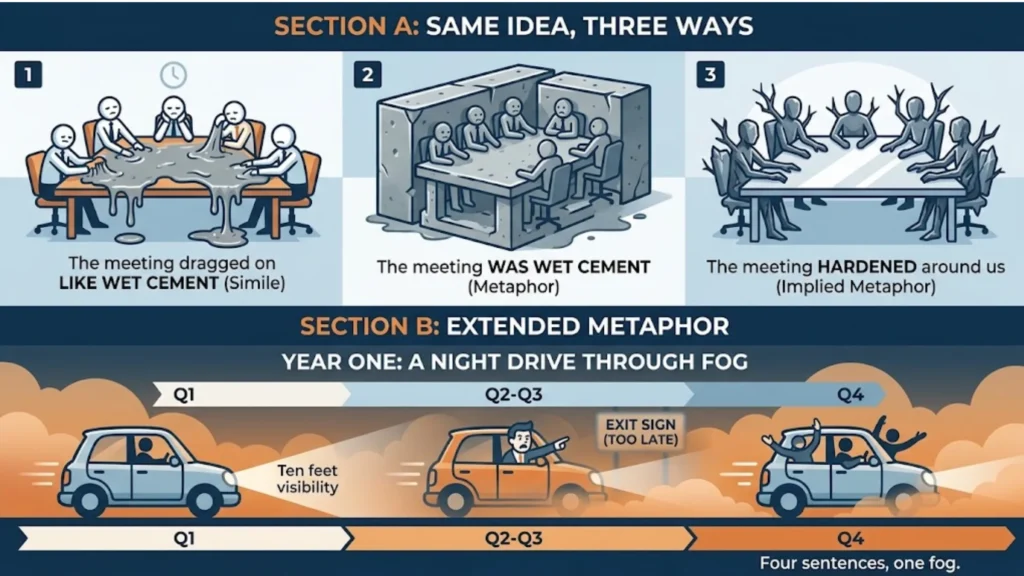
A boring sales meeting, written three ways:
- The meeting dragged on like wet cement.
- The meeting was wet cement.
- The meeting hardened around us.
The first points out the comparison. The reader is guided, and it feels a bit polite. The second commits. It’s heavier, and some readers find it too much.
The third never names cement. “Hardened” carries everything, and you only notice the image after you’ve read past it. That’s an implied metaphor. In anything long, it’s the version I’d keep, since the other two make the reader pause for half a second to admire the comparison.
Which one to pick? Ask how far the reader has to travel. A meeting turning into cement is a bit of a leap, so the simile helps. “Her inbox was a landfill” needs no help at all.
Stretch a metaphor over several lines, and it’s called an extended metaphor:
Year one at the company was a night drive through fog. The headlights reached ten feet. Every exit sign showed up late. And nobody would pull over.
Four sentences, one fog.
Where drafts go wrong
Mixed metaphors come first. “Let’s get all our ducks on the same page” welds two idioms together, and you end up picturing ducks with reading glasses. Fix it by choosing: line the ducks up, or get everyone on the same page, not both.
Sometimes the clash is the point. “Drowning in a desert of spreadsheets” puts water and sand in one phrase, and that’s close to how being buried in work feels: too much, and somehow still dry. Accidental mixes rarely do that.
The same trouble shows up when a metaphor and a simile share a sentence. “The deadline was a freight train, bearing down on us like a storm” makes the reader choose between rails and rain. Now try “Grandma’s kitchen was a harbor, warm and quiet like the lull after a storm.” Harbor, storm lull, same coastline. It holds.
Then there’s the worn-out kind. A “bottleneck” and a “table leg” were metaphors once, but nobody pictures glass or furniture anymore, and that’s harmless. Stale similes are worse, because readers still notice them. “Cold as ice” does nothing. “Her hands felt like a bag of frozen peas” at least shows something. A small odd detail beats a famous one.
The biggest slip of all is seeing “like” and writing “simile” on the page. Check what’s being compared first.
Try it yourself
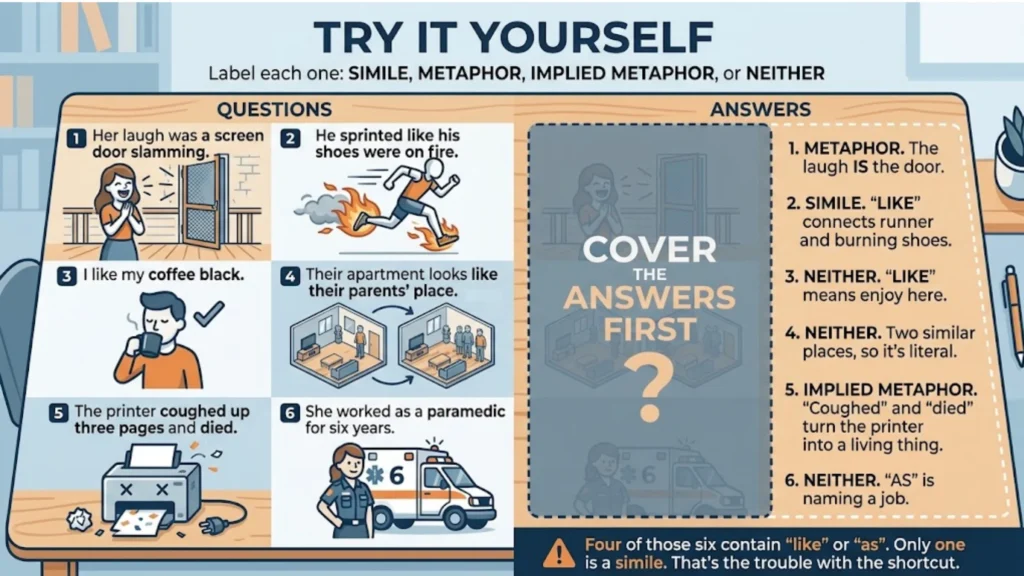
Six sentences. Label each one: simile, metaphor, implied metaphor, or neither. Cover the answers first.
- Her laugh was a screen door slamming.
- He sprinted like his shoes were on fire.
- I like my coffee black.
- Their apartment looks like their parents’ place.
- The printer coughed up three pages and died.
- She worked as a paramedic for six years.
Answers
- Metaphor. The laugh is the door, with no bridge.
- Simile. “Like” connects a runner to burning shoes.
- Neither. “Like” means enjoy here.
- Neither. Two similar places, so it’s literal.
- Implied metaphor. “Coughed” and “died” turn the printer into a living thing without saying so.
- Neither. “As” is naming a job.
Four of those six contain “like” or “as.” Only one is a simile. That’s the trouble with the shortcut.
See Also: How-To vs. How-Tos: Hyphen, Apostrophe, or Neither? (3 Jobs)
Quick answers
Which is stronger? Metaphor, most days, because it doesn’t hedge. A simile earns its place when clarity matters more than punch.
Can one sentence hold both? Yes, if the images agree, like the harbor line above.
What about analogy? An analogy explains, where the other two decorate, and it can borrow either. “A firewall is like a building’s front desk: it checks who comes in, but it can’t tell what they do once they’re past the lobby.” You come away knowing what a firewall does and where it stops.
A last thought on simile vs metaphor
Pull out something you wrote last month and circle every comparison. Then, one at a time, cut the “like” and read the line aloud. If it still works, you’ve found a metaphor you were being too polite about. If it falls over, it needed the “like.” Leave it in.

[…] See Also: Simile vs Metaphor: Tell Them Apart in 10 Seconds […]