
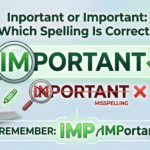
Inportant or Important: If you are choosing between inportant and important, use important. Standard English uses this spelling. Inportant is a misspelling. The correct word has m after the first i: important For example: If you often make this mistake, remember the first three letters: imp, not inp. Important or Inportant? Important is the correct … [Read more...] about Inportant or Important: Which Spelling Is Correct?
Word Differences
22th or 22nd: Which Spelling Is Correct?
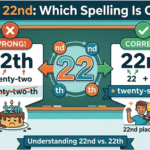
Understanding 22nd vs. 22th. Use 22nd, not 22th. When 22 shows position, order, or sequence, we write 22nd. The word form is twenty-second. For example: Why Is 22nd Correct? When 22 tells us the number of items rather than their position, it is a cardinal number: There are 22 students in the class. When the same number shows position or order, it becomes an … [Read more...] about 22th or 22nd: Which Spelling Is Correct?
Repore or Rapport: Which Spelling Is Correct?
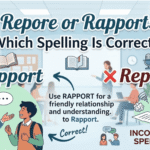
Understanding Repore or Rapport: The correct spelling is rapport, not repore. If you mean a friendly relationship or easy understanding between people, use rapport. You might hear this word often but hesitate when writing it. Its pronunciation doesn't make the spelling obvious, so repore sometimes appears as a mistaken form. Is It Repore or Rapport? Use rapport when … [Read more...] about Repore or Rapport: Which Spelling Is Correct?
Quit vs Resign: What Is the Difference?
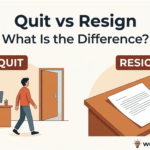
Quit and resign can both mean leaving a job, so it is easy to mix them up. In this context, both can describe someone who chooses to leave their job. The difference is mainly in meaning, usage, and tone. Quit has a wider meaning. It can describe leaving a job, stopping a habit, or giving up an activity. Resign is mainly used when someone gives up a job or position. So, … [Read more...] about Quit vs Resign: What Is the Difference?
Afterward vs Afterwards: Clear Rules to Fix Common Grammar Confusion

Afterward and afterwards are two correct forms of the same word. Both refer to something that happens later, usually following another event. The difference is mainly linked to regional English. Afterward is used more often in American English, while afterwards is especially common in British English. Afterward vs Afterwards: The Quick Answer Both words tell us that … [Read more...] about Afterward vs Afterwards: Clear Rules to Fix Common Grammar Confusion